
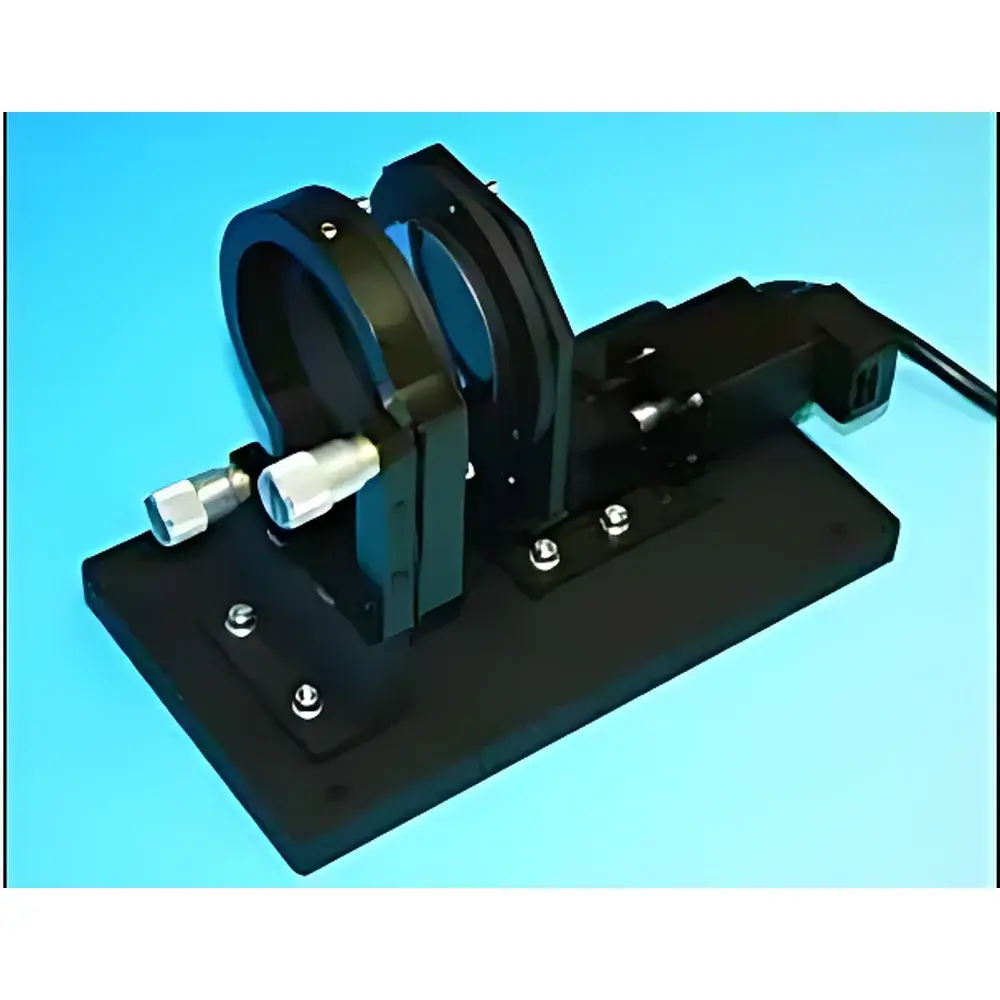
TYDEX TSFPI-2 Terahertz Fabry–Pérot Interferometer
| Brand | TYDEX |
|---|---|
| Origin | Russia |
| Model | TSFPI / TSFPI-2 |
| Operating Frequency Range | 0.1–15 THz |
| Free Spectral Range (FSR) | 0.01–1.8 THz |
| Mirror Spacing | 0–9.5 mm (standard), 1.8 mm (compact variant) |
| Spectral Tuning Accuracy | ±1.25 µm |
| Clear Aperture | 52 mm |
| Optical Port Height | 110 mm |
| Dimensions (L×H×W) | 232×151×120 mm |
| Weight | 5.0 kg |
| Detector Compatibility | Tydex GP-1P photoacoustic detector |
Overview
The TYDEX TSFPI-2 Terahertz Fabry–Pérot Interferometer is a precision optical instrument engineered for high-resolution spectral characterization of narrowband terahertz radiation. Based on the fundamental principles of interferometry—specifically, the constructive and destructive interference of coherent THz waves between two parallel, semi-transparent silicon mirrors—the TSFPI-2 enables direct measurement of wavelength, spectral linewidth, and relative intensity of THz sources with sub-micrometer mirror positioning control. Its design leverages the low-loss, high-refractive-index properties of single-crystal silicon in the 0.1–15 THz range, ensuring minimal absorption and high finesse across the operational bandwidth. Unlike grating-based or Fourier-transform spectrometers, the TSFPI-2 provides real-time, scanning-based spectral analysis without moving parts beyond the piezo-driven mirror actuator—making it especially suitable for integration into cryogenic, vacuum, or ultrafast laser pump-probe environments where mechanical stability and thermal drift must be minimized.
Key Features
- Wide operational frequency coverage from 0.1 to 15 THz, compatible with both pulsed and continuous-wave (CW) narrowband THz sources
- Adjustable mirror spacing (0–9.5 mm standard; 1.8 mm compact configuration), enabling flexible free spectral range (FSR) selection between 0.01 and 1.8 THz
- High-precision piezoelectric mirror translation stage with ±1.25 µm spectral tuning accuracy, calibrated traceably to interferometric standards
- Large clear aperture of 52 mm and 110 mm optical port height, facilitating collimated beam coupling and alignment with high-numerical-aperture THz optics
- Robust monolithic aluminum housing with vibration-damped baseplate, optimized for laboratory and synchrotron beamline deployment
- Integrated control unit with USB interface and dedicated mirror-flip software for automated FSR scanning and peak identification
Sample Compatibility & Compliance
The TSFPI-2 is designed for use with a broad spectrum of THz emitters, including optically pumped far-infrared lasers (e.g., p-Ge, CH₃OH), backward-wave oscillators (BWOs), quantum cascade lasers (QCLs), difference-frequency generation (DFG) sources, photomixers, and free-electron lasers (FELs). It supports both intensity-based and phase-sensitive detection when paired with calibrated photoacoustic detectors such as the Tydex GP-1P. The system complies with general laboratory safety standards for optical alignment and electromagnetic compatibility (EMC Directive 2014/30/EU). While not intrinsically certified for GMP or FDA-regulated environments, its deterministic interferometric output and reproducible mirror positioning support GLP-aligned data acquisition workflows when used with audit-trail-capable software extensions.
Software & Data Management
The TSFPI-2 ships with proprietary mirror-flip control software for Windows OS, providing real-time visualization of transmission spectra, automated mirror scan sequencing, and export of raw interferogram and calibrated wavelength-intensity datasets in CSV and HDF5 formats. The software supports user-defined scan parameters—including step size, dwell time, number of averages—and enables synchronization with external trigger signals (TTL input) for pump-probe or lock-in applications. All calibration metadata (mirror position vs. wavelength conversion coefficients, FSR values, temperature logs) are embedded in exported files, ensuring full traceability. For advanced users, a documented DLL API allows integration into LabVIEW, Python (via PySerial/pyUSB), or MATLAB environments.
Applications
- Calibration and line identification of THz laser sources in metrology laboratories
- Spectral purity assessment of QCLs and photomixers for communications and sensing
- Characterization of narrowband THz filters and resonant metamaterial structures
- In-situ monitoring of THz emission dynamics in ultrafast spectroscopy setups
- Validation of computational models of THz cavity modes and dispersion relations
- Supporting ISO/IEC 17025-accredited testing of THz components under defined uncertainty budgets
FAQ
What is the minimum resolvable frequency interval (resolution limit) of the TSFPI-2?
Resolution depends on mirror spacing and finesse; typical values range from ~100 MHz (at 9.5 mm spacing) to ~1 GHz (at 1.8 mm spacing), assuming optimal alignment and detector SNR.
Can the TSFPI-2 be operated under vacuum or cryogenic conditions?
Yes—the core interferometer body is vacuum-compatible (up to 10⁻⁵ mbar) and rated for operation between −20 °C and +50 °C; optional cryo-adapted versions with low-thermal-expansion mounts are available upon request.
Is the TSFPI-2 compatible with non-TYDEX detectors?
Yes—any broadband THz detector with sufficient dynamic range and temporal response (e.g., Golay cells, pyroelectric sensors, or bolometers) may be coupled via standard flange interfaces; signal conditioning and normalization procedures are documented in the user guide.
Does the system include NIST-traceable calibration documentation?
The TSFPI-2 is supplied with factory calibration reports referencing SI-traceable laser interferometry; full uncertainty budgets per ISO/IEC Guide 98-3 (GUM) are available as an optional service.
How is alignment verified during installation?
Alignment is performed using visible alignment lasers (633 nm HeNe) co-aligned with the THz path via integrated kinematic mounts; alignment procedure and tolerance thresholds are detailed in Section 4.2 of the user manual.




