
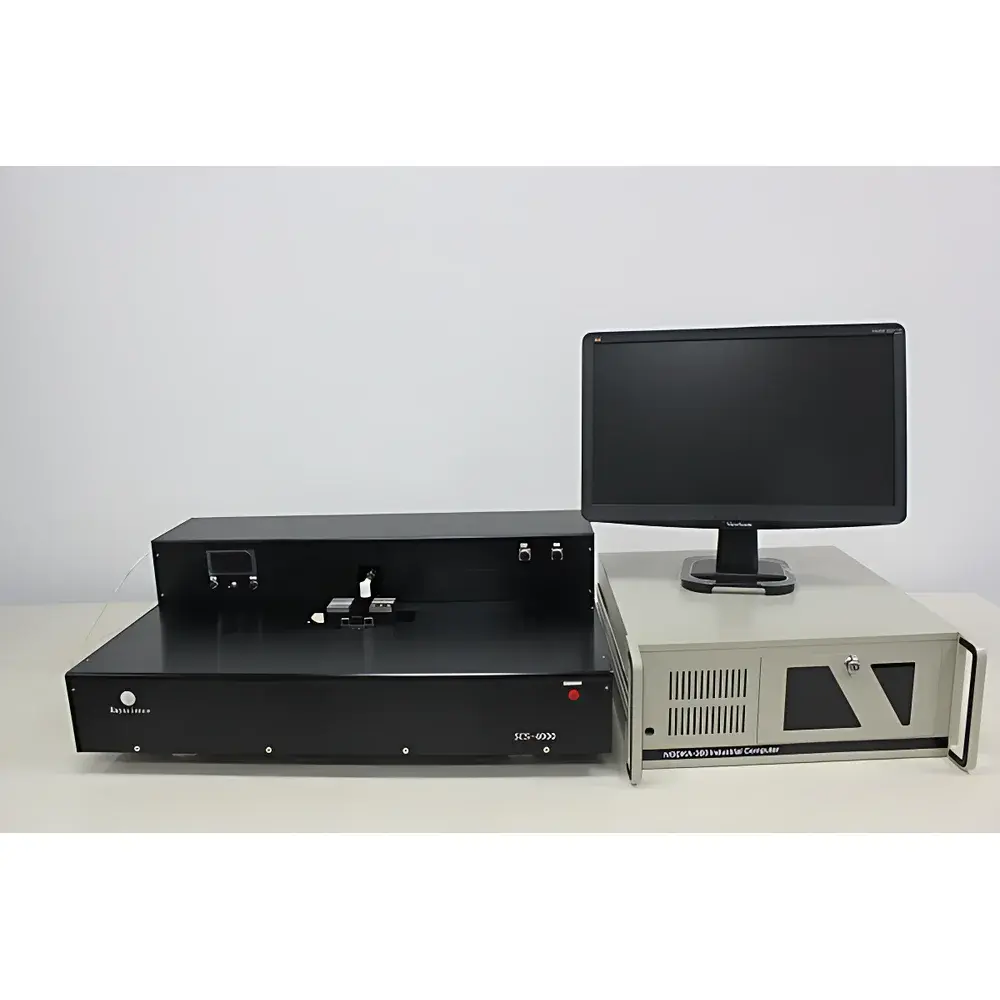
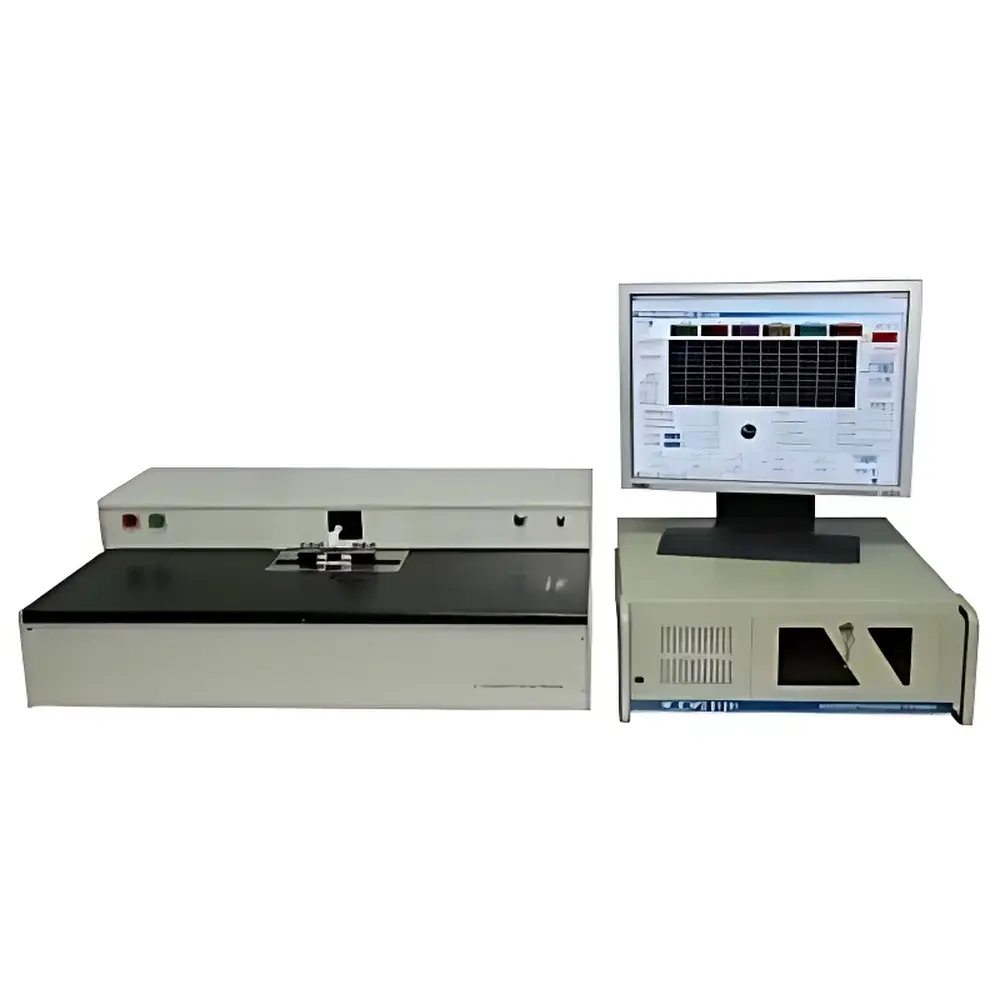
RAYSCIENCE SCS-4000 Fiber Fusion Tapering System
| Brand | RAYSCIENCE |
|---|---|
| Origin | Shanghai, China |
| Model | SCS-4000 |
| Product Type | Motorized Translation Stage |
| Pulling Accuracy | 0.2 µm |
| Pulling Speed Range | 0.2–10,000 µm/s |
| Max Pulling Distance | 50 mm |
| Fiber Clamping Diameter | φ0.1–0.5 mm |
| Flame Axial Stroke | 0–20 mm |
| Flame Scanning Speed | 0–4 mm/s |
| H₂ Flow Rate | 0–200 sccm (adjustable) |
| O₂ Flow Rate | 0–200 sccm (adjustable) |
| Detector Options | InGaAs (850–1600 nm), Si (400–1000 nm) |
| Light Source Options | 1310/1550 nm FP Laser Diode, 1 mW |
| Packaging Temperature Range | 0–130 °C |
| Power Supply | 220 V, 6 A |
Overview
The RAYSCIENCE SCS-4000 Fiber Fusion Tapering System is a fully integrated, high-precision optical manufacturing platform engineered for the reproducible fabrication of fused fiber devices—including single-mode couplers, polarization-maintaining (PM) couplers, broadband and WDM couplers, multimode combiners, and specialty tapered waveguides. Based on the principle of flame-based fusion tapering, the system thermally softens stripped fiber sections under controlled hydrogen-oxygen or hydrogen-air combustion, then applies precisely calibrated axial tension to form adiabatic double-taper structures with sub-micron dimensional control. This process enables deterministic control over coupling ratio, excess loss, polarization-dependent loss (PDL), and spectral bandwidth—critical parameters for telecom, sensing, and high-power laser applications. The SCS-4000 implements a closed-loop architecture integrating real-time optical power monitoring, synchronized motorized translation stages, programmable gas flow regulation, and thermal packaging—all coordinated via a deterministic Windows-based control interface.
Key Features
- Sub-micron pulling resolution (0.2 µm) with velocity modulation from 0.2 to 10,000 µm/s, enabling both slow, high-fidelity tapering and rapid prototyping cycles.
- Dual-gas flow control system with independent, calibrated mass flow controllers for H₂ and O₂ (0–200 sccm each), supporting stable, repeatable flame temperature profiles across varying ambient conditions.
- Custom-designed coaxial H₂/O₂ burner head—externally fueled hydrogen with internal oxygen injection—eliminates thermal instability associated with conventional top/bottom dual-oxygen configurations.
- Modular clamping system accommodating fiber diameters from 125 µm to 600 µm (coating removed), including parallel-jaw fixtures for precise alignment and knot-free fusion of PM and multimode fibers.
- Integrated optical monitoring path with selectable InGaAs (850–1600 nm) or Si (400–1000 nm) detectors, coupled to optional 1310/1550 nm FP laser sources for in situ coupling ratio feedback during draw.
- Programmable thermal packaging module (0–130 °C) with single-step epoxy curing, compatible with industry-standard UV- or heat-curable adhesives for hermetic device encapsulation.
Sample Compatibility & Compliance
The SCS-4000 supports fabrication of standardized and custom fused-fiber components compliant with ITU-T G.652.D (standard SMF), G.657.A1/B2 (bend-insensitive), and Panda-type PM fibers (e.g., Fujikura PANDA™, OFS PM1550). Devices produced meet typical specifications for telecom-grade couplers: excess loss ≤ 0.05 dB, coupling ratio tolerance ≤ ±0.5%, PDL < 0.05 dB (for optimized PM variants), and bandwidth uniformity across ±20 nm (C-band) or ±40 nm (L-band). The system’s operational parameters and software logging functionality support traceability requirements aligned with GLP practices. While not certified to ISO 9001 or FDA 21 CFR Part 11 out-of-the-box, its deterministic control architecture, audit-ready parameter logging, and exportable raw data files facilitate integration into regulated development environments upon user-defined validation protocols.
Software & Data Management
The proprietary SCS Control Suite runs on Windows OS and provides full automation of tapering sequences—including pre-stretch, flame scanning, real-time power feedback, pull termination, and post-draw packaging. Each session records timestamped metadata: motor position, gas flows, detector voltages, flame position, and thermal profile. Users define and store unlimited process recipes; the software auto-generates compliance-ready reports (PDF/CSV) containing coupling ratio vs. pull length curves, excess loss histograms, and batch summary statistics. Raw optical power traces are exportable in ASCII format for third-party analysis (e.g., MATLAB, Python). No cloud connectivity or remote access features are implemented—data remains local by default, satisfying institutional IT security policies common in academic and defense laboratories.
Applications
- Telecom component R&D: 1×2, 2×2, and NxM fused couplers for PON, DWDM, and optical switching architectures.
- Fiber laser engineering: Mode-field adapters, pump combiners (up to 7×1), and high-power signal splitters with >10 W handling capability.
- Fiber optic sensing: Mach-Zehnder and Michelson interferometric sensors, FBG interrogation couplers, and distributed acoustic sensing (DAS) tap couplers.
- Quantum photonics: Polarization-entangled photon source fabrication using PM-fiber couplers with extinction ratios ≥25 dB.
- Biophotonics instrumentation: Low-PDL beam splitters for OCT systems and fluorescence excitation/detection routing.
FAQ
What fiber types can the SCS-4000 process?
Standard single-mode (SMF-28, HI1060), polarization-maintaining (Panda, Bowtie), multimode (50/125 µm, 62.5/125 µm, 100–600 µm core), and specialty fibers (e.g., fluoride, photonic crystal) with appropriate custom fixtures.
Is vacuum-assisted fiber clamping included?
Yes—the system integrates a vacuum chuck subsystem for secure, non-marring fixation of bare fiber sections during alignment and heating phases.
Can the system produce devices for high-power laser applications?
Yes—by optimizing taper geometry, flame chemistry, and packaging adhesive selection, users routinely fabricate couplers rated for continuous-wave powers exceeding 10 W at 1064 nm.
Does the software support automated calibration routines?
The system includes built-in calibration wizards for motor encoder zeroing, detector responsivity normalization, and gas flow linearity verification—each documented in the operator manual.
What level of technical support is provided internationally?
RAYSCIENCE offers remote diagnostics, English-language documentation, and application engineering consultation; hardware service is delivered via authorized regional partners in North America, Europe, and APAC.





