
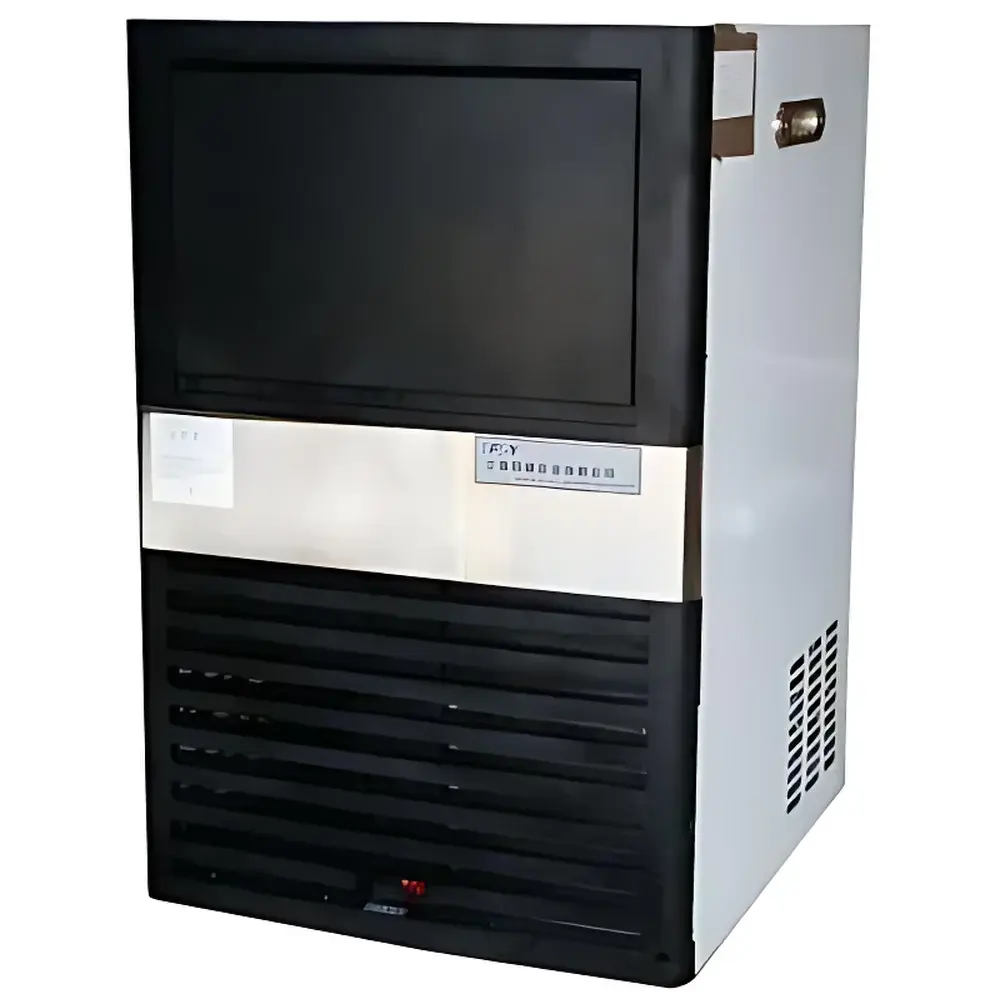
TF-ZBJ-K1900/W Large-Scale Split-System Flake Ice Machine
| Origin | Shanghai, China |
|---|---|
| Manufacturer Type | Authorized Distributor |
| Origin Category | Domestic (China) |
| Model | TF-ZBJ-K1900/W |
| Cooling Method | Water-Cooled |
| Maximum Ice Production | 1000 kg/24h |
| Ice Storage Capacity | 550 kg |
| External Dimensions (W×D×H) | 1219 × 815 × 2030 mm |
| Construction | Full Stainless Steel (AISI 304) Cabinet with 45° Ergonomic Ice Discharge Slope |
| Refrigerant Compatibility | R22, R134a |
| Control System | Microprocessor-Based Fuzzy Logic Controller with Photoelectric Ice-Level Detection |
| Insulation | High-Density Polyurethane Foam (≥60 mm Thickness) |
Overview
The TF-ZBJ-K1900/W is a high-capacity, water-cooled, split-system flake ice machine engineered for continuous, reliable ice production in demanding laboratory, pharmaceutical, food processing, and biomedical environments. Unlike conventional cubed or nugget ice systems, this unit employs a vertically oriented evaporator drum design where water is evenly distributed over a low-temperature stainless steel surface. As the drum rotates, thin layers of water freeze rapidly—forming dry, irregularly shaped, low-density flake ice with high surface-area-to-volume ratio. This morphology ensures rapid thermal transfer, minimal melt loss during handling, and superior compatibility with sensitive sample cooling applications—including chromatography column temperature control, enzymatic reaction quenching, tissue homogenization, and cold-chain logistics validation. The machine’s split architecture separates the condensing unit (installed remotely with dedicated water cooling infrastructure) from the ice-making and storage module, enabling flexible installation in space-constrained labs while maintaining acoustic and thermal isolation.
Key Features
- Stainless steel (AISI 304) construction throughout—evaporator drum, storage bin, and cabinet—ensuring corrosion resistance, cleanability, and compliance with ISO 14644-1 Class 8 (ISO Class 100,000) cleanroom-compatible surface finish requirements.
- Microprocessor-based fuzzy logic control system dynamically adjusts water feed rate, freezing cycle duration, and harvest timing based on ambient temperature, inlet water temperature, and load history—optimizing energy efficiency without compromising ice quality or output consistency.
- Photoelectric ice-level sensor with dual-threshold detection provides fail-safe full-bin shutdown and automatic restart upon ice removal—immune to condensation, dust, or vibration-induced false triggers.
- Patented residual water drainage mechanism eliminates standing water in the water distribution trough and sump after each cycle, preventing biofilm formation and meeting FDA 21 CFR Part 11–aligned hygiene standards for GxP environments.
- Dedicated self-cleaning mode initiates a hot-water flush (up to 70 °C) of the entire water circuit—including spray nozzles, distributor manifold, and evaporator surface—reducing manual maintenance frequency and supporting GLP/GMP audit readiness.
- Water-cooled condensing system enables stable operation under sustained ambient temperatures up to 43 °C and eliminates reliance on ambient airflow—critical for enclosed mechanical rooms or HVAC-restricted laboratory zones.
Sample Compatibility & Compliance
The TF-ZBJ-K1900/W produces flake ice with nominal thickness of 1.0–2.2 mm and particle size distribution ranging from 6 mm to 18 mm—ideal for packing biological specimens, chilling reagent bottles, or serving as a thermal mass in calorimetric calibration procedures. Ice meets ASTM D4169–22 performance criteria for low-melt-rate packaging media and complies with NSF/ANSI 12–2023 for food equipment sanitation. All wetted components are certified to EU Regulation (EC) No. 1935/2004 for materials in contact with foodstuffs. Electrical safety conforms to IEC 61000-6-3 (EMC) and IEC 60335-1 (general safety), with optional CE marking available upon configuration review.
Software & Data Management
While the base unit operates via embedded firmware without external software dependency, optional RS-485 Modbus RTU interface enables integration into centralized facility monitoring systems (e.g., LabVantage, Siemens Desigo, or custom SCADA). Logged parameters—including cumulative ice output, compressor run-time, fault codes, cleaning cycle timestamps, and inlet water temperature—are stored locally for ≥30 days and exportable via USB port in CSV format. Audit trail functionality supports 21 CFR Part 11 compliance when deployed with validated third-party electronic record systems.
Applications
- Pharmaceutical QC laboratories: Cold preservation of stability study samples (ICH Q5C), lyophilization pre-chilling, and excipient temperature conditioning.
- Clinical diagnostics: Maintaining whole-blood specimen integrity during transport to central testing labs (CLIA/CAP requirement for ≤4 °C hold time).
- Research institutions: Cryoprotection during cryosectioning, controlled-rate cooling of primary cell cultures, and thermal management in benchtop NMR probe cooling loops.
- Biobanking facilities: Buffering ultra-low temperature freezer door openings and supporting LN₂-free short-term storage workflows.
- Food safety testing labs: Rapid chilling of composite food samples prior to microbiological enrichment per ISO 6887-1:2017.
FAQ
What refrigerants are compatible with the TF-ZBJ-K1900/W?
R22 and R134a are supported; R404A and R507 may be enabled via field-service refrigerant retrofit kit (subject to local regulatory approval and compressor compatibility verification).
Is potable water supply required?
Yes—feed water must meet ASTM D1193 Type IV specifications (conductivity ≤5 µS/cm, total organic carbon <50 ppb) to prevent scale formation on the evaporator drum.
Can the unit operate continuously for 72+ hours without intervention?
Yes—designed for unattended 24/7 operation with automatic defrost, self-cleaning, and fault-recovery protocols; recommended preventive maintenance interval is every 500 operating hours.
Does the system support remote alarm notification?
Standard configuration includes dry-contact relay outputs for high-temperature, low-water-pressure, and full-bin conditions; Ethernet or GSM add-on modules are available for SNMP or SMS alerting.
What is the expected service life under laboratory duty cycle?
With scheduled maintenance and proper water treatment, mean time between failures (MTBF) exceeds 18,000 hours; critical components—including Copeland or Panasonic compressors and Danfoss expansion valves—carry 36-month limited warranties.



