
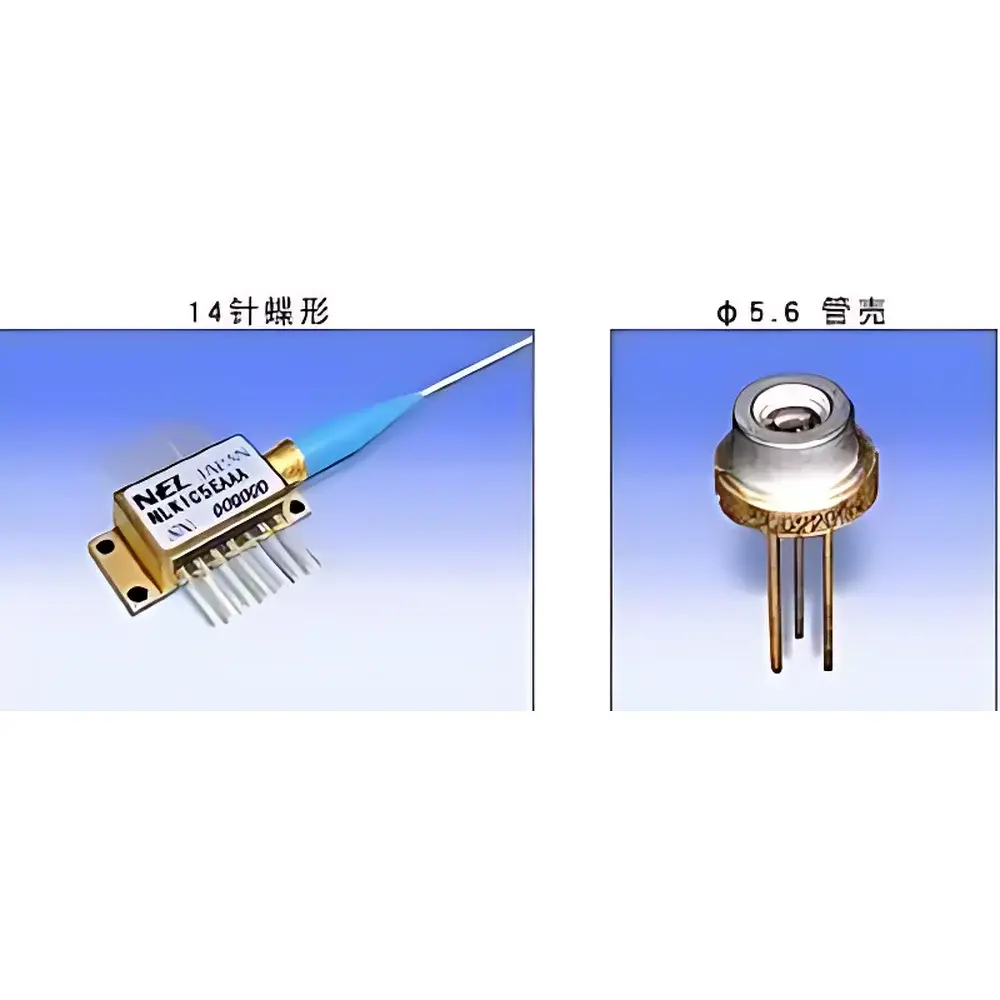
Rayscience NLK1E5EAAA Distributed Feedback (DFB) Laser Diode
| Brand | Rayscience |
|---|---|
| Model | NLK1E5EAAA |
| Wavelength Range | 1580–1670 nm |
| Output Power | ≥10 mW (CW) |
| Package | 14-Pin Butterfly |
| Fiber Pigtail | SMF-28, FC/PC Connector |
| Operating Mode | Continuous Wave (CW) |
| Spectral Linewidth | <3 MHz (typ.) |
| Side Mode Suppression Ratio (SMSR) | >50 dB |
| Tuning Range | ±1 nm (temperature & current) |
| Compliance | RoHS, CE |
Overview
The Rayscience NLK1E5EAAA is a high-stability, single-mode distributed feedback (DFB) laser diode engineered for precision gas sensing, tunable diode laser absorption spectroscopy (TDLAS), and optical metrology in the near-infrared (NIR) spectral region. Operating in continuous wave (CW) mode, this device leverages monolithic DFB grating integration to deliver narrow-linewidth emission (50 dB). Its center wavelength falls within the 1580–1670 nm range — a strategically important band for detecting key industrial and environmental trace gases including CO2, CO, NH3, H2O vapor, and hydrocarbons via their fundamental and overtone rovibrational absorption lines. The laser is fabricated using InP-based epitaxial structures and incorporates thermoelectric cooling (TEC) and integrated monitor photodiode for closed-loop power and temperature control — essential for long-term reproducibility in field-deployable or laboratory-grade analyzers.
Key Features
- Monolithically integrated DFB grating ensuring inherent single-longitudinal-mode operation without external cavity components
- 14-pin butterfly package with integrated TEC, thermistor, and back-facet photodiode for real-time output monitoring and stabilization
- Hermetically sealed housing compliant with MIL-STD-883H for reliability under thermal cycling and humidity stress
- Standard polarization-maintaining (PM) or standard single-mode fiber (SMF-28) pigtail with FC/PC connector; custom fiber types (e.g., HI1060, PM980) available upon request
- Low relative intensity noise (RIN) < −145 dB/Hz (10 MHz–1 GHz), optimized for heterodyne detection and interferometric applications
- Thermal tuning coefficient of ~0.1 nm/°C and current tuning coefficient of ~0.01 nm/mA, enabling fine-wavelength scanning over ±1 nm around nominal emission
Sample Compatibility & Compliance
The NLK1E5EAAA is designed for integration into OEM gas analyzers, process monitoring systems, and research-grade spectroscopic platforms. Its wavelength coverage aligns with ASTM E2910–22 (Standard Practice for Calibration of Tunable Diode Laser Absorption Spectrometers) and supports compliance with ISO 14001 environmental monitoring requirements. When deployed in regulated environments — such as pharmaceutical cleanroom air quality verification or semiconductor fab exhaust stack analysis — the laser’s stable CW output enables adherence to USP optical system qualification protocols. Device-level conformity includes RoHS Directive 2011/65/EU and CE marking per EMC Directive 2014/30/EU and Low Voltage Directive 2014/35/EU. Full traceability documentation (including MTRs for semiconductor wafers and calibration certificates for wavelength accuracy ±0.05 nm at 25°C) is provided with each unit.
Software & Data Management
Rayscience supplies a Windows-compatible USB-controlled driver board (RSD-DRV-14P) with LabVIEW™, Python (PyVISA), and MATLAB® API support. The embedded firmware implements IEEE 1241-compliant digital-to-analog control for precise current (0–150 mA, 16-bit resolution) and temperature (−10 to +50°C, ±0.02°C stability) regulation. All operational parameters — including forward voltage, photodiode current, TEC power draw, and real-time wavelength drift logs — are timestamped and exportable in CSV or HDF5 format. Audit trails meet FDA 21 CFR Part 11 requirements when used with validated host software, supporting GLP/GMP-compliant instrument qualification (IQ/OQ/PQ) in regulated laboratories.
Applications
- TDLAS-based in-situ measurement of CO concentration in combustion flue gas (1565–1620 nm)
- High-resolution ammonia (NH3) detection in agricultural emissions and refrigeration leak monitoring (1512–1532 nm, 1651 nm)
- Moisture (H2O) quantification in natural gas pipelines using 1368 nm and 1877 nm water vapor bands
- Calibration source for optical frequency combs and wavelength reference cells in metrology labs
- Seed laser for erbium-doped fiber amplifiers (EDFAs) and coherent optical communication testbeds
- Atomic physics experiments requiring narrow-linewidth NIR sources for Rb/Dy/Yb optical lattice loading
FAQ
What is the maximum operating current and case temperature for sustained CW operation?
The NLK1E5EAAA is rated for ≤130 mA drive current and ≤45°C heatsink temperature under continuous operation. Exceeding these limits may accelerate facet degradation and reduce lifetime below the specified 50,000-hour MTTF.
Can this laser be modulated at frequencies above 10 MHz?
Yes — direct current modulation up to 50 MHz is supported with appropriate impedance-matched drivers. For >100 MHz applications, external Mach-Zehnder modulators are recommended to preserve linewidth integrity.
Is wavelength calibration traceable to NIST standards?
Each unit undergoes factory calibration using a wavemeter referenced to NIST-traceable iodine-stabilized HeNe lasers. A certificate of calibration (CoC) with uncertainty budget (k=2) is included.
Are custom wavelengths available within the 1580–1670 nm range?
Yes — Rayscience offers wafer-level wavelength selection with ±0.2 nm binning tolerance. Minimum order quantity (MOQ) applies for non-stock wavelengths.
Does the device support analog or digital temperature setpoint control?
Both modes are supported: analog voltage input (0–5 V = −10 to +50°C) and digital I²C/SPI interface for programmable setpoints and alarm thresholds.





