
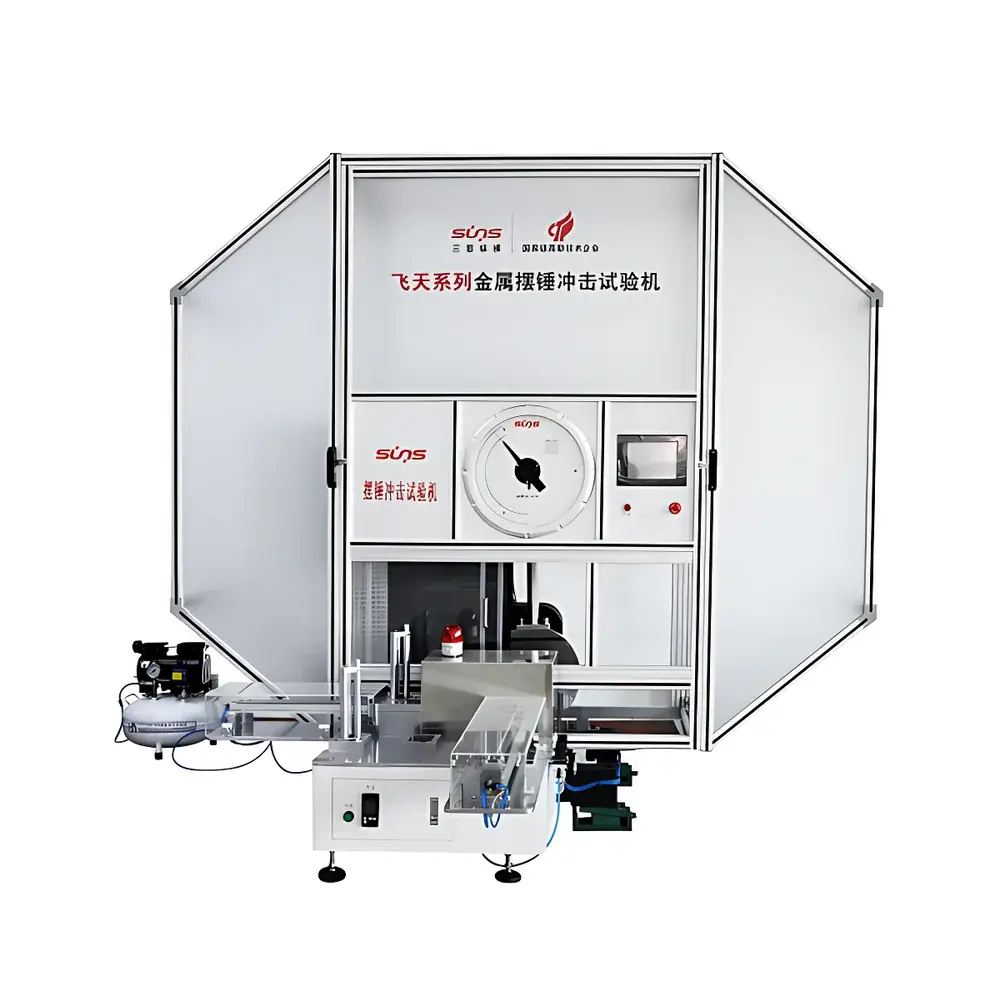
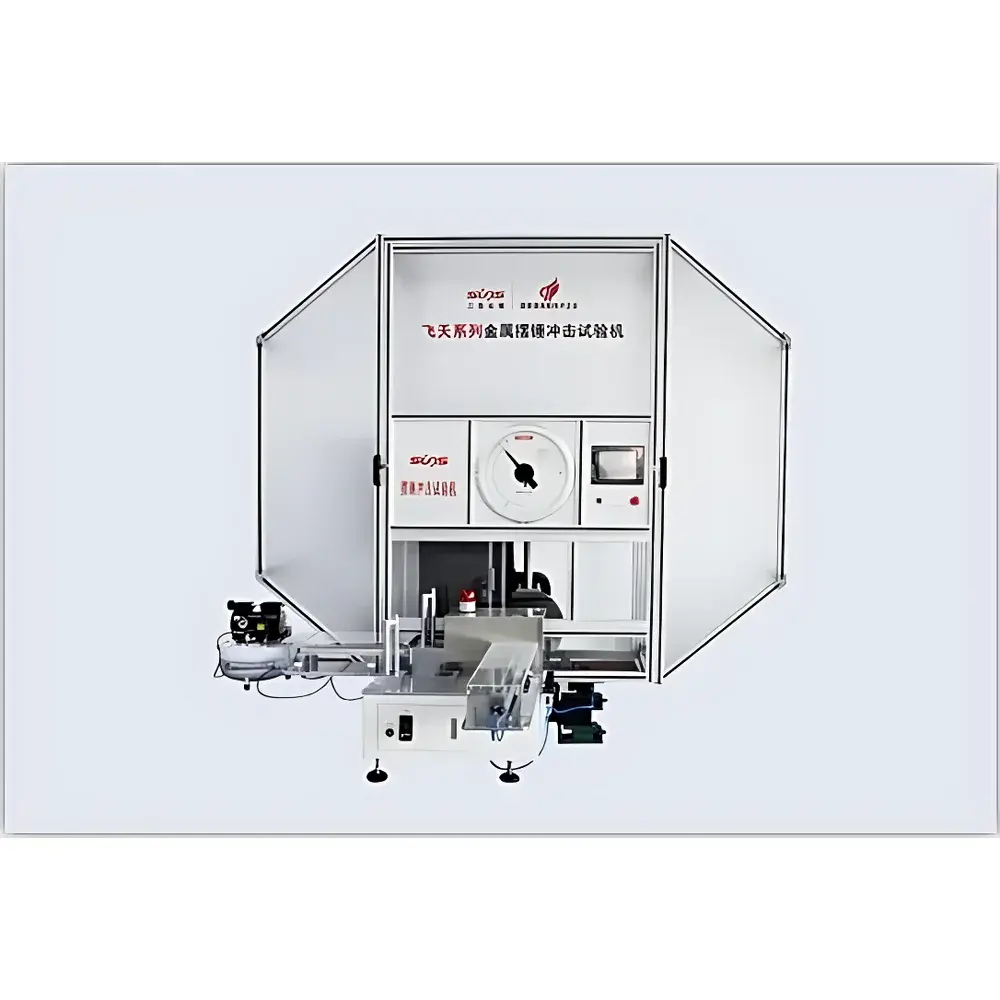
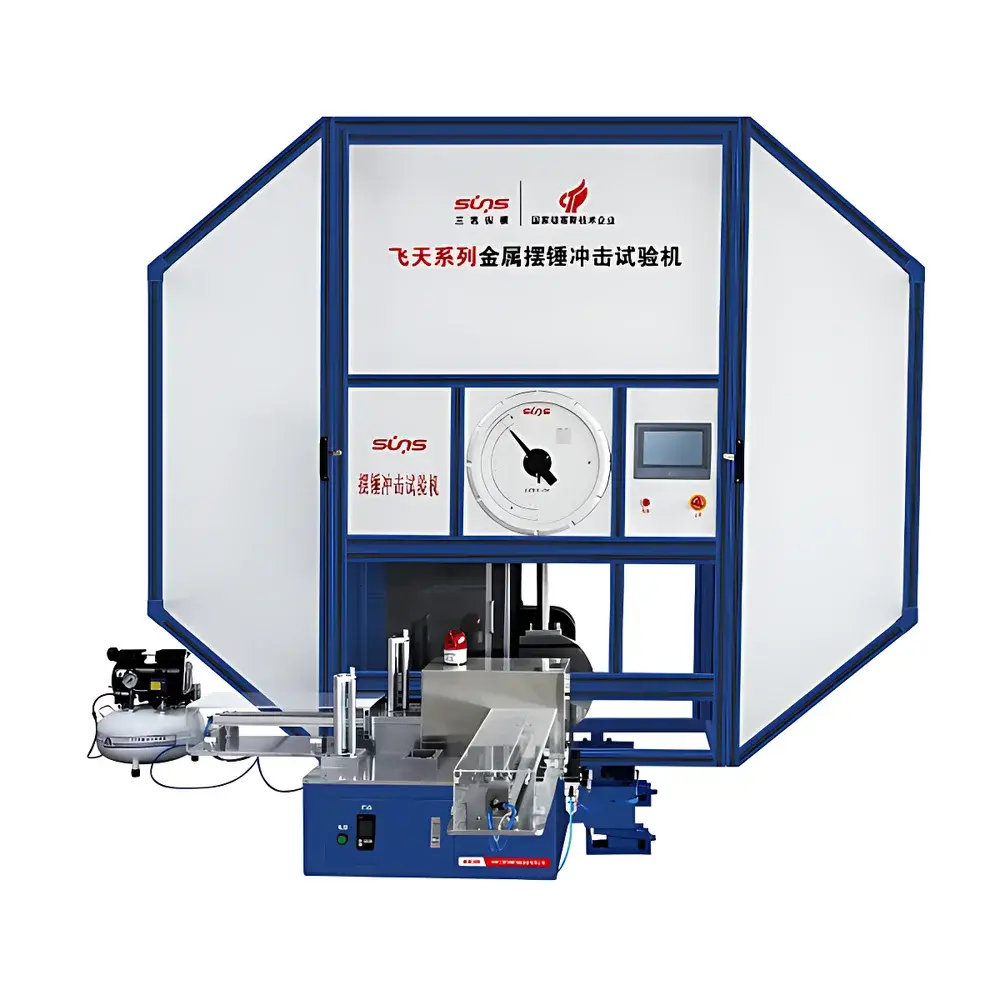
SUNS Feitian Series Metal Pendulum Impact Testing Machine
| Brand | SUNS |
|---|---|
| Origin | Guangdong, China |
| Manufacturer Type | Direct Manufacturer |
| Product Category | Domestic |
| Model Series | Feitian |
| Instrument Type | Pendulum Impact Tester |
| Nominal Impact Energy | 750 J |
| Impact Velocity | 5.24 m/s |
| Pendulum Moment (Impact Constant) | 241.1543 N·m |
| Maximum Lifting Height | 750 mm |
| Specimen Support Span | 40 mm |
| Pendulum Release Angle | 150° ± 1° |
| Anvil-to-Specimen Center Distance (for 10 mm specimen) | 750 mm |
| Hammer Blade Radius | 2–2.5 mm |
| Hammer Blade Angle | 30° |
| Hammer Blade Thickness | 12 mm |
| Specimen Dimensions Supported | 55 × 10 × 10 mm, 55 × 10 × 7.5 mm, 55 × 10 × 5 mm, 55 × 10 × 2.5 mm |
| Net Weight | ~1000 kg |
| Power Supply | 3-phase 5-wire AC 380 V ±10%, 50 Hz, 800 W, 10 A |
| Overall Dimensions (incl. full enclosure) | 2400 × 800 × 2200 mm |
Overview
The SUNS Feitian Series Metal Pendulum Impact Testing Machine is a precision-engineered instrument designed for determining the Charpy and Izod impact resistance of metallic materials under dynamic loading conditions. Based on the fundamental principle of gravitational potential energy conversion—where a calibrated pendulum is raised to a defined height and released to strike a notched specimen—the system quantifies absorbed energy (in joules) through precise measurement of the pendulum’s residual swing angle. This mechanical energy-based method adheres strictly to internationally recognized test standards including ISO 148-1, ASTM E23, GB/T 229, and ISO R148/R83. The Feitian Series was comprehensively redesigned in 2013 following extensive benchmarking against leading European and North American systems, with emphasis on operational robustness, repeatability, and integration into high-throughput quality control environments. Its architecture reflects a mature balance between classical pendulum mechanics and modern safety and usability engineering.
Key Features
- Quick-swap pendulum mechanism: Tool-free rotation of a single locking screw enables seamless transition between nominal impact energies (150 J to 750 J), eliminating manual recalibration or realignment downtime.
- Electromagnetic brake system: Enables precise, repeatable positioning of the pendulum at any release angle (0°–150°), supporting specialized test protocols such as Izod-type configurations and research-grade angular dependency studies.
- Dual-anvil modular design: Separation of anvil base and clamping jaws allows full jaw replacement by a single operator in under three minutes—critical for laboratories handling multiple specimen geometries or standardized notch types (U- vs. V-notch).
- Integrated oscillographic impact recording: Standard configuration includes real-time force-time waveform capture via high-frequency load cell (not specified in base model but compatible with optional sensor upgrade), enabling fracture behavior analysis beyond nominal absorbed energy.
- Full-interlock safety enclosure: Aluminum-framed, optically transparent polycarbonate shielding with dual symmetrical access doors complies with ISO 13857 and EN 954-1 Category 3 requirements; pendulum motion is physically inhibited unless both doors are fully latched and verified via redundant microswitches.
- Thermal compatibility: Designed for ambient and sub-zero testing environments (with optional cryogenic chamber); specimen alignment fixture ensures consistent notch positioning across temperature ranges per ASTM E23 Annex A3 and ISO 148-2.
Sample Compatibility & Compliance
The Feitian Series accommodates standard Charpy specimens per ISO 148-1 (55 × 10 × 10 mm, 55 × 10 × 7.5 mm, 55 × 10 × 5 mm, and 55 × 10 × 2.5 mm), with interchangeable anvils and hammers certified to tolerances defined in GB/T 3808–2002 and JJG 145–2007. All mechanical components—including support span (40 mm ± 0.2 mm), anvil radius (1–1.5 mm), hammer blade radius (2–2.5 mm), and blade angle (30° ± 0.5°)—are traceably verified during factory calibration. The system meets metrological requirements for Class 1 verification per ISO 148-1:2016 and supports audit-ready documentation for GLP/GMP-regulated environments. Optional accessories—including automated specimen feeders and liquid nitrogen-cooled environmental chambers—extend compliance to ASTM E23-22 Annex B (low-temperature impact) and ISO 148-2:2016 (instrumented impact).
Software & Data Management
Standard delivery includes dedicated PC-based acquisition software with embedded reporting engine compliant with ISO/IEC 17025 documentation principles. Software records impact energy, residual angle, calculated toughness (kJ/m²), and—when equipped with optional instrumentation—load-time and displacement-time profiles. All data entries include timestamp, operator ID, environmental conditions (if logged), and calibration certificate references. Audit trail functionality satisfies FDA 21 CFR Part 11 requirements for electronic records and signatures when deployed with user authentication and digital signature modules. Export formats include CSV, PDF (print-ready reports), and XML for LIMS integration. Calibration history, maintenance logs, and preventive service alerts are maintained within the same secure database instance.
Applications
- Metallurgical quality assurance in steel, aluminum, titanium, and nickel-alloy production lines.
- Validation of heat treatment efficacy (e.g., tempering, quenching) via comparative impact energy trends across lot batches.
- Fracture mechanics research, particularly ductile-to-brittle transition temperature (DBTT) mapping using standardized sub-ambient testing protocols.
- Third-party certification laboratories performing accredited Charpy testing per ISO/IEC 17025 scope.
- R&D departments evaluating weld zone toughness, HAZ (heat-affected zone) integrity, and additive manufacturing build-direction anisotropy.
- Regulatory submission support for aerospace (AMS 2301), nuclear (ASTM E208), and pressure vessel (ASME BPVC Section VIII) applications.
FAQ
Does the Feitian Series comply with ASTM E23 for instrumented impact testing?
Base configuration supports non-instrumented ASTM E23 procedures. Full instrumented capability (force-time integration, crack initiation energy, etc.) requires optional high-speed load cell, displacement transducer, and upgraded software module—ordered separately.
Can the system be integrated into an existing MES or LIMS environment?
Yes. The included software provides ODBC-compliant database access and configurable API endpoints for bidirectional data exchange with enterprise lab systems.
What calibration documentation is provided upon shipment?
Each unit ships with NIST-traceable calibration certificate covering pendulum moment, impact velocity, anvil geometry, and angle encoder linearity—valid for 12 months under normal operating conditions.
Is remote diagnostic support available?
SUNS offers secure remote maintenance via encrypted VNC tunnel, subject to customer network policy approval and signed service agreement.
Are spare pendulums and hammers supplied with the base configuration?
Two pendulums are included: one primary (matched to ordered max energy, e.g., 750 J) and one secondary (e.g., 450 J). Standard hammers (V-notch and U-notch) and anvils are also supplied; additional tooling must be ordered separately.



