
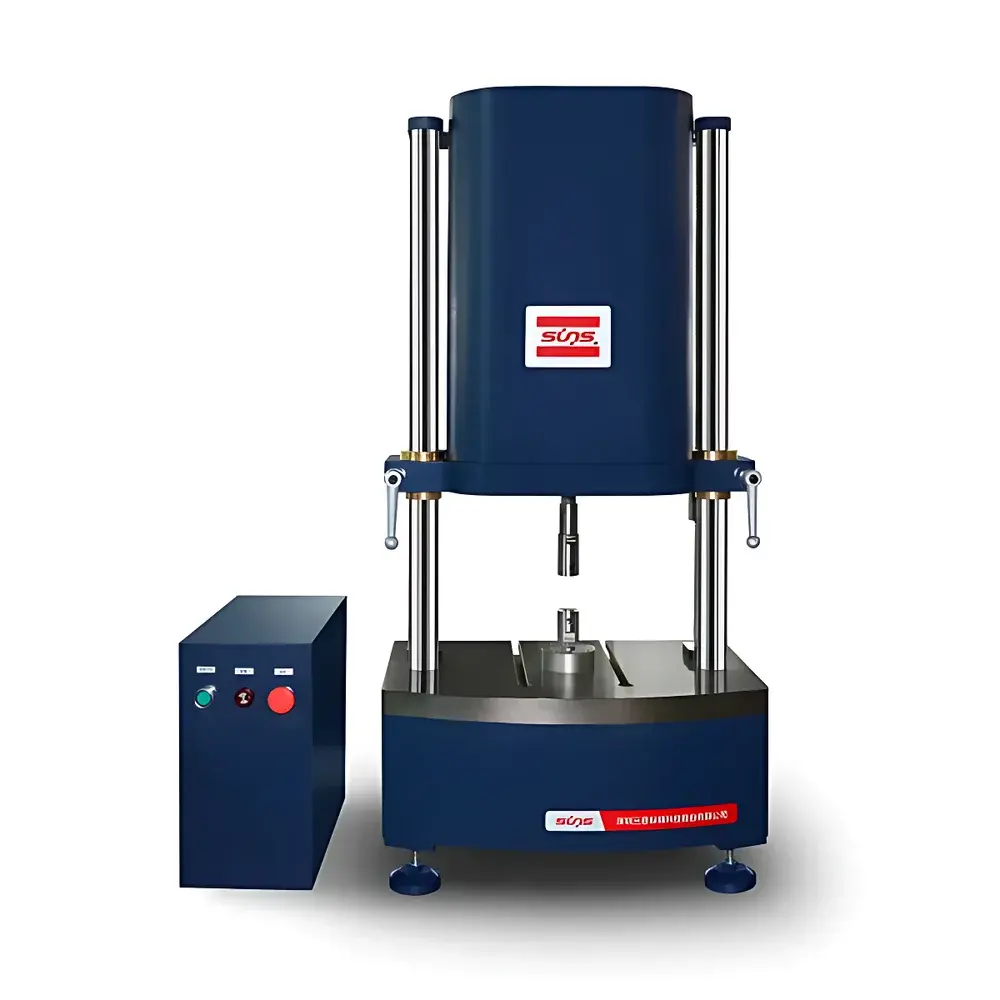
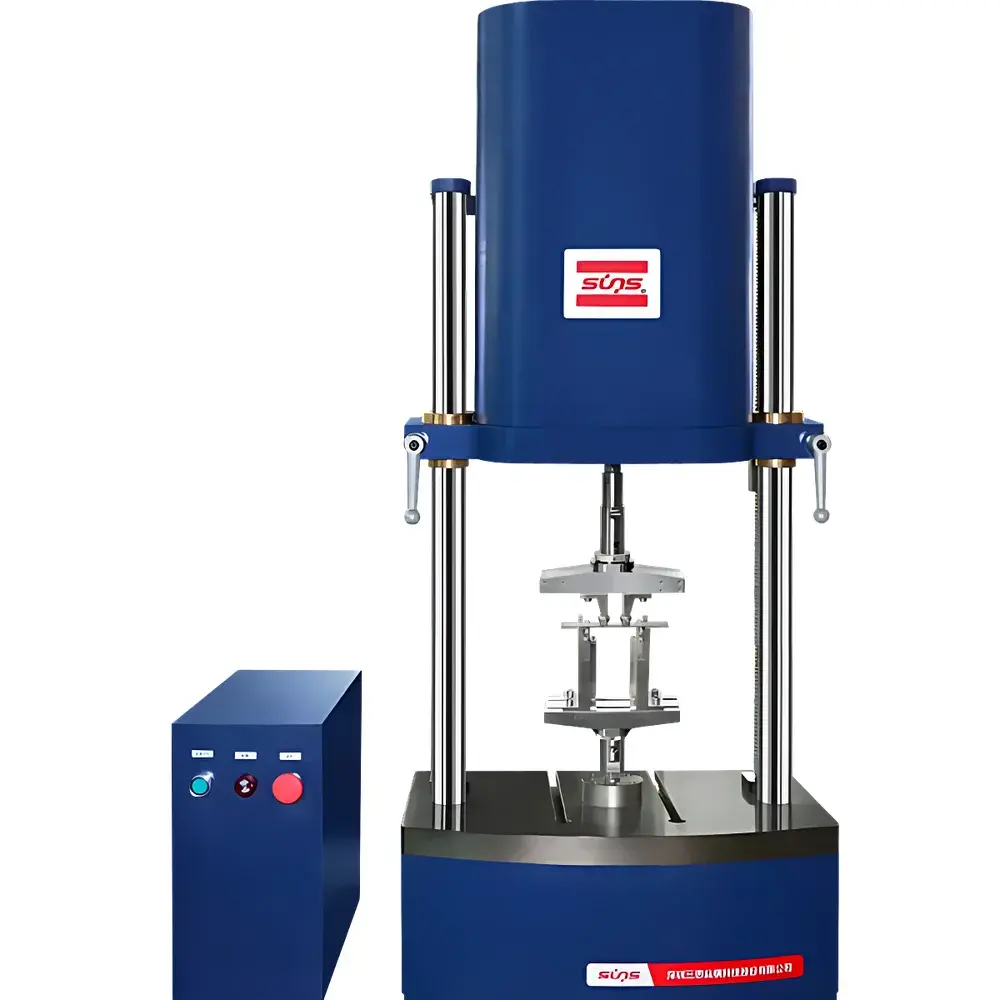
SUNS 891 Desktop Electromechanical Fatigue Testing Machine
| Brand | SUNS |
|---|---|
| Origin | Guangdong, China |
| Manufacturer Type | Direct Manufacturer |
| Country of Origin | China |
| Model | SUNS 891 |
| Instrument Category | Electromechanical Axial Fatigue Tester |
| Maximum Test Load | 10 kN |
| Frequency Range | 0.1–15 Hz |
| Host Weight | 300 kg |
Overview
The SUNS 891 Desktop Electromechanical Fatigue Testing Machine is an axial-load fatigue system engineered for high-precision, low-to-medium amplitude cyclic mechanical testing of small-scale specimens under controlled static and dynamic loading conditions. Utilizing a servo-controlled electromechanical actuator with a precision ball-screw transmission mechanism, the system eliminates hydraulic fluid dependency, delivering clean, quiet, and energy-efficient operation while maintaining traceable force and displacement linearity across its full dynamic range. Designed specifically for laboratories with spatial constraints, the compact desktop configuration supports standardized axial fatigue protocols—including high-cycle fatigue (HCF), low-cycle fatigue (LCF), crack growth rate (da/dN) measurement per ASTM E647, and fracture mechanics characterization—without compromising mechanical rigidity or thermal stability. Its modular architecture allows seamless integration with environmental chambers (high/low temperature, corrosive atmospheres) and auxiliary fixtures to extend test capability beyond ambient conditions.
Key Features
- Electromechanical actuation with integrated servo motor and preloaded ball-screw drive—ensuring zero backlash, repeatable stroke control, and minimal maintenance
- Three-closed-loop control architecture: simultaneous stress, strain, and displacement control with smooth mode transitions and real-time switching during test execution
- Adjustable test space ≥ 690 mm in height, optimized via motorized crosshead positioning for flexible specimen accommodation
- T-slot test table with standardized mounting interface for rapid interchange of tensile, compression, flexural, and custom-designed fixtures
- Real-time data acquisition at up to 1 kHz sampling rate, supporting synchronized load, displacement, and optional extensometer or LVDT inputs
- Low-noise (< 65 dB(A)) and low-power consumption design—suitable for shared lab environments and ISO 17025-accredited facilities
- Front-accessible electronics bay with industrial-grade signal conditioning, analog-to-digital conversion, and embedded safety interlocks
Sample Compatibility & Compliance
The SUNS 891 accommodates specimens ranging from biomedical polymer sutures and orthopedic bone cement samples (per YY/T 1429–2016) to miniature metallic implants (e.g., dental abutments, stent segments) and elastomeric seals. Its 1–10 kN selectable load capacity and ±50 mm stroke support both macro-scale component validation and micro-specimen evaluation under ASTM E466, ISO 1099, and GB/T 2611–2007 compliance frameworks. The system meets JB 9397–2002 requirements for axial fatigue machine performance verification and JJG 556–2011 metrological verification criteria for force and displacement accuracy. Optional environmental modules enable testing per ASTM D7705 (high-temperature polymer fatigue) and ASTM G129 (corrosion-fatigue under simulated physiological media).
Software & Data Management
The proprietary fatigue test software provides ISO/IEC 17025-aligned data integrity features including electronic signatures, audit trail logging, and configurable user access levels. It supports parametric waveform definition (sine, triangle, square, trapezoidal), automatic S–N curve generation with Weibull or Basquin fitting, and customizable reporting templates compliant with GLP and FDA 21 CFR Part 11 requirements. All raw data are stored in open-format CSV and binary HDF5 containers, enabling third-party post-processing in MATLAB, Python (SciPy/Pandas), or commercial CAE platforms. Software calibration routines include dual-point force verification and displacement linearity checks traceable to national metrology institutes.
Applications
- Mechanical evaluation of resorbable polymer scaffolds under cyclic compressive loading (ISO 13314)
- Bending fatigue life assessment of titanium alloy craniofacial plates (YY/T 0342–2002)
- Crack propagation kinetics in acrylic bone cements under sinusoidal loading (YY/T 1429–2016)
- High-cycle fatigue screening of silicone elastomer diaphragms used in implantable drug pumps
- Thermo-mechanical fatigue behavior of shape-memory alloys in constrained bending configurations
- Corrosion-assisted fatigue testing of stainless steel wire in Ringer’s solution using integrated electrochemical cell coupling
FAQ
What load frame configurations are available for the SUNS 891 series?
The SUNS 891 is offered in four standard force ratings: 1 kN, 3 kN, 5 kN, and 10 kN. Each variant shares identical control architecture, software platform, and mechanical footprint.
Can the system perform true strain-controlled LCF tests?
Yes—the integrated three-closed-loop controller enables precise strain control using external extensometers with resolution down to 0.1 µm, meeting ASTM E606 requirements for low-cycle fatigue testing.
Is the software validated for regulated environments?
The fatigue test software includes documented IQ/OQ protocols, version-controlled release notes, and built-in 21 CFR Part 11 compliance features including role-based permissions and immutable audit trails.
Does the system support remote monitoring and data export?
All test sessions generate timestamped, metadata-embedded datasets compatible with LIMS integration. Remote access is supported via secure HTTPS API endpoints with TLS 1.2 encryption.
What is the typical lead time for factory calibration and installation?
Standard delivery includes NIST-traceable force and displacement calibration certificates. On-site commissioning and operator training are scheduled within 10 business days of shipment confirmation.



