
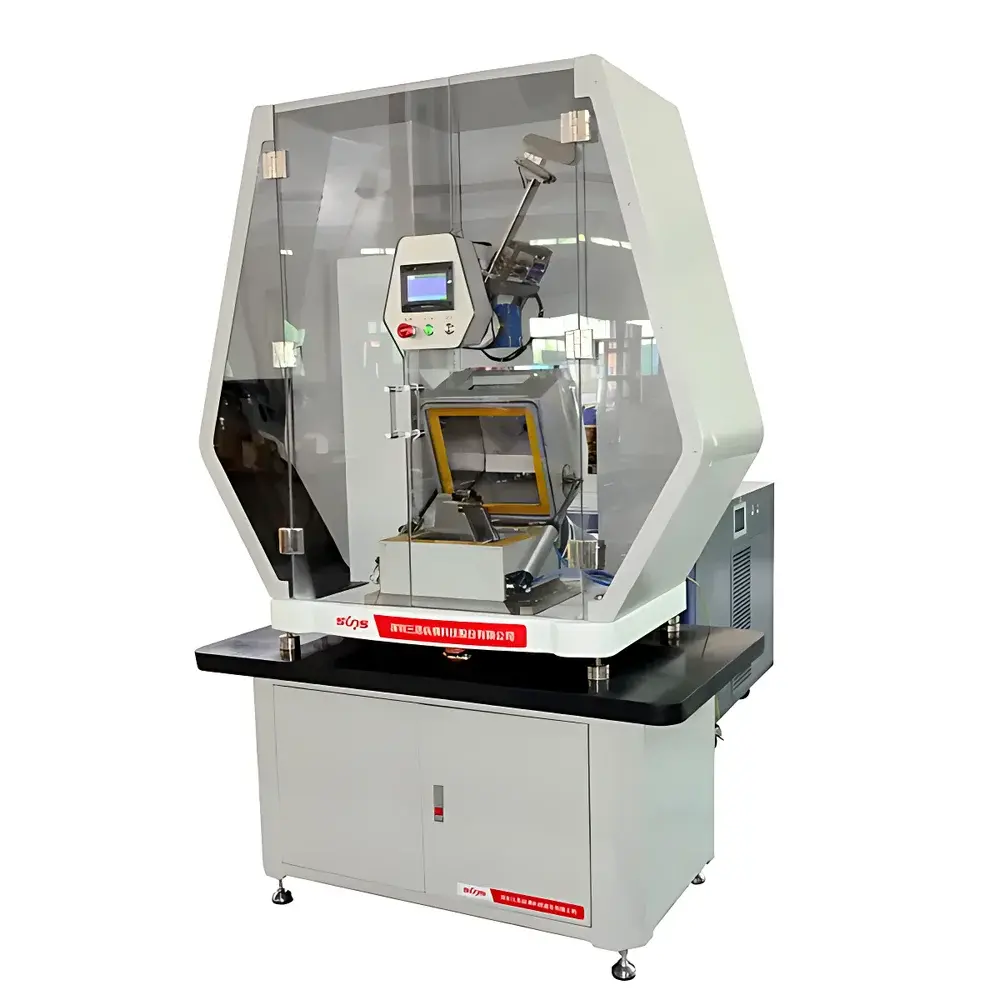
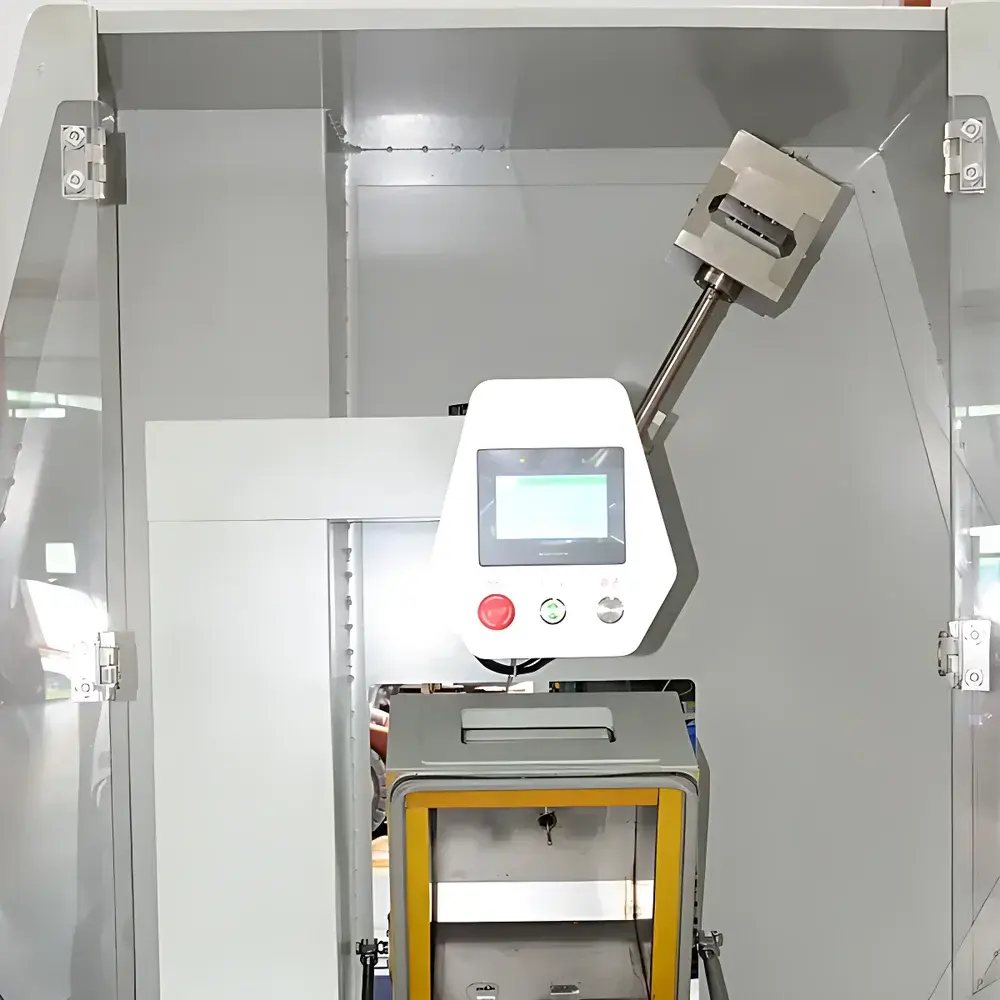
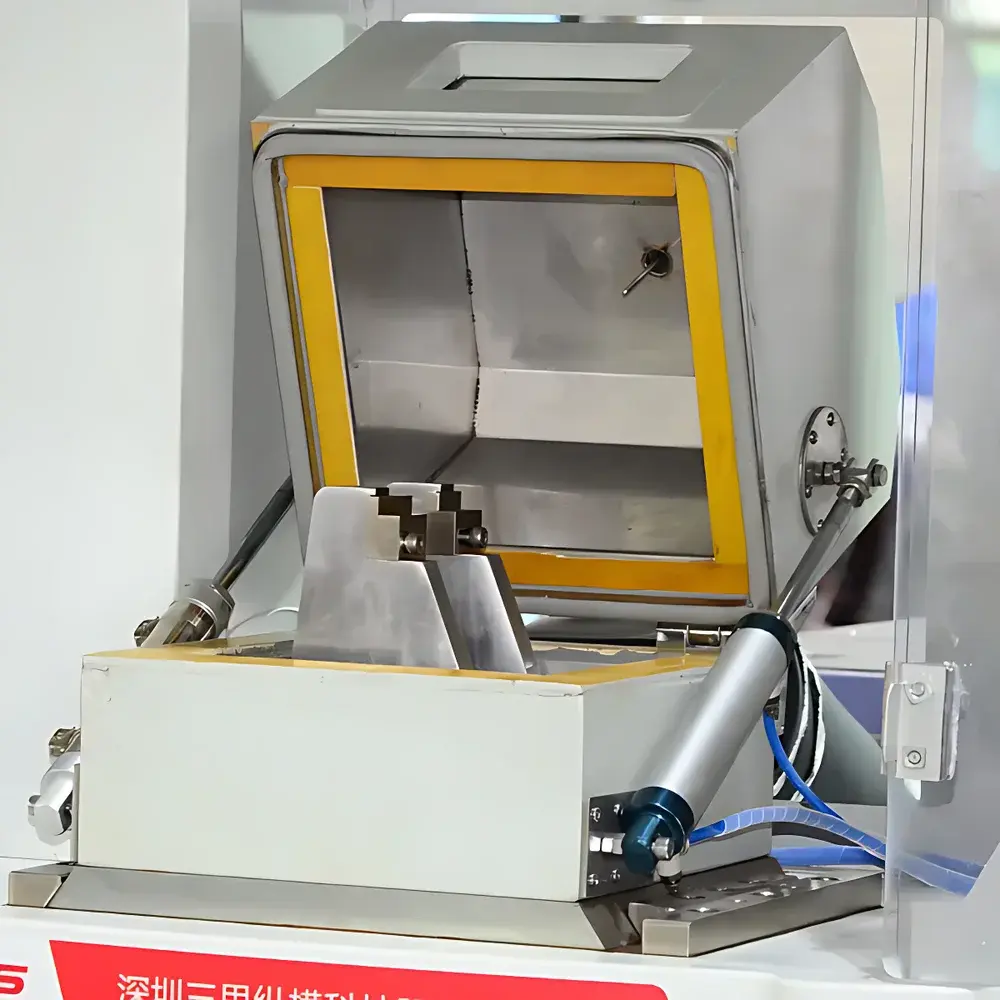
SUNS PTM7000-4 Instrumented Plastic Pendulum Impact Tester
| Brand | SUNS |
|---|---|
| Origin | Shenzhen, China |
| Manufacturer | Yes |
| Country of Origin | China |
| Model | PTM7000-4 |
| Instrument Type | Pendulum Impact Tester |
| Nominal Impact Energy | 5.5 J |
| Impact Velocity | 3.5 m/s |
| Pendulum Torque (Impact Constant) | 2.94744 N·m |
| Load Cell Range | 2 kN |
| Maximum Pendulum Lifting Height | 0–160 mm Adjustable |
| Beam Span Options | 40, 60, 62, 70 mm |
| Temperature Chamber Range | −40 °C to +85 °C |
| Temperature Uniformity | ±2 °C |
| Temperature Control Accuracy | ±0.5 °C |
| Angular Resolution | 0.045° |
| Energy Resolution (FS) | < 1/2375 |
| Sampling Frequency | 2 MHz |
| AD Resolution | 16 bit |
| Sensor Static Linearity Error | < ±2% FS |
| Response Frequency | 800 kHz |
Overview
The SUNS PTM7000-4 Instrumented Plastic Pendulum Impact Tester is an electromechanically controlled, high-resolution impact testing system engineered for precise characterization of dynamic fracture behavior in non-metallic materials under standardized Charpy (simply supported beam) and Izod (cantilever beam) configurations. Based on classical pendulum impact mechanics—where gravitational potential energy is converted into kinetic energy upon release—the instrument quantifies both total absorbed energy and time-resolved force–displacement response during specimen fracture. Its fully instrumented architecture integrates a high-frequency load cell (2 kN full scale), optical angular encoder (0.045° resolution), and synchronized 2 MHz data acquisition to capture transient mechanical events with sub-millisecond fidelity. Designed for laboratories requiring traceable, repeatable impact performance data, the PTM7000-4 supports both ambient and conditioned testing environments via integrated climatic chamber (−40 °C to +85 °C), enabling evaluation of temperature-dependent toughness transitions in thermoplastics, composites, and brittle polymers.
Key Features
- Multi-mode impact capability: Configurable for Charpy (simply supported beam), Izod (cantilever), and tensile impact tests using interchangeable pendulums and fixtures.
- High-fidelity instrumentation: 16-bit AD converter, 2 MHz sampling rate, and 800 kHz sensor bandwidth ensure accurate capture of peak load, fracture initiation energy, and post-yield dissipation.
- Precise mechanical calibration: Pendulum torque certified at 2.94744 N·m; impact energy calibrated per ISO 13802 and ASTM E23 verification protocols.
- Adjustable lifting mechanism: Programmable pendulum elevation (0–160 mm) enables fine-tuned control over impact energy delivery across multiple ranges (e.g., 2.75 J and 5.5 J for Izod, up to 27.5 J for Charpy).
- Thermally stabilized testing: Integrated environmental chamber maintains ±0.5 °C control accuracy and ±2 °C uniformity across full operating range, supporting low-temperature embrittlement and high-temperature ductility studies.
- Modular fixture system: Interchangeable anvils, supports, and notching tools compliant with GB/T 1043, GB/T 1843, ISO 179, ISO 180, and ASTM D256 geometries—including 40 mm, 60 mm, 62 mm, and 70 mm span options.
Sample Compatibility & Compliance
The PTM7000-4 accommodates rigid and semi-crystalline polymeric specimens including ABS, PC, PP, PE, PVC, FRP, GFRP, glass-ceramics, insulating composites, friction materials, and structural ceramics. Specimen dimensions adhere to standard cross-sections (e.g., 10 mm × 10 mm × 80 mm for Izod; 80 mm × 10 mm × 4 mm for Charpy), with optional micro-notching tools meeting ISO 2818 tolerances. All mechanical and thermal subsystems are validated against national and international metrological standards. The system satisfies requirements for GLP-compliant testing environments and supports audit-ready documentation per ISO/IEC 17025:2017. Test reports generated include raw force–angle–time traces, energy partitioning (pre-crack, crack propagation, plastic deformation), and statistical summaries aligned with ASTM E23 Annex A1 reporting conventions.
Software & Data Management
The proprietary SUNS IMPACT Suite provides real-time visualization, automated parameter calculation (impact strength, modulus of toughness, normalized energy), and export to CSV, XML, or PDF formats. Software architecture includes configurable test templates, multi-user role management, electronic signature support, and full audit trail logging—enabling compliance with FDA 21 CFR Part 11 for regulated quality control labs. Raw waveform data is stored with metadata (operator ID, environmental conditions, calibration certificate IDs, specimen ID), and all calculations are traceable to NIST-traceable reference standards. Optional integration with LIMS platforms via OPC UA or REST API ensures seamless workflow alignment in centralized QA/QC infrastructures.
Applications
- Quality assurance of injection-molded components in automotive and electronics industries.
- Evaluation of polymer blend compatibility and toughening agent efficacy in R&D settings.
- Comparative analysis of aging effects (UV, thermal, hydrolytic) on impact resistance.
- Validation of material substitutions in medical device housings and electrical insulation systems.
- Supporting failure analysis investigations where brittle-to-ductile transition temperatures must be mapped.
- Accredited third-party testing per CNAS, ILAC-MRA, and A2LA scopes for certification bodies.
FAQ
What impact standards does the PTM7000-4 support out-of-the-box?
It natively supports GB/T 1043-2008, GB/T 1843-1996, ISO 179-2000(E), ISO 180-2001(E), and ASTM D256-2010, with preloaded test methods, geometry definitions, and pass/fail logic.
Can the system perform low-temperature impact testing below 0 °C?
Yes—the integrated environmental chamber operates from −40 °C to +85 °C with active air circulation and dual-stage refrigeration, validated per ISO 23718 for thermal stability during impact event sequencing.
Is the load cell calibrated independently from the pendulum energy calibration?
Yes—force transducers undergo separate static calibration per ISO 376 Class 1, while pendulum energy calibration follows ISO 13802 procedures using certified reference specimens and angular displacement verification.
Does the software support multi-language UI and report generation?
The IMPACT Suite offers English and Chinese language interfaces; all reports are exportable in English by default, with customizable templates supporting localized regulatory terminology.
What maintenance intervals are recommended for long-term measurement stability?
Annual recalibration of angular encoder, load cell, and environmental chamber sensors is recommended; biannual verification of pendulum pivot friction and knife-edge wear (per ASTM E23 Section 7.3.2) ensures continued compliance with energy loss limits.



