
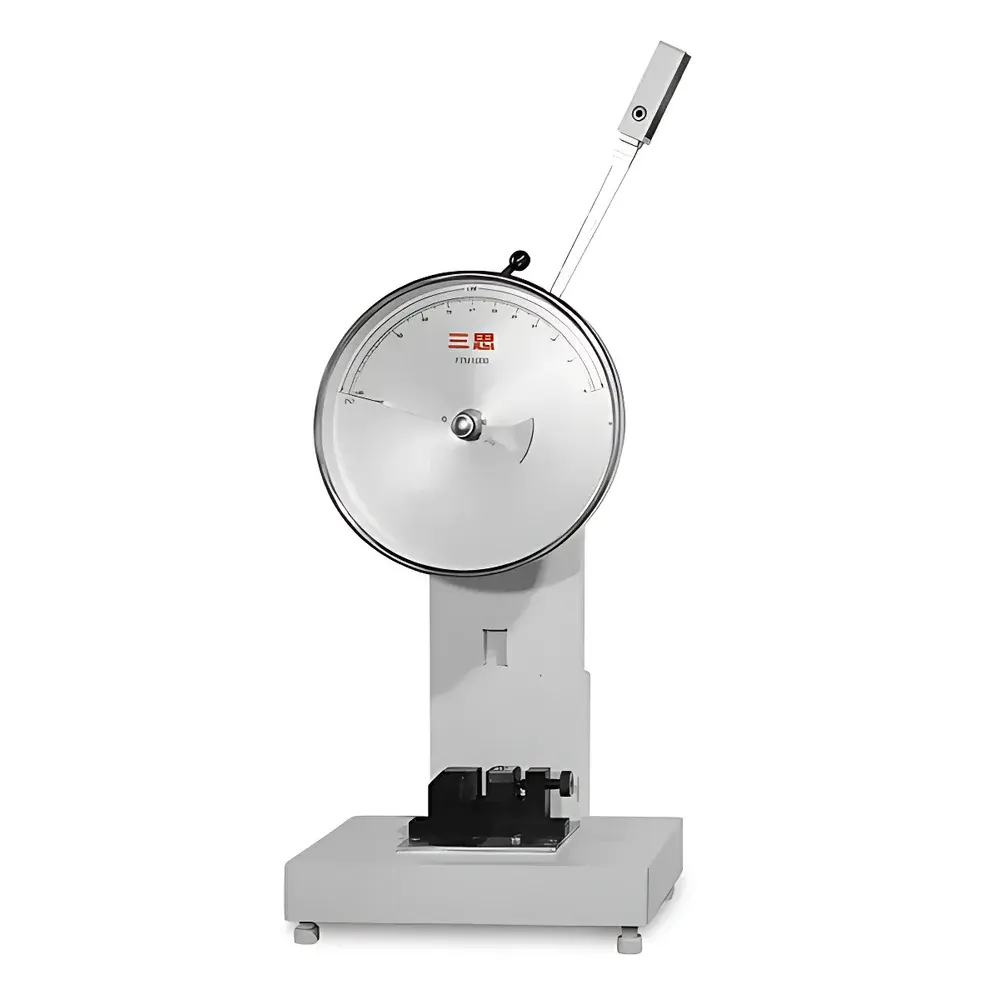
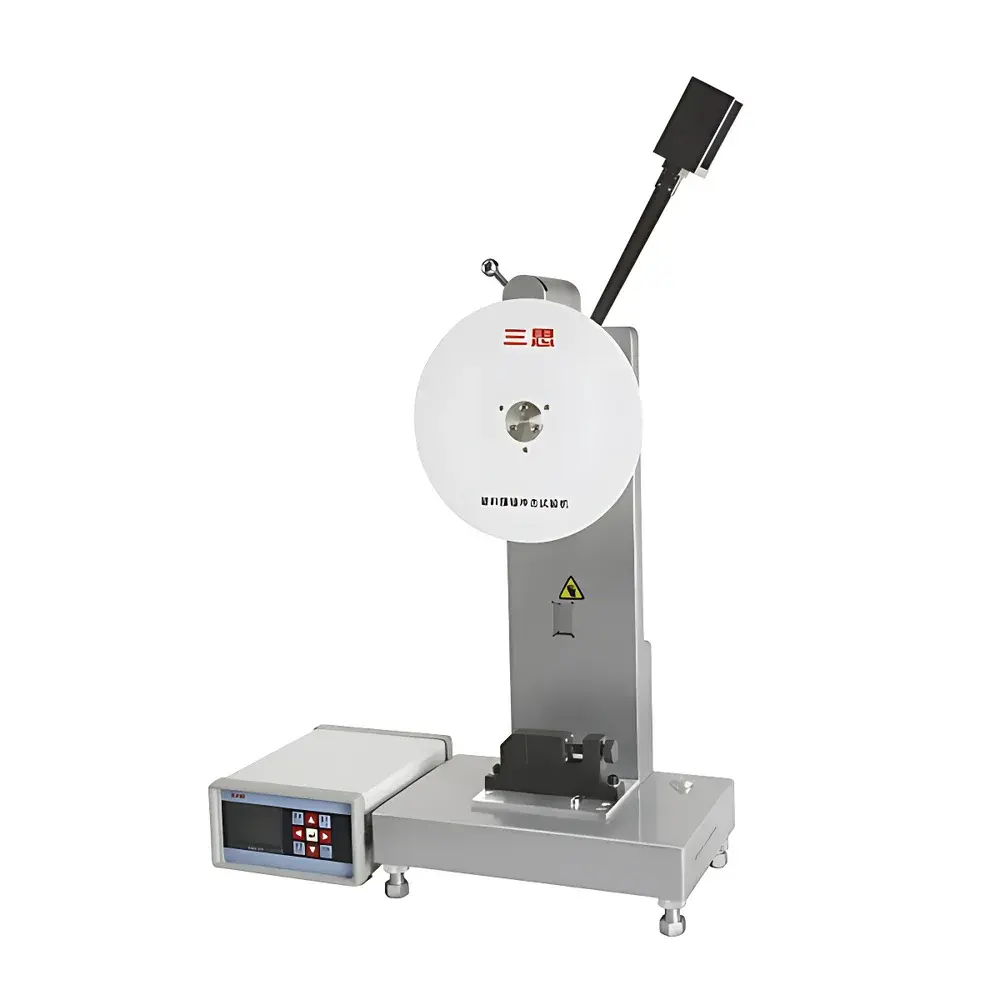
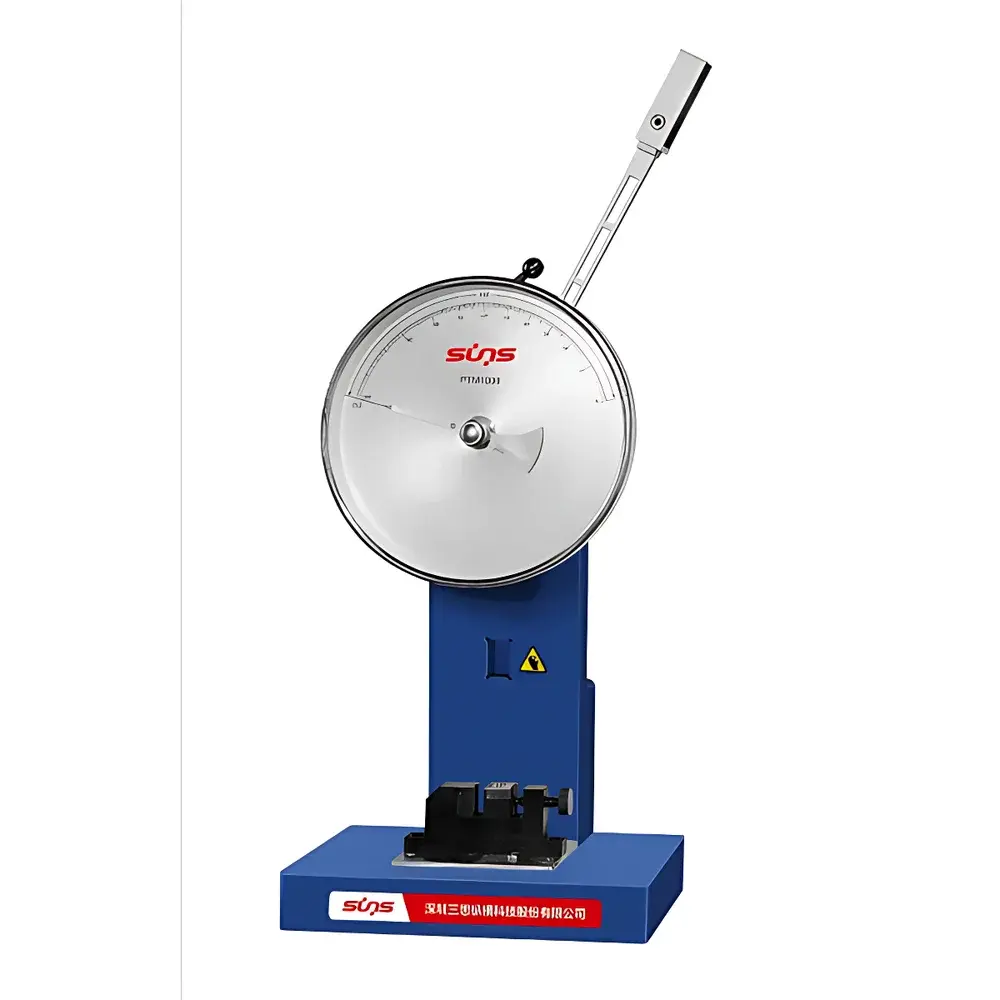
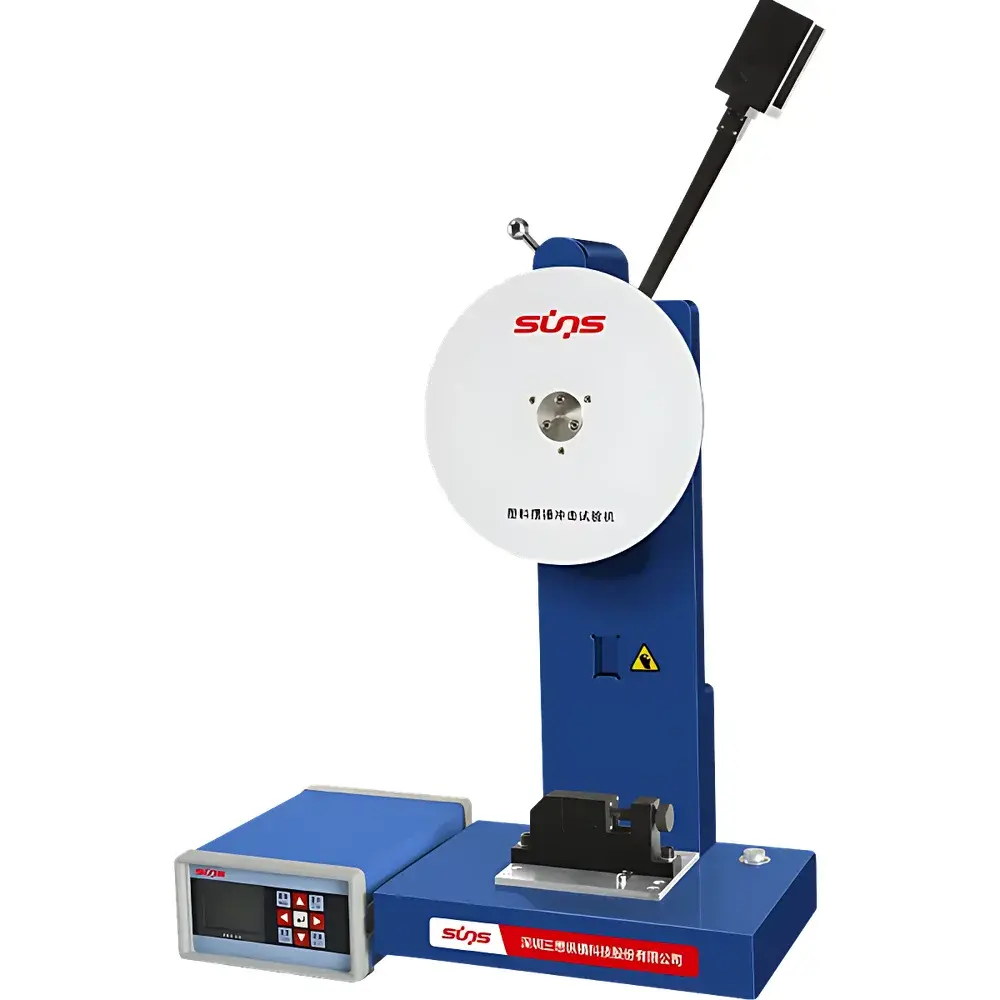
SUNS PTM1000 Series Pendulum Impact Testing Machine for Plastics
| Brand | SUNS |
|---|---|
| Origin | Shenzhen, China |
| Manufacturer Type | Direct Manufacturer |
| Instrument Type | Pendulum Impact Tester |
| Model | PTM1000 Series |
| Impact Energy Range | 1 J, 2 J, 4 J / 2.75 J, 4 J / 7.5 J, 15 J, 25 J / 5.5 J, 11 J, 22 J / 15 J, 50 J |
| Impact Velocities | 2.9 m/s, 3.5 m/s, 3.8 m/s (model-dependent) |
| Pendulum Moment (Impact Constant) | 150° |
| Display Options | Analog Pointer or LCD Digital Readout |
| Compliance | ASTM D6110, ISO 179-1:2010 (Charpy), ISO 180:2000 (Izod), GB/T 1043–2008, GB/T 1843–2008, GB/T 18743–2002 |
Overview
The SUNS PTM1000 Series Pendulum Impact Testing Machine is a precision-engineered instrument designed for standardized Charpy and Izod impact testing of rigid plastics, thermosets, reinforced composites, rubber, ceramics, and fiber-reinforced materials. Based on the classical pendulum principle—where gravitational potential energy is converted into kinetic energy upon release—the PTM1000 measures the energy absorbed by a notched or unnotched specimen during fracture under controlled impact loading. Its modular pendulum system supports multiple energy ranges (1 J to 50 J), enabling compliance with international test standards across diverse material classes and thicknesses. The machine operates in both simple-beam (Charpy) and cantilever-beam (Izod) configurations, accommodating standard specimen geometries per ISO, ASTM, and GB specifications. Its robust cast-iron frame, low-friction bearing assembly, and geometrically optimized pendulum arm ensure high reproducibility and minimal mechanical hysteresis—critical for quality control laboratories operating under GLP or ISO/IEC 17025-accredited environments.
Key Features
- Three-dimensional CAD-optimized pendulum design ensures precise alignment of the center of percussion with the specimen notch, minimizing rotational error and maximizing measurement fidelity.
- Imported high-precision angular contact ball bearings reduce frictional energy loss to <0.2% of nominal impact energy—validated per ISO 148-1 Annex B calibration protocols.
- Quick-change modular base fixtures allow seamless transition between Charpy (three-point bending) and Izod (clamped cantilever) configurations without realignment.
- Dual-display options: analog pointer scale (for direct visual verification) and optional high-resolution LCD digital display with auto-zeroing, real-time energy readout, and built-in correction algorithms for air resistance and bearing friction.
- Non-contact optical encoder-based data acquisition eliminates mechanical slippage and pointer inertia errors inherent in traditional dial systems.
- Integrated energy-loss compensation software applies dynamic corrections per ISO 148-1:2016 Clause 7.3, ensuring raw impact values are automatically adjusted to standardized reference conditions.
- Optional safety interlock-compatible polycarbonate guarding system meets EN ISO 13857 requirements for operator protection during high-energy tests (≥15 J).
Sample Compatibility & Compliance
The PTM1000 accommodates standard specimens per ISO 179-1 (80 × 10 × 4 mm Charpy bars), ISO 180 (63.5 × 12.7 × 3.2 mm Izod bars), and GB/T 18743 (pipe segment specimens with defined wall thickness and notch geometry). It supports both unnotched and machined-notch configurations (A-type and B-type per ISO 180). The machine is fully compliant with ASTM D6110 (for plastics), ISO 148-1:2016 (metallic materials—used as reference for calibration traceability), and GB/T 1043–2008 and GB/T 1843–2008 for domestic regulatory submissions. All configurations undergo factory calibration using NIST-traceable certified reference pendulums and are supplied with calibration certificates meeting ISO/IEC 17025 requirements.
Software & Data Management
The optional PC-based control software provides full audit trail functionality compliant with FDA 21 CFR Part 11 (electronic signatures, user access levels, change history logging). Test sequences are programmable with configurable pass/fail thresholds, statistical analysis (mean, SD, CV%), and automated report generation in PDF or Excel formats. Raw encoder data is timestamped and stored with metadata including ambient temperature, humidity, operator ID, and calibration status. The system supports export to LIMS via CSV or OPC UA interfaces. Firmware includes non-volatile memory with power-loss recovery—retaining all unsaved test records after unexpected shutdown.
Applications
This instrument serves critical roles in polymer formulation development, incoming raw material inspection, production line QC, and regulatory submission testing for medical devices, automotive interior components, electrical insulation housings, and construction-grade thermoplastics. Typical use cases include comparative evaluation of impact modifiers (e.g., ABS vs. PC blends), aging studies (UV/thermal degradation effects on toughness), qualification of recycled content in structural parts, and validation of processing parameters (e.g., injection molding gate location influence on notch sensitivity). Laboratories performing third-party certification to UL 94, IEC 60695, or RoHS-compliant material declarations rely on its repeatability and cross-standard interoperability.
FAQ
What standards does the PTM1000 support for plastic impact testing?
It complies with ISO 179-1 (Charpy), ISO 180 (Izod), ASTM D6110, GB/T 1043–2008, GB/T 1843–2008, and GB/T 18743–2002 for pipe materials.
Can the same machine perform both Charpy and Izod tests?
Yes—interchangeable anvil and clamp assemblies enable rapid reconfiguration without recalibration.
Is energy correction applied automatically during testing?
Yes—built-in firmware applies ISO 148-1–specified corrections for bearing friction and air drag in real time.
Does the system meet regulatory data integrity requirements?
The digital version supports 21 CFR Part 11–compliant audit trails, electronic signatures, and secure user authentication.
What maintenance is required to sustain accuracy?
Annual verification using certified reference pendulums and periodic bearing lubrication per manufacturer schedule—no routine recalibration needed between certifications.



