
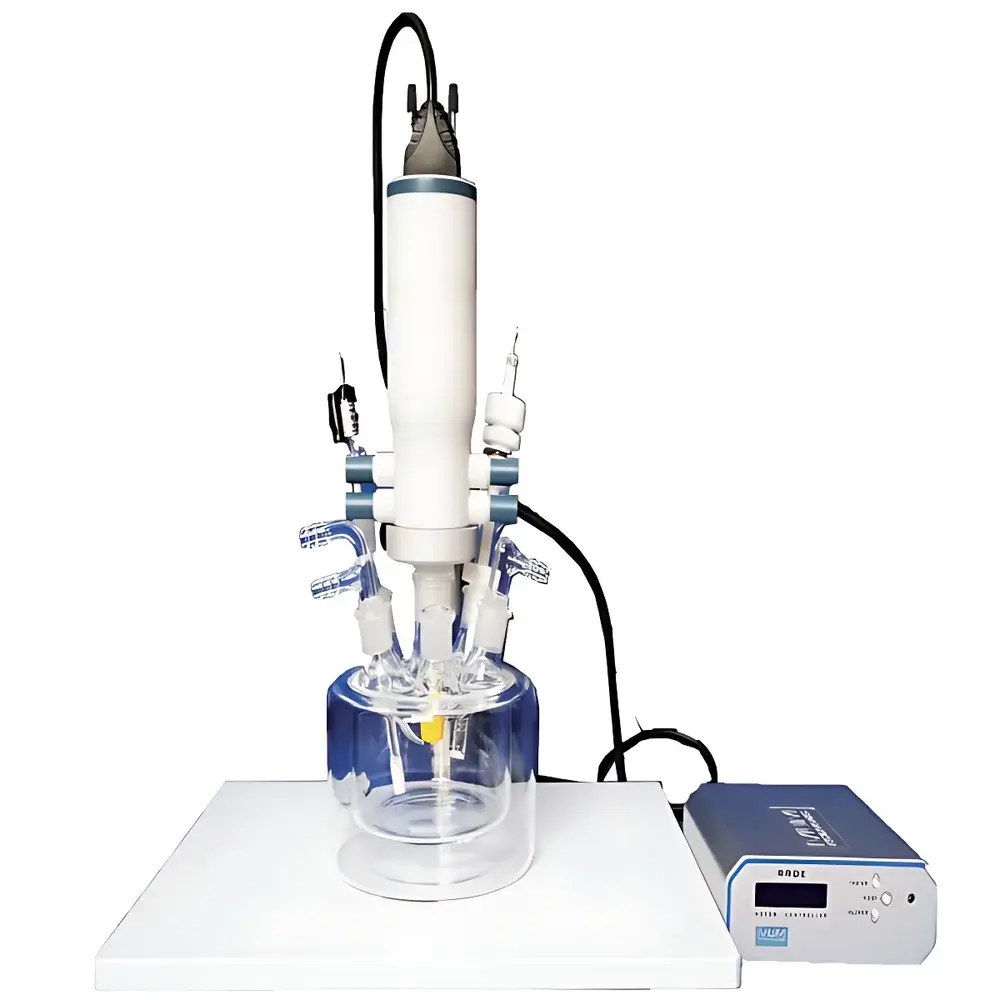
Ivium RDE/RRDE Rotating Disk and Rotating Ring-Disk Electrode System
| Brand | Ivium |
|---|---|
| Origin | Netherlands |
| Model | IVIUM RDE/RRDE |
| Rotation Speed Range | 100–10,000 rpm |
| Speed Control | Analog voltage input (0–10 V DC) |
| Speed Resolution | 0.02 rpm (average) |
| Output Signal | 0–10 V DC proportional to rotational speed |
| Drive Architecture | High-acceleration brushless DC motor |
| Electrode Mounting | Chemically inert PEEK housing |
| Power Supply | Bipolar ±15 V DC for enhanced electrochemical kinetics |
| Application Domain | Hydrodynamic modulation voltammetry, kinetic studies, mass-transport-controlled electroanalysis |
Overview
The Ivium RDE/RRDE Rotating Disk and Rotating Ring-Disk Electrode System is a precision-engineered hydrodynamic electrochemical accessory designed for integration with all Ivium potentiostats and galvanostats. It operates on the fundamental principles of controlled-convection electrochemistry, enabling quantitative separation of kinetic and diffusion-controlled contributions in redox processes. The system supports both rotating disk electrode (RDE) and rotating ring-disk electrode (RRDE) configurations—critical for mechanistic investigations involving intermediate species generation, collection efficiency calibration, and coupled chemical-electrochemical (EC, CE, ECE) reaction pathway analysis. Its brushless DC motor architecture delivers rapid acceleration (<100 ms to reach target speed), ensuring minimal transient disturbance during step-change experiments. Designed for laboratory-scale fundamental research and method development—not routine QC—the system maintains mechanical stability and electrical isolation under continuous operation across the full 100–10,000 rpm range.
Key Features
- High-fidelity rotational control with analog voltage input (0–10 V DC), allowing seamless synchronization with potentiostat-triggered protocols or external data acquisition systems.
- Real-time rotation speed feedback via linear 0–10 V DC output signal—enabling closed-loop validation and post-experiment drift correction in time-resolved voltammetric datasets.
- Chemically resistant PEEK (polyether ether ketone) electrode holder ensures compatibility with aggressive electrolytes including concentrated acids, alkaline media, and organic solvents commonly used in fuel cell catalyst evaluation or battery interface studies.
- Bipolar ±15 V DC power supply enhances dynamic response during fast-scan voltammetry and improves current resolution in low-conductivity non-aqueous systems.
- Modular mechanical design permits rapid interchange between RDE and RRDE assemblies without recalibration; standard shaft interface complies with ASTM D1364 and ISO 13893 recommendations for rotating electrode geometry alignment.
- No internal electronics or firmware—fully passive operation eliminates electromagnetic interference with sensitive current measurements (sub-pA resolution achievable when paired with Ivium’s Femto series potentiostats).
Sample Compatibility & Compliance
The Ivium RDE/RRDE system accommodates standard commercial electrode assemblies with 4 mm or 6 mm disk diameters and industry-typical ring-to-disk gap dimensions (e.g., 0.1–0.3 mm). It is routinely deployed in studies compliant with ASTM G102 (electrochemical impedance spectroscopy under convection), ASTM G59 (potentiodynamic polarization in rotating systems), and ISO 17475 (corrosion testing using hydrodynamic electrodes). While not certified for GMP environments, its traceable speed calibration (±0.02 rpm average deviation) and mechanical reproducibility support GLP-aligned documentation workflows. No proprietary consumables are required—users retain full control over electrode material selection (Pt, Au, GC, Ni, etc.) and polishing protocols.
Software & Data Management
The system requires no dedicated driver software. Rotation control and monitoring integrate natively within IviumSoft™ (v6.0+), where users define speed ramps, step sequences, and trigger coupling directly within experiment scripts. All speed-related metadata—including actual vs. setpoint values, timestamped voltage output logs, and acceleration profiles—are embedded in the .mpt binary data file alongside electrochemical signals. This enables synchronized multi-parameter analysis in third-party tools (e.g., Python-based PyIvium, MATLAB Electrochem Toolbox) without data alignment errors. Audit trails comply with FDA 21 CFR Part 11 requirements when IviumSoft is configured with user authentication and electronic signature modules.
Applications
- Kinetic parameter extraction (k⁰, α, D) from Levich and Koutecký–Levich plots in oxygen reduction reaction (ORR) and hydrogen evolution reaction (HER) catalysis screening.
- Quantitative detection and lifetime estimation of short-lived intermediates (e.g., O₂⁻, NO•, CO₂•⁻) via ring collection efficiency mapping in RRDE mode.
- Mass transport characterization in lithium-ion battery electrolyte formulations, including ion transference number determination and SEI growth modeling under forced convection.
- Corrosion mechanism elucidation in chloride-containing environments through rotating cylinder electrode (RCE)-equivalent flow simulation.
- Enzyme kinetics and bioelectrocatalysis studies where substrate diffusion limitations must be decoupled from intrinsic turnover rates.
FAQ
Can the Ivium RDE/RRDE be used with non-Ivium potentiostats?
Yes—provided the external instrument supplies a stable 0–10 V analog control signal and accepts a 0–10 V tachometer output for speed verification.
Is the rotation speed calibrated at the electrode surface or at the motor shaft?
Calibration is performed at the electrode tip using laser Doppler velocimetry traceable to NIST standards; shaft-speed deviations are compensated in firmware.
What maintenance is required for long-term speed accuracy?
No scheduled maintenance is specified; however, periodic cleaning of the PEEK chuck and verification against a handheld optical tachometer every 6 months is recommended for GLP adherence.
Does the system support vacuum or glovebox operation?
Yes—the absence of internal electronics and sealed PEEK housing allows safe integration into inert-atmosphere gloveboxes; optional feedthroughs available for electrical leads.
How is ring collection efficiency determined?
Using reversible redox couples (e.g., Fe(CN)₆³⁻/⁴⁻) at known rotation speeds; IviumSoft includes automated K-L fitting and collection efficiency calculation templates.





