
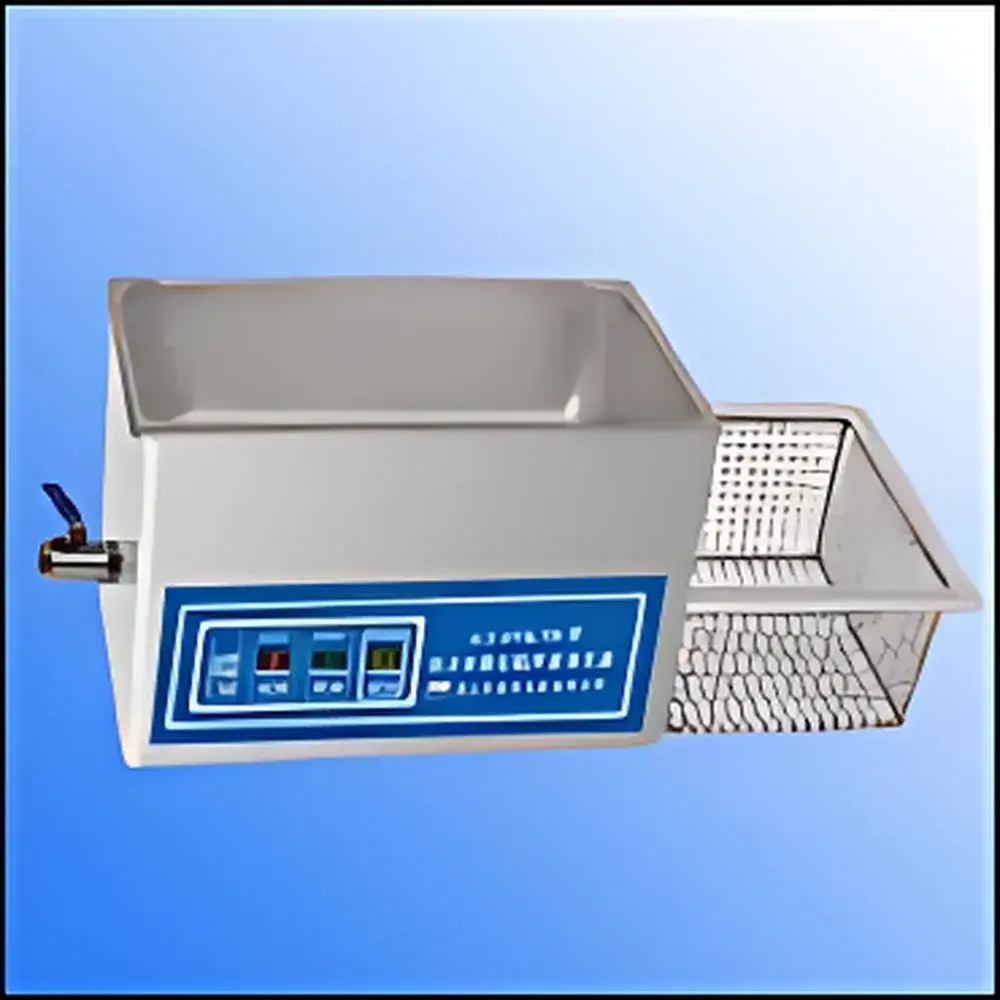
KQ-250DE Desktop Digital Ultrasonic Cleaner (10 L)
| Origin | Shanghai, China |
|---|---|
| Manufacturer Type | Authorized Distributor |
| Country of Origin | China |
| Model | KQ-250DE |
| Dimensions (W×D×H) | 320 × 264 × 320 mm |
| Tank Internal Dimensions (W×D×H) | 300 × 240 × 150 mm |
| Capacity | 10 L |
| Ultrasonic Frequency | 40 kHz |
| Total Ultrasonic Power | 250 W |
| Power per Transducer | 50 W (5 transducers) |
| Temperature Control Range | Ambient to 80 °C |
| Timer Range | 1–99 min |
| Heating Function | Yes |
| Drain Valve | Yes |
| Stainless Steel Mesh Basket | Yes |
| Sound-Dampening Lid | Yes |
| Low-Level & Dry-Run Protection | Yes |
| Cumulative Operating Hours Counter | Up to 999,999 h |
| Display | Digital LED (time, temp, power, status indicators) |
| Microcontroller-Based Control System | Yes |
| Tank Material | 304 Stainless Steel |
| Exterior Material | 304 Stainless Steel (except for select models) |
| Safety Protections | Overtemperature, overvoltage, overcurrent indication |
Overview
The KQ-250DE Desktop Digital Ultrasonic Cleaner is a precision-engineered laboratory-grade cleaning system designed for reproducible, non-destructive removal of particulate contaminants, organic residues, and surface-adhered films from delicate components, glassware, instrumentation parts, and biological samples. Utilizing high-frequency (40 kHz) piezoelectric transduction, the unit generates controlled cavitation within aqueous or compatible solvent media—producing microjet implosions that dislodge sub-micron debris without mechanical abrasion. Its integrated digital control architecture enables precise parameter management across time, temperature, and ultrasonic intensity, making it suitable for routine QC cleaning, pre-analytical sample preparation, and R&D workflows requiring trace-level cleanliness validation.
Key Features
- Digital LED display with real-time monitoring of set/actual temperature, elapsed cleaning time, ultrasonic power level, and cumulative operational hours (up to 999,999 h)
- Microprocessor-controlled operation with programmable timer (1–99 minutes), adjustable heating range (ambient to 80 °C), and 10-step ultrasonic power modulation
- Robust 304 stainless steel tank (300 × 240 × 150 mm internal) with seamless welding and corrosion-resistant finish, ensuring long-term chemical compatibility with common lab solvents
- Included stainless steel mesh basket (argon-welded construction) for secure sample placement and uniform energy distribution
- Integrated sound-dampening lid to reduce ambient noise levels during operation—critical for shared lab environments and compliance with occupational health guidelines
- Comprehensive safety protections: automatic shutdown on low liquid level detection, dry-run prevention, overtemperature cutoff, overvoltage warning, and overcurrent fault indication
- Front-mounted drain valve for rapid, spill-free solution exchange—supporting multi-step cleaning protocols and solvent recovery procedures
- Five independently driven 50 W transducers (total 250 W output) mounted on the tank base, delivering uniform acoustic field distribution across the full 10 L working volume
Sample Compatibility & Compliance
The KQ-250DE accommodates a broad spectrum of laboratory substrates including borosilicate glassware (vials, cuvettes, pipette tips), metal components (surgical instruments, calibration standards), ceramic filters, silicon wafers, and polymer-based microfluidic devices. It supports aqueous cleaning solutions, mild alkaline detergents, and low-volatility solvents (e.g., isopropanol, ethanol, terpenes) when used within defined flash-point and ventilation parameters. While not certified for medical device reprocessing under ISO 15883 or FDA 510(k), the unit meets general electrical safety requirements per IEC 61010-1 and conforms to EMC directives (EN 61326-1). Its programmable logging capability—including timestamped start/stop events and thermal profiles—supports GLP-aligned documentation practices in regulated research settings.
Software & Data Management
The KQ-250DE operates via embedded firmware with no external software dependency. All operational parameters are stored in non-volatile memory, retaining user-defined presets across power cycles. The digital interface records cumulative runtime, enabling preventive maintenance scheduling and equipment lifecycle tracking. Though lacking USB or Ethernet connectivity, its deterministic control logic ensures repeatable execution of standardized cleaning SOPs—facilitating audit readiness for ISO/IEC 17025-accredited laboratories where procedural consistency is mandated. Optional third-party data loggers may be deployed via external PT100 probe integration for enhanced thermal validation.
Applications
- Pretreatment of HPLC vials, GC autosampler trays, and spectrophotometer cells to eliminate carryover contamination
- Decontamination of electron microscopy grids and TEM sample holders prior to imaging
- Removal of flux residues from printed circuit boards (PCBs) and microelectronic assemblies
- Cell lysate clarification and nanoparticle dispersion in nanomaterial synthesis workflows
- Extraction support for botanical analytes and environmental soil extracts using sonication-assisted leaching
- Ultrasonic degassing of mobile phases and calibration standards to prevent bubble-induced instrument errors
FAQ
What is the recommended cleaning solution for general laboratory glassware?
Aqueous 1–2% laboratory-grade detergent (e.g., Alconox® or Liquinox®) at 40–60 °C is optimal for most organics and particulates. Avoid chlorine-based or strongly acidic formulations unless validated for stainless steel compatibility.
Can the KQ-250DE be used for sterilization?
No. This unit performs cleaning and decontamination—not microbial sterilization. Sterilization requires validated steam, dry heat, or ethylene oxide processes compliant with ISO 11135 or ISO 17665.
Is the unit compatible with flammable solvents?
Only under strict engineering controls: use in explosion-proof fume hoods, disable heating function, limit bath fill level to ≤70% capacity, and verify solvent flash point exceeds operating temperature by ≥20 °C.
How often should the transducers be inspected?
Visual inspection for physical damage or delamination is recommended every 500 operational hours; performance verification (cavitation intensity mapping) should occur annually or per institutional QA policy.
Does the KQ-250DE meet FDA 21 CFR Part 11 requirements?
No. It lacks electronic signature, audit trail, and user access control features required for Part 11 compliance. However, manual logbook entries referencing its digital timestamps satisfy basic traceability needs in non-GxP environments.
Related Products



