
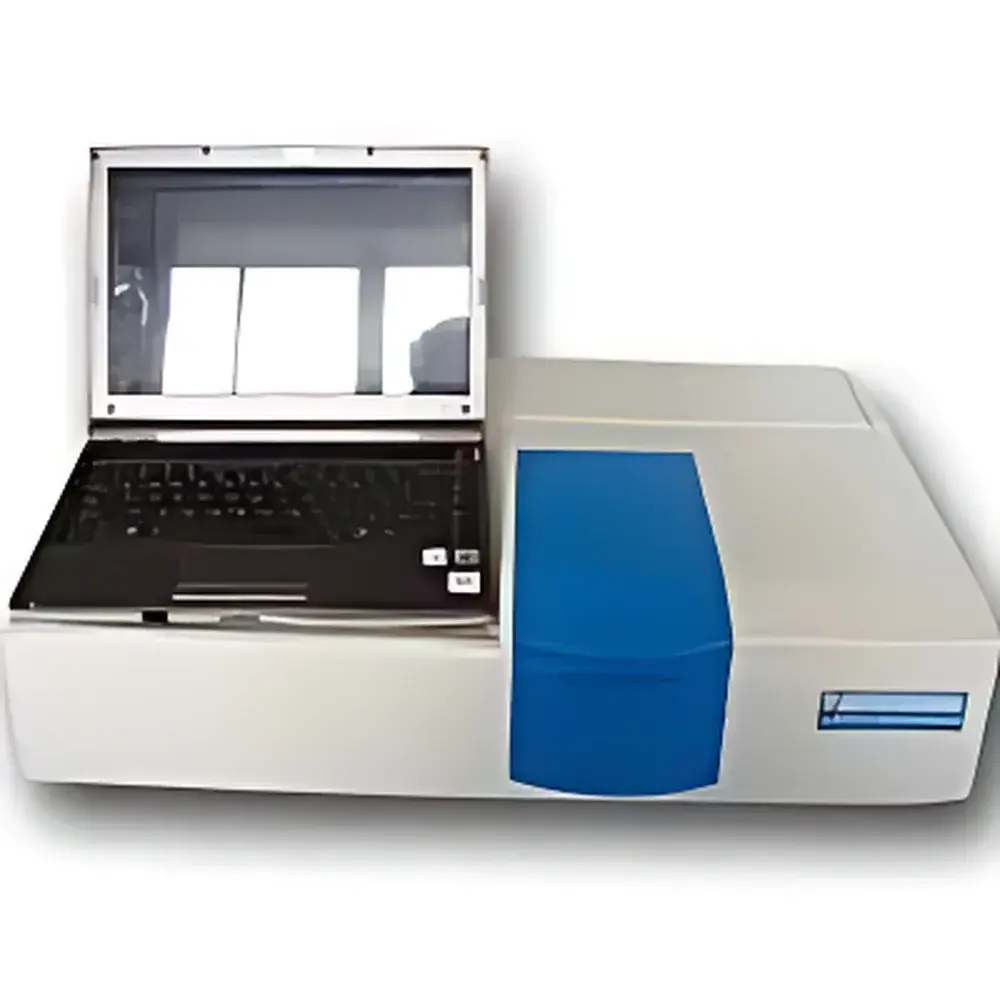
Chu Ding UV1900PC / UV1901PC Dual-Beam Ultraviolet-Visible Spectrophotometer
| Brand | Chu Ding |
|---|---|
| Origin | Shanghai, China |
| Model | UV1900PC / UV1901PC |
| Wavelength Range | 190–1100 nm |
| Light Source | Imported Tungsten Lamp & Deuterium Lamp |
| Optical System | Dual-Beam, 1200-line/mm Plane Grating |
| Wavelength Accuracy | ≤ ±0.3 nm |
| Wavelength Repeatability | ≤ 0.1 nm |
| Stray Light | ≤ 0.05 %T (at 220 nm, NaI solution) |
| Photometric Range | –3 to +3 A |
| Noise | ≤ 0.0003 Abs/h |
| Baseline Flatness | ≤ ±0.0005 A |
| Spectral Bandwidth | 2 nm (UV1900PC), 1 nm (UV1901PC) |
| Drift | ≤ ±0.0004 Abs/h |
| Photometric Accuracy | ±0.3 %T (0–100 %T) |
| Photometric Repeatability | 0.001 Abs (0–0.5 Abs) |
| Detector | Imported Silicon Photodiode |
| Power Supply | AC 220 V/50 Hz or AC 110 V/60 Hz |
| Dimensions | 658 × 468 × 264 mm |
| Weight | 30 kg |
Overview
The Chu Ding UV1900PC and UV1901PC are dual-beam ultraviolet-visible (UV-Vis) spectrophotometers engineered for precision absorbance, transmittance, and energy measurements across a broad spectral range of 190–1100 nm. Based on classical double-beam optical architecture, these instruments split the light path into sample and reference beams using a high-stability chopper system, enabling real-time compensation for source intensity fluctuations and detector drift. This design ensures high photometric stability and reproducibility—critical for quantitative analysis in regulated environments. The optical train incorporates a 1200 lines/mm holographic plane grating, imported deuterium and tungsten-halogen lamps, and a silicon photodiode detector optimized for signal-to-noise performance. With spectral bandwidths of 2 nm (UV1900PC) and 1 nm (UV1901PC), the systems support applications requiring either rapid screening or higher-resolution spectral discrimination.
Key Features
- Dual-beam optical design with real-time reference beam correction for enhanced baseline stability and long-term measurement integrity
- High-fidelity 1200-line/mm plane grating delivering low stray light (≤0.05 %T at 220 nm using NaI solution) and improved spectral fidelity
- Automated wavelength scanning with three selectable speeds (fast/medium/slow) and arbitrary wavelength setting capability
- Modular sample compartment with tool-free access—designed for rapid interchange of accessories including cuvette holders, solid-sample stages, and fiber-optic probes
- Open-source lamp chamber facilitating straightforward replacement of deuterium and tungsten lamps without optical realignment
- Robust mechanical architecture (30 kg mass, rigid aluminum alloy chassis) minimizing vibration-induced noise during kinetic or low-absorbance measurements
- Integrated thermal management system maintaining detector and optical bench temperature stability within ±0.5 °C over extended operation
Sample Compatibility & Compliance
The UV1900PC/UV1901PC accommodates standard 10 mm square quartz, glass, or plastic cuvettes (pathlengths from 1 mm to 100 mm via optional holders), as well as reflectance accessories for solid or film samples. It supports both liquid-phase quantification and solid-surface characterization under ambient laboratory conditions. From a regulatory standpoint, the instrument meets essential performance criteria outlined in ISO 9001–certified manufacturing practices and aligns with ASTM E275 and USP for spectrophotometer verification. While not pre-certified for FDA 21 CFR Part 11, its PC-based software architecture permits integration with validated LIMS or ELN platforms supporting audit trails, electronic signatures, and data integrity controls required under GLP and GMP frameworks.
Software & Data Management
Controlled via Windows-compatible application software (English/Chinese bilingual interface), the system provides full method development, instrument calibration, and post-acquisition processing capabilities. Supported functions include multi-wavelength photometry (1–6 wavelengths simultaneously), full-spectrum scanning (absorbance/transmittance/energy), kinetic time-course monitoring, quantitative analysis with linear/nonlinear regression (1–9-point calibration curves, up to 4th-order polynomial fitting), and derivative spectroscopy (1st–3rd order). All raw and processed data are exported in standardized ASCII or CSV formats compatible with third-party statistical tools (e.g., OriginLab, JMP, MATLAB). Software logs include timestamped acquisition metadata, operator ID fields, and parameter versioning—enabling traceable data lineage per ALCOA+ principles.
Applications
These spectrophotometers serve core analytical roles across pharmaceutical QC (active ingredient assay, dissolution testing, excipient compatibility), environmental chemistry (nitrate/nitrite, COD, phosphate quantification), food safety (colorant analysis, antioxidant capacity), biochemical research (protein concentration via Bradford/Lowry, nucleic acid purity assessment at 260/280 nm), and materials science (thin-film transmittance, semiconductor bandgap estimation). The UV1901PC’s 1 nm bandwidth is particularly suited for resolving closely spaced absorption maxima in conjugated organic molecules or metal-ligand complexes, while the UV1900PC offers optimal throughput for routine batch analysis in industrial QA labs.
FAQ
What is the difference between the UV1900PC and UV1901PC models?
The primary distinction lies in spectral bandwidth: UV1900PC uses a fixed 2 nm slit, whereas UV1901PC employs a 1 nm slit for improved resolution—ideal when distinguishing overlapping peaks in complex mixtures.
Does the system support compliance with FDA 21 CFR Part 11?
The base software does not include built-in Part 11 features (e.g., role-based access control, electronic signatures), but it exports auditable data files and can be deployed within validated IT infrastructure meeting Part 11 requirements.
Can I perform kinetic measurements at multiple wavelengths simultaneously?
No—kinetic mode operates at a single user-defined wavelength; however, multi-wavelength photometry allows discrete endpoint readings across up to six wavelengths in one scan cycle.
Is lamp alignment required after replacement?
No—the open-source chamber and pre-aligned lamp sockets eliminate manual collimation; lamp replacement is a plug-and-play procedure.
What validation documentation is provided?
Each unit ships with a factory performance verification report covering wavelength accuracy, photometric linearity, stray light, and baseline flatness—traceable to NIST-traceable standards.
Related Products





