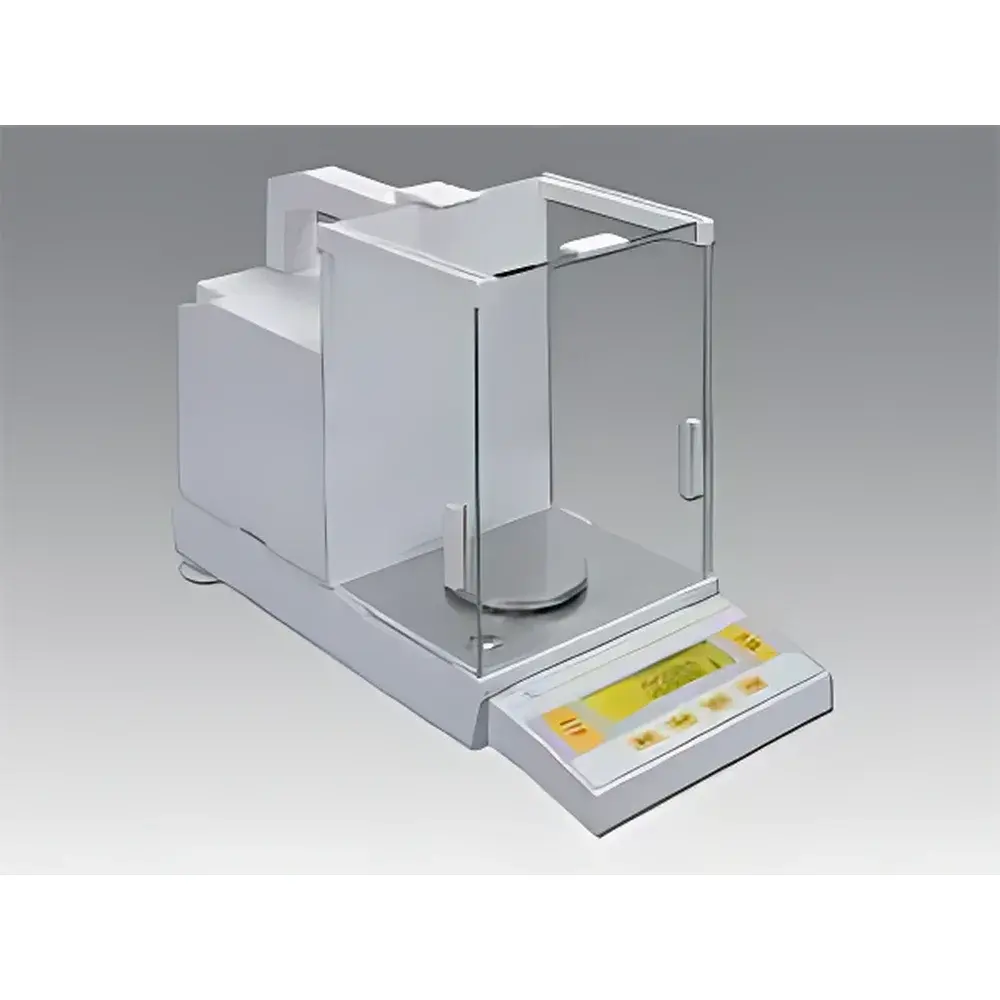
Chu Ding Technology FA2004 Precision Analytical Balance
| Brand | Chu Ding Technology |
|---|---|
| Origin | Shanghai, China |
| Model | FA2004 |
| Capacity | 200 g |
| Readability | 0.1 mg |
| Repeatability | ≤ 0.1 mg |
| Linearity | ±0.2 mg |
| Pan Diameter | Φ90 mm |
| Draft Shield Dimensions | 195 × 160 × 235 mm |
| Overall Dimensions | 195 × 445 × 300 mm |
| Power Options | AC adapter or 9 V battery |
| Interface | RS232 |
| Compliance | Designed for GLP/GMP-aligned laboratory workflows |
Overview
The Chu Ding Technology FA2004 Precision Analytical Balance is a high-accuracy, microgram-resolution weighing instrument engineered for routine and regulated analytical tasks in research laboratories, quality control environments, and educational institutions. Operating on electromagnetic force compensation (EMFC) principle, the FA2004 employs a rear-mounted electromagnetic sensor architecture—distinct from strain-gauge-based systems—to eliminate common sources of drift, creep, and nonlinearity. This design ensures stable, repeatable measurements across ambient temperature fluctuations, supported by dynamic temperature compensation algorithms embedded in its single-chip microcontroller firmware. With a 200 g maximum capacity and 0.1 mg readability (100 µg), the balance meets the performance requirements for Class I analytical applications per ISO 9001 and USP general chapter guidelines on balance qualification. Its compact footprint, integrated draft shield, and dual-power capability (AC adapter or 9 V battery) support flexible deployment in fume hoods, clean benches, or mobile lab settings.
Key Features
- Rear-mounted electromagnetic force compensation sensor for enhanced stability, minimal warm-up time, and immunity to mechanical hysteresis
- High-contrast backlit LCD display with adjustable brightness and multiple display modes (e.g., gross/net/tare, dynamic weight bar)
- Programmable weighing speed (fast/standard/sensitive) to optimize response time versus vibration resistance
- Four-stage anti-vibration system with adaptive damping, enabling reliable operation on standard lab benches without dedicated isolation tables
- Full-range tare function with auto-zero tracking, configurable drift threshold, and programmable auto-rezero interval
- Built-in internal calibration routine with automatic motor-driven weight actuation; supports user-initiated calibration at any time
- Integrated below-balance weighing hook for density determination, magnetic susceptibility, or suspended sample measurement
- Overload protection circuitry with audible and visual alert upon exceeding 110% of rated capacity
- Unit conversion across metric (g, kg), imperial (oz, lb), and precious-metals (ct, dwt) systems without external software
Sample Compatibility & Compliance
The FA2004 accommodates a wide range of sample types—including powders, granules, liquids in tared vessels, and small solid components—within its Φ90 mm stainless steel weighing pan. The removable acrylic draft shield (195 × 160 × 235 mm) provides ISO 17025-compliant environmental isolation during sub-milligram measurements while allowing unobstructed access for pipette or spatula handling. The balance’s firmware supports audit-ready operation: all calibration events, zero adjustments, and configuration changes are timestamped and stored in non-volatile memory. While not pre-certified to FDA 21 CFR Part 11, the device is fully compatible with electronic record systems that implement Part 11 controls (e.g., signature capture, audit trail export via RS232). It satisfies essential requirements for GLP and GMP environments where traceability, repeatability, and documented calibration are mandatory.
Software & Data Management
Equipped with a standard RS232 serial interface, the FA2004 enables seamless integration with LIMS, ELN, or custom data acquisition platforms. Output format is ASCII-based and configurable for delimiter (comma/tab), units, and metadata inclusion (e.g., date/time stamp, ID code, stability flag). No proprietary drivers are required—native COM port communication is supported across Windows, macOS, and Linux environments. Firmware allows user-defined ID entry (up to 16 characters) for instrument identification in multi-balance labs. All internal diagnostics—including sensor status, temperature deviation, and load cell excitation voltage—are accessible via service menu for preventive maintenance logging.
Applications
- Quantitative preparation of reference standards and working solutions in pharmaceutical QC labs
- Weighing of catalysts, reagents, and active pharmaceutical ingredients (APIs) per ICH Q5C and USP
- Gravimetric analysis including ash content, moisture loss on drying (LOD), and residue on ignition (ROI)
- Formulation development requiring precise mass ratios (e.g., polymer blends, composite materials)
- Teaching laboratories performing stoichiometry, molar mass determination, and calibration curve construction
- Inventory management via piece-counting mode with statistical validation (mean weight, standard deviation, count tolerance)
FAQ
What is the recommended calibration frequency for the FA2004 in a GLP environment?
Calibration should follow a risk-based schedule: daily verification with certified check weights prior to use, full internal calibration at startup and after significant ambient shifts, and external verification using NIST-traceable standards at least weekly—or per SOP-defined intervals.
Does the FA2004 support external calibration with manual weights?
No—the FA2004 relies exclusively on internal motorized calibration; it does not accept external weights for calibration routines. External verification remains essential for metrological traceability.
Can the balance operate continuously on battery power?
Yes, the 9 V alkaline battery supports up to 8 hours of intermittent use; however, continuous operation is advised only with the AC adapter to maintain thermal equilibrium and measurement stability.
Is the RS232 interface optically isolated?
No—it is a standard non-isolated RS232 port. For electrically noisy industrial environments, use of an opto-isolating USB-to-RS232 adapter is recommended.
How is linearity error characterized for this model?
Linearity is specified as ±0.2 mg across the full 0–200 g range, verified using five-point ascending/descending test loads traceable to national metrology institutes.