
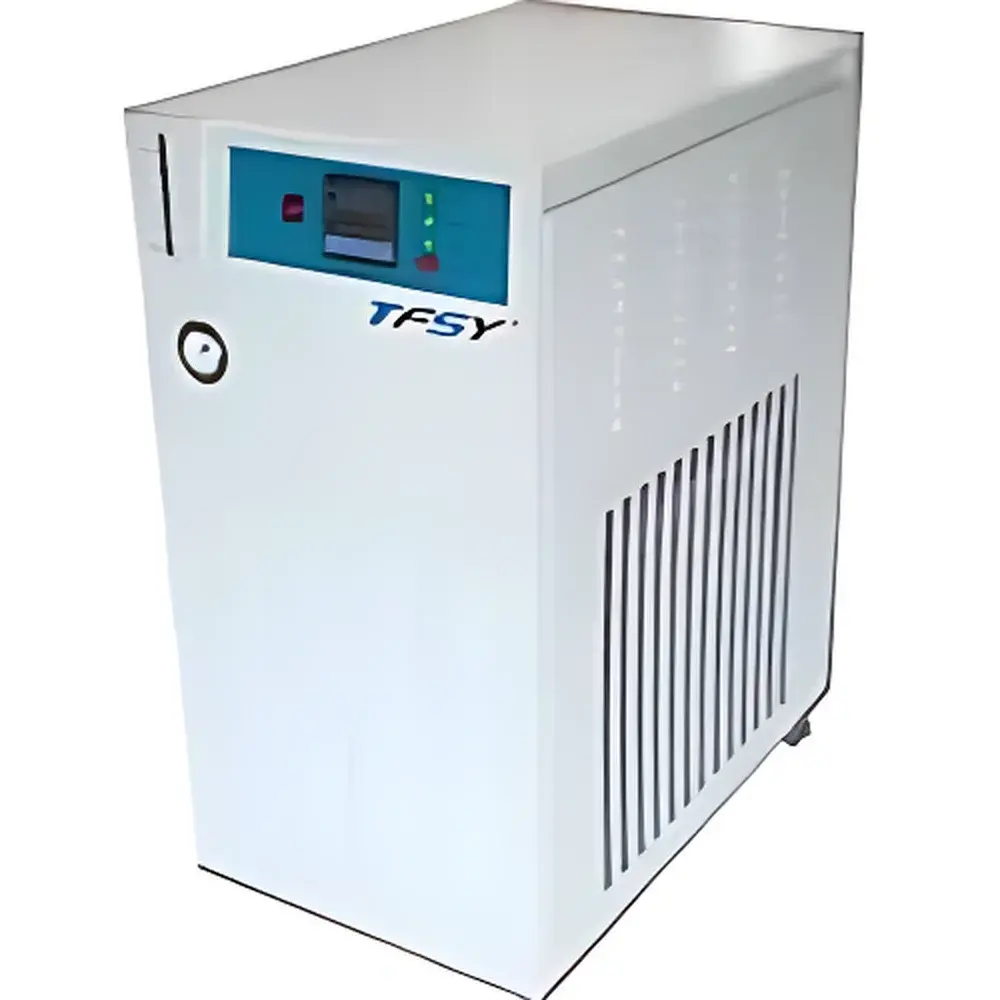
Shanghai LS-1000 Precision Circulating Chiller for Laser & Analytical Instrument Cooling
| Origin | Shanghai, China |
|---|---|
| Manufacturer Type | Authorized Distributor |
| Country of Origin | China |
| Model | LS-1000 |
| Cooling Capacity | 1.0 kW/h (860 kcal/h) |
| Reservoir Volume | 12 L |
| Temperature Stability | ±0.1 °C |
| Refrigerant | R22 / R134a / R407C (configurable) |
| Compressor Power | 0.28 kW |
| Input Power | 0.8 kW |
| Power Supply | 3-phase 380 V, 50 Hz |
| Pump Flow Rate | ≥12 L/min |
| Max. Head | 20 m |
| Evaporator Type | Titanium-tube immersion coil (316 stainless steel optional) |
| Safety Protections | High/Low pressure, overtemperature, flow loss, phase failure, compressor overheating, anti-freeze |
| Dimensions (W×D×H) | 674 × 450 × 810 mm |
| Net Weight | 70 kg |
Overview
The Shanghai LS-1000 Precision Circulating Chiller is an engineered thermal management solution designed for stable, continuous cooling of high-sensitivity laboratory and industrial equipment requiring precise temperature control. Operating on vapor-compression refrigeration principles, it integrates a hermetically sealed scroll or rotary compressor, thermostatic expansion valve (TXV), titanium-tube immersion evaporator, and high-efficiency finned-tube condenser with low-noise external rotor fan. Its core function is to maintain constant coolant temperature—typically within ±0.1 °C—under variable thermal loads, making it suitable for applications where even transient thermal drift may compromise measurement integrity or optical alignment. Unlike generic chillers, the LS-1000 employs PID-based digital temperature regulation via a programmable logic controller (PLC), enabling dynamic response to load changes while minimizing overshoot and oscillation. It is not intended for ambient air conditioning or process fluid heating; rather, it serves as a dedicated secondary cooling loop for instruments demanding clean, vibration-isolated, and chemically inert coolant circulation.
Key Features
- Precision temperature control with ±0.1 °C stability across operating range (5–35 °C), adjustable via intuitive keypad interface
- Titanium-tube immersion evaporator—resistant to corrosion from deionized water, ultrapure water, and mild aqueous solutions—ensures long-term reliability in analytical instrumentation loops
- High-efficiency centrifugal pump (0.37 kW, 20 m head, ≥12 L/min flow) constructed entirely from 316 stainless steel wetted parts
- Multi-layer safety architecture: dual independent flow sensors, high/low pressure switches, compressor discharge temperature monitoring, phase sequence detection, and freeze protection logic
- Industrial-grade electrical components—including Schneider Electric contactors, circuit breakers, and solid-state relays—certified to IEC 60947 and UL 508 standards
- Electrostatically applied powder-coated steel enclosure with rapid-access front and side panels for serviceability without tools
- Modular refrigerant compatibility: factory-configurable for R22, R134a, or R407C per regional environmental compliance requirements (e.g., EU F-Gas Regulation, EPA SNAP)
Sample Compatibility & Compliance
The LS-1000 is validated for use with instruments requiring closed-loop recirculation of deionized or distilled water at flow rates between 8–25 L/min and inlet temperatures from 10–30 °C. It is routinely deployed with laser sources (CO₂, fiber, DPSS), ICP-OES/MS systems, XRD and SEM/TEM specimen stages, graphite furnace AAS autosamplers, and high-speed spindle cooling circuits. All wetted materials—titanium evaporator, 316 SS pump housing, EPDM seals, and polypropylene reservoir—are compatible with ASTM D1193 Type II and Type IV water specifications. The unit complies with CE marking requirements under the Low Voltage Directive (2014/35/EU) and Electromagnetic Compatibility Directive (2014/30/EU). Optional documentation packages support GLP/GMP validation protocols, including IQ/OQ templates aligned with ISO/IEC 17025 and FDA 21 CFR Part 11 data integrity expectations for audit trails and parameter change logs.
Software & Data Management
While the LS-1000 operates as a standalone unit with local PLC control, its RS-485 Modbus RTU interface enables integration into centralized facility monitoring systems (e.g., LabVantage, Siemens Desigo, or custom SCADA platforms). Real-time parameters—including setpoint, actual bath temperature, flow rate, compressor run time, and fault codes—are accessible via Modbus register mapping. No proprietary software is required; third-party HMI or historian systems can log timestamps, trend deviations, and trigger alarms based on configurable thresholds. Audit-ready event logging captures all manual setpoint changes, safety interlock activations, and power cycle events—retained onboard for ≥30 days. For laboratories subject to 21 CFR Part 11, optional firmware upgrade supports electronic signature enforcement and role-based access control (RBAC) for critical parameters.
Applications
- Laser material processing systems: maintaining diode stack junction temperature below 25 °C to prevent wavelength drift and mode instability
- ICP-MS and ICP-OES plasma torch and interface cone cooling, where ±0.5 °C excursion risks oxide formation and signal suppression
- X-ray diffraction goniometers and detector cryostats, where thermal expansion must be constrained to sub-micron positional tolerance
- Transmission electron microscope (TEM) objective lens cooling, mitigating thermal lensing effects during high-resolution imaging
- Graphite furnace atomic absorption spectrometry (GFAAS), ensuring reproducible pyrolysis and atomization ramp profiles
- High-speed CNC spindles and EDM die-sinking units requiring consistent thermal boundary conditions for dimensional stability
FAQ
What is the minimum recommended coolant conductivity for safe operation?
Deionized water with resistivity ≥1 MΩ·cm (conductivity ≤1 µS/cm) is required to prevent galvanic corrosion in titanium and stainless-steel circuits. Conductivity exceeding 5 µS/cm triggers an alarm and automatic shutdown.
Can the LS-1000 be integrated into a building management system (BMS)?
Yes—via standard RS-485 Modbus RTU (addressable node ID, 9600 baud, 8N1). BMS integration requires no additional gateway; register maps and configuration guides are supplied with commissioning documentation.
Is remote temperature setpoint adjustment supported?
Setpoint modification is permitted only via Modbus write command (register 40001) when RBAC permissions are assigned. Local keypad entry remains locked unless enabled by administrator-level password.
What maintenance intervals are specified for compressor oil and refrigerant charge?
Hermetic compressors require no scheduled oil replacement. Refrigerant charge verification is recommended every 24 months using calibrated manifold gauges and leak detection per ISO 5149-2. Filter-drier replacement is advised every 36 months.
Does the unit comply with RoHS and REACH substance restrictions?
Yes—full material declarations (IMDS/SDS) confirm absence of restricted substances per Annex XIV of REACH and RoHS Directive 2011/65/EU, including lead-free solder and cadmium-free plating.



