
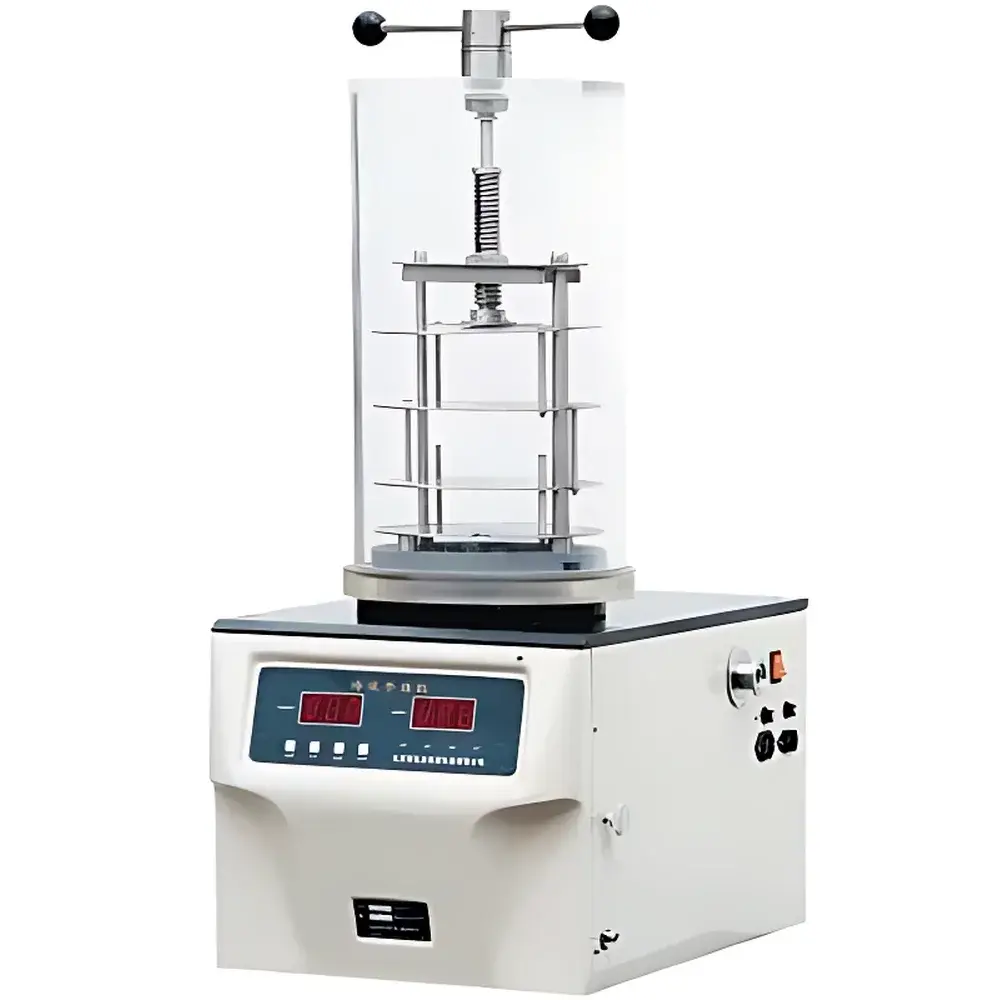
FD-1B-50 / LGJ-12 Benchtop Vacuum Stoppering Freeze Dryer
| Origin | Shanghai, China |
|---|---|
| Manufacturer Type | Authorized Distributor |
| Product Origin | Domestic (PRC) |
| Model | FD-1B-50 / LGJ-12 |
| Condenser Temperature | ≤ −50 °C |
| Ultimate Vacuum | < 20 Pa |
| Freeze-Drying Area | 0.07 m² |
| Shelf Capacity | 700 mL (10 mm layer thickness) or ~155 × 22 mm vials |
| Condenser Dimensions | Φ220 × 130 mm |
| Shelf Diameter | Φ180 mm (3-tier stainless steel) |
| Power Supply | 220 V, 50 Hz, 850 W |
| Unit Dimensions | 380 × 600 × 345 mm |
| Refrigeration System | Imported hermetic compressor |
| Vacuum Interface | Standard KF-25 flange |
| Optional | Sample temperature monitoring |
Overview
The FD-1B-50 / LGJ-12 Benchtop Vacuum Stoppering Freeze Dryer is a laboratory-scale lyophilization system engineered for reproducible, low-temperature dehydration of thermolabile biological and pharmaceutical materials via primary and secondary drying under high vacuum. Based on the principle of sublimation—where ice transitions directly from solid to vapor phase below the triple point of water (0.01 °C, 611 Pa)—this unit maintains condenser temperatures ≤ −50 °C to ensure efficient water vapor capture, while sustaining an ultimate vacuum < 20 Pa to facilitate rapid mass transfer. Designed for R&D laboratories, QC facilities, and academic research groups, it supports aseptic post-drying sealing of vials using a manually operated stoppering mechanism—critical for maintaining sterility and residual moisture control in final dosage forms such as lyophilized antibiotics, monoclonal antibodies, diagnostic reagents, and enzyme preparations.
Key Features
- Benchtop footprint (380 × 600 × 345 mm) optimized for space-constrained lab environments without compromising functional capacity.
- Triple-tier stainless steel shelf assembly (Φ180 mm per shelf) with adjustable inter-shelf spacing—enabling uniform heat transfer and flexible sample loading configurations.
- Large-diameter, corrosion-resistant stainless steel condenser (Φ220 × 130 mm) with smooth internal surface and no embedded cooling coils—minimizing frost accumulation and simplifying defrost cycle maintenance.
- Patented airflow-guiding cylinder design enhances effective condensing surface area and improves vapor path efficiency during primary drying.
- Hermetically sealed, imported refrigeration compressor ensures stable low-temperature performance, low acoustic emission (< 55 dB(A)), and extended service life under continuous operation.
- Transparent acrylic bell jar with integrated safety interlock provides real-time visual monitoring of drying progress while meeting IEC 61010-1 mechanical safety requirements.
- Integrated precision vacuum control valve (imported) allows controlled backfilling with dry nitrogen or inert gas—supporting oxygen-sensitive formulations and enabling residual moisture analysis via headspace GC or Karl Fischer titration.
- Digital vacuum and condenser temperature display with ±0.5 °C and ±1 Pa resolution—calibrated traceable to NIST-traceable standards upon factory commissioning.
Sample Compatibility & Compliance
This freeze dryer accommodates standard 22 mm serum vials (up to 155 units per run at nominal fill depth), as well as bulk samples in stainless steel trays (max. 700 mL per run at 10 mm layer thickness). The manual stoppering function is compatible with rubber stoppers meeting USP particulate matter specifications and ISO 8536-1/2 vial dimensional tolerances. All wetted surfaces are electropolished 316L stainless steel, compliant with FDA 21 CFR Part 11–ready documentation workflows when paired with validated data logging software. The system meets essential requirements of ISO 22000 (food), ISO 13485 (medical devices), and EU GMP Annex 1 for aseptic processing support—particularly during formulation development and stability study execution under ICH Q5C conditions.
Software & Data Management
While the base model features analog-digital hybrid instrumentation, optional USB-connected data loggers enable time-stamped recording of chamber pressure, condenser temperature, and shelf temperature (with external probe). Exported CSV files conform to ALCOA+ principles—ensuring Attributable, Legible, Contemporaneous, Original, Accurate, Complete, Consistent, Enduring, and Available records for regulatory audits. When integrated with third-party LIMS or ELN platforms, the system supports 21 CFR Part 11-compliant electronic signatures, audit trails, and role-based access control—fully aligning with GLP and cGMP documentation expectations for clinical trial material manufacturing and biologics characterization.
Applications
- Stabilization of monoclonal antibodies, recombinant proteins, and viral vectors prior to long-term storage or transport.
- Preparation of reference standards and certified reference materials (CRMs) for analytical method validation (e.g., HPLC, LC-MS).
- Lyophilization of cell culture supernatants, bacterial lysates, and tissue homogenates for downstream omics analysis.
- Development of excipient screening matrices under Design of Experiments (DoE) protocols per ICH Q5E guidelines.
- Routine dehydration of calibration standards in environmental and food testing laboratories—ensuring matrix integrity and analyte recovery consistency across batches.
- Process simulation for scale-up studies: operational parameters (shelf ramp rates, hold times, vacuum ramps) map directly to pilot- and production-scale freeze dryers using the same thermodynamic modeling framework (e.g., SMART™ or LyoTrack™).
FAQ
What types of vials are compatible with the manual stoppering mechanism?
Standard 22 mm diameter serum vials with crimp-sealed butyl rubber stoppers (USP Class VI compliant) are supported. Vial height must not exceed 65 mm to ensure full engagement with the stoppering plunger.
Is pre-freezing required before loading samples into the chamber?
Yes. Samples must be fully frozen at ≤ −40 °C prior to chamber loading to prevent melt-back during primary drying. The condenser may serve as a pre-freeze station only for small-volume aliquots—not for bulk freezing.
Can the system operate continuously for extended stability studies?
The unit is rated for unattended 72-hour cycles under nominal load (≤ 500 mL). For multi-week studies, periodic manual defrosting and vacuum pump oil replacement per manufacturer schedule are required.
Does the FD-1B-50 meet ISO 5 or Class A cleanroom compatibility requirements?
The unit itself is not classified as cleanroom-compatible equipment; however, it may be installed in ISO 5/Class A environments when housed within a laminar flow hood or isolator, provided all external interfaces (electrical, vacuum, gas lines) are sealed per ISO 14644-1 Annex B.
Is remote monitoring or Ethernet connectivity available?
Not natively. Remote supervision requires integration with external industrial IoT gateways supporting Modbus RTU over RS-485—configured per customer-specific network security policy and validated per IEC 62443-3-3.



