Chu Ding Technology JA3003 Precision Analytical Balance
| Key | Capacity: 300 g |
|---|---|
| Readability | 1 mg |
| Repeatability | ≤1 mg |
| Linearity | ±2 mg |
| Pan Diameter | Φ110 mm |
| Draft Shield Dimensions | 198 × 225 × 240 mm |
| Overall Dimensions | 212 × 330 × 323 mm |
| Power Options | AC adapter or 9 V DC battery |
| Interface | RS232 |
| Display | Backlit LCD |
| Sensor Type | Electromagnetic force compensation (EMFC) |
| Environmental Compensation | Dynamic temperature compensation |
| Weighing Units | g, oz, ct, pcs, etc. |
Overview
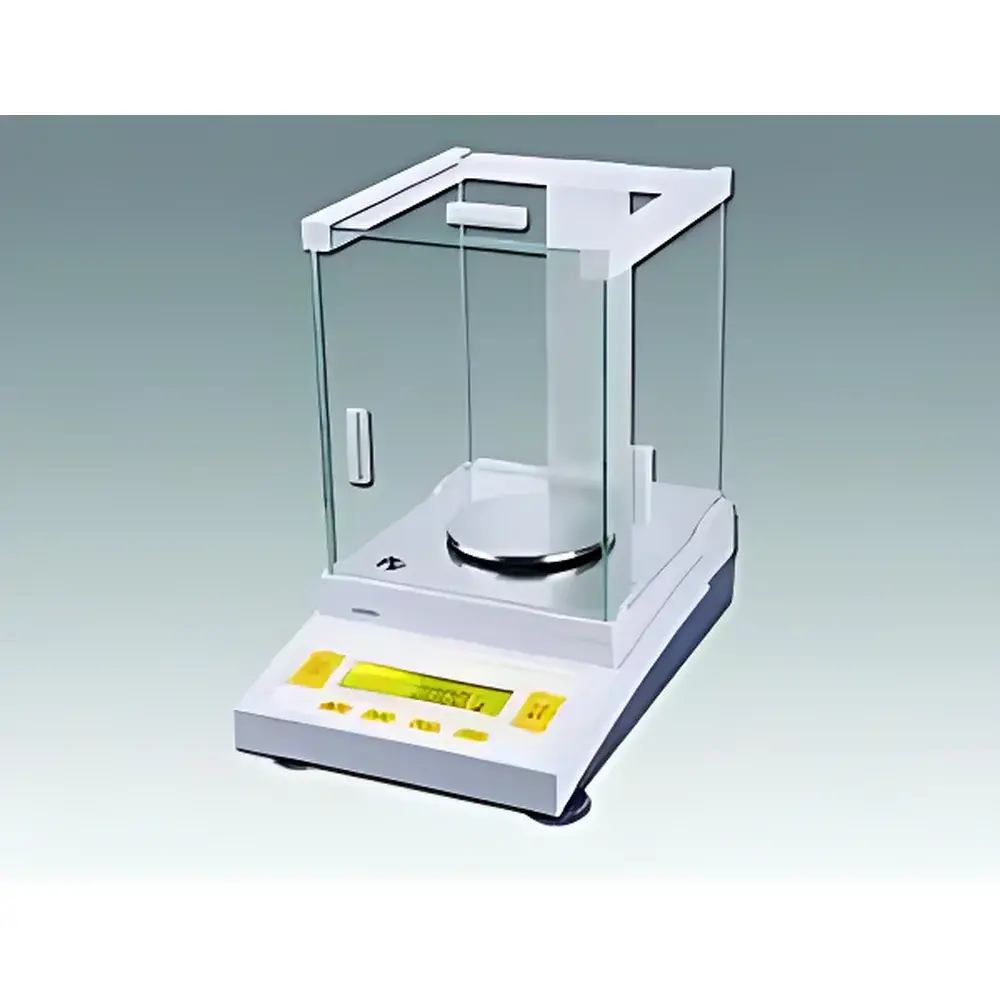
The Chu Ding Technology JA3003 Precision Analytical Balance is a high-stability, microprocessor-controlled laboratory balance engineered for accurate mass determination in research, quality control, and educational environments. Utilizing electromagnetic force compensation (EMFC) sensor technology—distinct from strain-gauge-based systems—the JA3003 eliminates common drift sources such as creep, hysteresis, and nonlinearity associated with resistive transducers. This architecture delivers consistent repeatability of ≤1 mg and linearity within ±2 mg across its full 300 g capacity, meeting the performance expectations of ISO/IEC 17025-compliant laboratories for routine analytical weighing tasks. Its compact footprint (212 × 330 × 323 mm), five-sided glass draft shield (198 × 225 × 240 mm), and Φ110 mm stainless-steel weighing pan support stable operation under variable ambient conditions while maintaining visual accessibility and ergonomic usability.
Key Features
- Electromagnetic force compensation (EMFC) sensor system for superior long-term stability and minimal thermal drift
- Backlit LCD display with adjustable contrast for clear readability under low-light or high-glare conditions
- Integrated draft shield with five transparent glass panels providing full side and top access while minimizing air current interference
- Four-stage shock absorption mechanism and user-adjustable weighing speed to accommodate vibration-prone lab environments
- Dynamic temperature compensation algorithm continuously corrects for thermal effects across the operational range (10–30 °C)
- Built-in RS232 serial interface for direct data transfer to PCs, printers, or LIMS without external adapters
- Internal below-balance hook for density determination and magnetic susceptibility measurements using auxiliary fixtures
- Programmable auto-zero tracking, overload protection, and audible over-limit alert for operator safety and procedural integrity
- Multi-unit conversion (g, oz, ct, dwt, grain, pcs) and advanced functions including percent weighing, formulation, and piece counting
Sample Compatibility & Compliance
The JA3003 supports a broad spectrum of sample types—from powdered reagents and small-volume liquid aliquots to solid reference standards and calibration weights—within its 300 g capacity and 1 mg resolution. The stainless-steel pan and chemically resistant housing ensure compatibility with common solvents and mild corrosives encountered in pharmaceutical, chemical, and materials science workflows. While not certified for Class I or II metrological verification per OIML R 76, the balance meets functional requirements outlined in ASTM E1223 (Standard Guide for Use of Analytical Balances) and supports GLP/GMP documentation practices through traceable calibration logs and user-accessible internal calibration routines. Its design facilitates routine verification using NIST-traceable Class M2 or Class F1 weights in accordance with USP and EP 2.1.6 guidelines.
Software & Data Management
Data output via RS232 adheres to standard ASCII protocol with configurable baud rates (up to 9600 bps), enabling seamless integration with third-party laboratory software, electronic notebooks (ELN), and statistical process control (SPC) platforms. Each weighing event can be timestamped and tagged with user ID when connected to compliant host systems. Though the JA3003 does not include embedded audit trail or 21 CFR Part 11-compliant electronic signature functionality, its deterministic output format and error-flagging protocol (e.g., “OVR” for overload, “UNST” for instability) support manual auditability and raw data review per ALCOA+ principles. Internal memory retains up to 99 weighing records for quick recall and verification prior to external export.
Applications
- Quantitative preparation of standard solutions and calibration standards in analytical chemistry labs
- Weighing of active pharmaceutical ingredients (APIs) and excipients during formulation development
- Quality assurance testing of raw materials and finished products in food, cosmetics, and polymer manufacturing
- Teaching fundamental metrology concepts—including uncertainty estimation, calibration hierarchy, and measurement traceability—in university laboratories
- Piece counting for inventory management of uniform components (e.g., tablets, screws, microbeads)
- Density determination of solids using the built-in below-pan suspension hook and auxiliary sinker accessories
FAQ
What is the recommended calibration frequency for the JA3003 in a regulated environment?
Calibration should be performed before each critical weighing session, after relocation, and following any environmental shift exceeding ±2 °C. Daily verification with a check weight is advised per ISO/IEC 17025 clause 6.5.2.
Does the JA3003 support internal calibration with motorized weight deployment?
No—it requires external calibration weights; internal calibration is manual and user-initiated via front-panel command.
Can the balance operate reliably on battery power during short-term field use?
Yes—its 9 V DC battery option provides up to 8 hours of continuous operation at room temperature, with low-battery warning and automatic shutdown to preserve calibration integrity.
Is the RS232 interface compatible with modern Windows/macOS systems without legacy drivers?
Yes—when used with a USB-to-RS232 converter supporting standard CDC ACM protocols, no proprietary drivers are required for basic data streaming.
How does dynamic temperature compensation improve measurement consistency?
It continuously monitors internal sensor temperature and applies real-time correction coefficients derived from factory characterization, reducing drift by up to 60% compared to uncompensated EMFC balances under diurnal lab temperature fluctuations.