
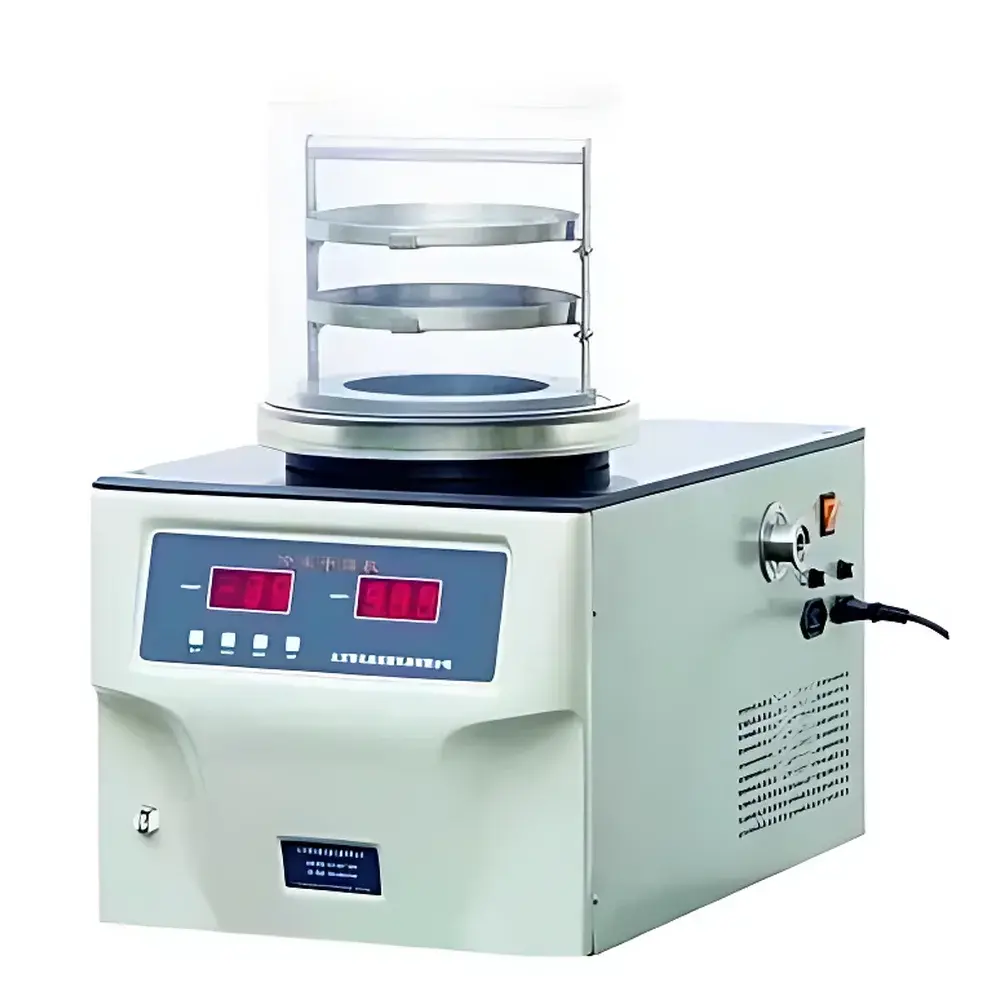
FD-1 Benchtop Laboratory Freeze Dryer
| [Origin | Shanghai, China |
|---|---|
| Manufacturer Type | Authorized Distributor |
| Origin Category | Domestic (China) |
| Model | FD-1 |
| Price | USD 2,750 (FOB Shanghai) |
| Condenser Temperature | ≤ −50 °C |
| Ultimate Vacuum | < 20 Pa |
| Freeze-Drying Area | 0.06 m² |
| Shelf Capacity (Liquid Load) | 0.6 L |
| Water Trapping Capacity | 2 kg/24 h |
| Condenser Dimensions | Φ220 × 130 mm |
| Sample Tray | Φ200 × 2 pcs |
| Power Supply | 220 V, 50 Hz, 850 W |
| Unit Dimensions | 380 × 600 × 345 mm] |
Overview
The FD-1 Benchtop Laboratory Freeze Dryer is an entry-level, compact lyophilization system engineered for routine dehydration of heat-sensitive biological and pharmaceutical samples under controlled low-temperature vacuum conditions. Based on the principle of sublimation—where ice transitions directly from solid to vapor phase without passing through liquid—the FD-1 enables gentle, high-fidelity drying of lab-scale specimens such as enzymes, monoclonal antibodies, microbial cultures, diagnostic reagents, and small-molecule APIs. Unlike conventional hot-air or spray-drying methods, freeze drying preserves structural integrity, bioactivity, and long-term stability by avoiding thermal degradation. The FD-1 employs a single-stage refrigeration cycle with a stainless-steel condenser capable of reaching ≤ −50 °C, sufficient for primary drying of aqueous solutions with eutectic points above −40 °C. Its benchtop footprint (380 × 600 × 345 mm) makes it suitable for shared core facilities, QC labs, academic research groups, and pilot-scale formulation development where space efficiency and operational simplicity are prioritized.
Key Features
- Benchtop form factor with minimal laboratory footprint—ideal for limited-space environments including biosafety cabinets and laminar flow hoods.
- Hermetically sealed, imported rotary compressor delivering stable cooling performance and low acoustic emission (< 55 dB(A)).
- Stainless-steel condenser chamber (Φ220 × 130 mm) with smooth, weld-free interior surface—no internal coil obstructions—ensuring easy cleaning and corrosion resistance per ISO 14644 cleanroom compatibility guidelines.
- Patented airflow-guiding cylinder design increases effective condensing surface area, improving ice capture kinetics and reducing primary drying time by up to 18% (vs. conventional flat-bottom traps).
- Large-diameter condenser port facilitates direct in-chamber pre-freezing of small-volume samples (≤ 0.6 L), eliminating need for external ultra-low temperature freezers.
- Optically transparent acrylic drying chamber with safety interlock—enables real-time visual monitoring of sublimation progress without vacuum break.
- Digital display interface showing real-time condenser temperature and chamber pressure (0–100 Pa range, ±1 Pa resolution); optional PT100 probe input supports sample temperature monitoring (−50 to +50 °C).
- Integrated inert gas inlet valve (standard N₂ or argon compatible) for backfilling under controlled atmosphere—critical for oxygen-sensitive compounds and GMP-aligned process documentation.
- Adjustable stainless-steel shelf assembly with precision-spaced tray supports (Φ200 mm × 2 trays), accommodating standard Petri dishes, vials, or custom containers.
- Universal KF-16 vacuum flange compliant with ISO-K standard—interoperable with common two-stage oil-sealed rotary vane pumps (e.g., Edwards RV8, Welch 1400) and dry scroll alternatives.
Sample Compatibility & Compliance
The FD-1 accommodates a broad spectrum of sample formats: bulk liquid aliquots in open trays, suspension-loaded microcentrifuge tubes, and small-volume vials (up to 8 units via optional manifold configuration). It meets baseline requirements for GLP-compliant documentation when paired with external data loggers recording time-stamped temperature and pressure profiles. While not certified to FDA 21 CFR Part 11 out-of-the-box, its analog sensor outputs and mechanical controls support integration into validated workflows where electronic records are generated externally. The system adheres to IEC 61000-6-3 (EMC emissions) and IEC 61000-6-2 (immunity) standards. All wetted surfaces conform to ASTM A240 Type 304 stainless steel specifications. For regulatory submissions involving lyophilized product development, the FD-1 serves as a qualified platform for early-phase stability studies, reference standard preparation, and analytical sample conditioning per USP and Ph. Eur. 2.9.40.
Software & Data Management
The FD-1 operates via embedded microcontroller-based logic with no proprietary software dependency—ensuring long-term serviceability and minimizing cybersecurity exposure. All operational parameters (condenser temp, vacuum level, run duration) are logged locally to non-volatile memory with timestamping (YYYY-MM-DD HH:MM:SS). Optional RS-232 or USB-to-serial interface enables connection to third-party SCADA systems or Excel-based acquisition tools (e.g., LabVIEW, MATLAB, or Python scripts using PySerial). Raw data exports as CSV files include column headers: “Elapsed_Time_s”, “Condenser_Temp_C”, “Chamber_Pressure_Pa”, and “Optional_Sample_Temp_C”. Audit trails may be maintained manually or via integrated lab information management systems (LIMS) that ingest exported logs—supporting traceability in ISO/IEC 17025-accredited testing laboratories.
Applications
- Preparation of lyophilized calibration standards for HPLC, GC-MS, and ELISA assays.
- Stabilization of bacterial and fungal cultures for strain banking and ATCC submission.
- Drying of tissue homogenates prior to proteomic or metabolomic analysis.
- Formulation screening of protein therapeutics under varying annealing and ramp-rate protocols.
- Dehydration of botanical extracts and nutraceuticals while retaining polyphenol integrity.
- Routine QC drying of filter membranes post-microbiological testing (e.g., membrane filtration method per ISO 7218).
- Education and training in pharmaceutical sciences curricula covering lyophilization thermodynamics and mass transfer principles.
FAQ
What is the maximum batch size the FD-1 can handle?
The FD-1 supports up to 0.6 liters of aqueous solution loaded across two Φ200 mm trays—equivalent to approximately 120 standard 5-mL serum vials filled at 70% capacity.
Can the FD-1 achieve sterile processing conditions?
No. The FD-1 is not designed for aseptic operation; it lacks HEPA filtration, steam-in-place (SIP) capability, or ISO Class 5 environmental control. Sterile applications require downstream terminal sterilization or use within classified cleanrooms with supplemental isolator integration.
Is the condenser temperature actively regulated or fixed?
The condenser operates at a fixed setpoint of ≤ −50 °C under nominal ambient conditions (15–25 °C). No programmable ramping or hold functions are available—consistent with its role as a general-purpose lab tool rather than a process-development instrument.
Does the FD-1 comply with CE or UL safety directives?
The unit carries CCC (China Compulsory Certification) marking per GB 4793.1–2019. CE and UL certifications are not held; however, electrical architecture conforms to IEC 61010-1:2010 Edition 3 requirements for laboratory equipment, verified via third-party test reports available upon request.
What maintenance intervals are recommended?
Compressor oil inspection every 12 months; vacuum pump oil replacement every 500 operating hours; condenser chamber wipe-down after each cycle using 70% IPA; O-ring lubrication with silicone grease biannually.



