
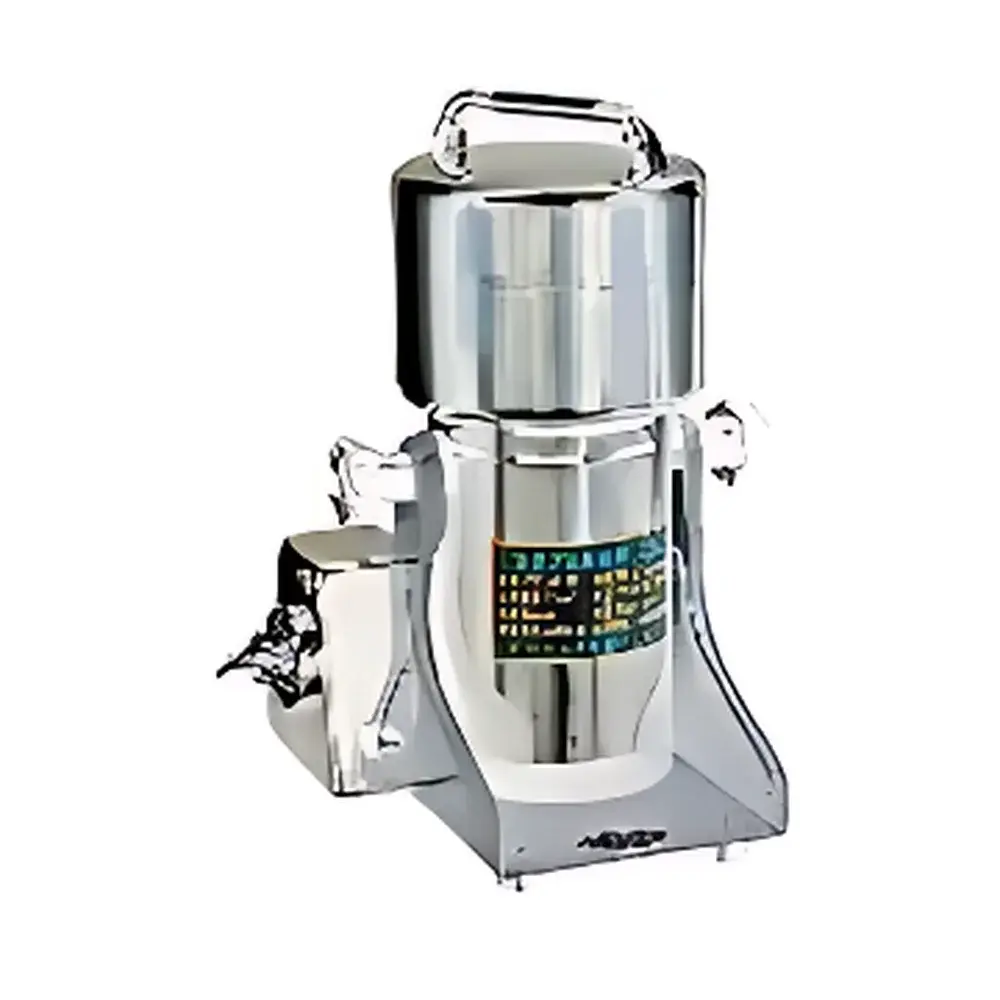
F120 Herbal Powder Grinder
| Origin | Shanghai, China |
|---|---|
| Manufacturer Type | Authorized Distributor |
| Origin Category | Domestic (China) |
| Model | F120 |
| Power | 180 W, 220 V AC |
| Rated Speed | 1400 rpm |
| Dimensions (L×W×H) | 300 × 185 × 300 mm |
| Particle Size Range | 60–200 mesh |
| Price | USD 320 (FOB Shanghai) |
Overview
The F120 Herbal Powder Grinder is a compact, benchtop laboratory grinder engineered for consistent, reproducible size reduction of dried botanical materials—including traditional Chinese herbs, plant roots, leaves, barks, and dried animal tissues—prior to analytical sample preparation. It operates on the principle of high-torque rotary shearing, where a precision-machined rotating blade engages with an adjustable stationary cutting edge to generate controlled mechanical impact and shear forces. This mechanism ensures minimal thermal degradation and low cross-contamination risk—critical for downstream applications such as moisture content determination (per ASTM D4442), protein quantification (Kjeldahl or NIR), lipid extraction (Soxhlet or ASE), and pharmacopeial compliance testing (e.g., Chinese Pharmacopoeia ChP 2020, USP ). Designed for routine QC/QA labs in pharmaceutical R&D, TCM research institutes, agricultural testing centers, and food safety laboratories, the F120 delivers reliable performance under GLP-aligned workflows.
Key Features
- Stainless-steel grinding chamber (AISI 304) resistant to corrosion and organic solvent exposure, ensuring sample integrity and ease of cleaning between batches.
- Adjustable fixed-blade gap mechanism enables fine-tuning of particle size distribution for heterogeneous herbal matrices—especially beneficial for fibrous (e.g., Astragalus membranaceus root) or oily (e.g., Schisandra chinensis fruit) samples.
- Thermally stable 180 W induction motor with overload protection and smooth-start circuitry minimizes torque fluctuation during extended operation.
- Compact footprint (300 × 185 × 300 mm) and lightweight design (≤8.5 kg) facilitate integration into fume hoods, laminar flow cabinets, or shared lab benches without structural reinforcement.
- Interlocked safety cover with microswitch cutoff prevents operation when open—compliant with IEC 61000-6-2 EMC and basic functional safety requirements for Class I laboratory equipment.
Sample Compatibility & Compliance
The F120 accommodates dry, brittle, and moderately fibrous biological samples with moisture content ≤12% w/w. Verified use cases include powdered Angelica sinensis (Dang Gui), processed Rehmannia glutinosa (Shu Di Huang), crushed Glycyrrhiza uralensis (Gan Cao), and comminuted deer antler velvet. It is not intended for wet, sticky, or thermolabile substances (e.g., fresh rhizomes, essential oil-rich herbs, or freeze-dried proteins). While not certified to ISO/IEC 17025 or FDA 21 CFR Part 11 out-of-the-box, its mechanical design supports traceable sample handling when paired with documented SOPs, batch logs, and operator training records—meeting baseline requirements for GMP Annex 11 and ChP General Chapter 9101 (Laboratory Quality Management System).
Software & Data Management
The F120 is a manually operated, non-programmable instrument with no embedded software or digital interface. All operational parameters—including run time, blade gap setting, and sample mass—are recorded externally in laboratory notebooks or LIMS-integrated electronic batch records. For audit readiness, users are advised to maintain calibration logs for rotational speed verification (using handheld tachometer, traceable to NIM, China), and to perform periodic visual inspection of blade wear per manufacturer-recommended maintenance schedule (every 200 operating hours or quarterly, whichever occurs first).
Applications
- Preparation of homogenized herbal powders for quantitative HPLC analysis of active markers (e.g., paeoniflorin in Paeonia lactiflora, berberine in Coptis chinensis).
- Routine grinding of cereal grains (wheat, rice, soybean) prior to near-infrared (NIR) spectroscopic determination of moisture, protein, and oil content per AOAC 991.22 and ISO 712.
- Size reduction of mineral-based TCM adjuvants (e.g., gypsum fibrosum, talc) for XRD phase identification and elemental mapping via SEM-EDS.
- Fragmentation of dried animal-derived materials (e.g., cuttlefish bone, deer antler) for calcium/phosphorus ratio analysis by ICP-OES following EPA Method 3050B digestion.
FAQ
Is the F120 suitable for cryogenic grinding?
No. The unit lacks liquid nitrogen ports or insulated chambers and is rated for ambient temperature operation only (10–35°C). Cryogenic grinding requires dedicated planetary ball mills or mortar grinders with LN₂ feed systems.
Can it process samples containing volatile oils?
Not recommended. High-speed shearing may cause localized heating and volatilization loss of monoterpenes or sesquiterpenes. For such samples, consider low-speed mortar grinding at 4°C or lyophilized pre-treatment.
What maintenance is required for long-term accuracy?
Replace rotating blades every 500 hours of cumulative use; inspect stationary blade alignment quarterly using feeler gauges; clean chamber with ethanol and lint-free wipes after each batch to prevent residue buildup.
Does the device meet CE or UL certification standards?
It carries CCC (China Compulsory Certification) and conforms to GB 4706.1-2005 (Household and Similar Electrical Appliances Safety). CE/UL marking is not applicable, as it is classified as a non-medical, non-hazardous-location laboratory tool under current EU and US regulatory frameworks.



