
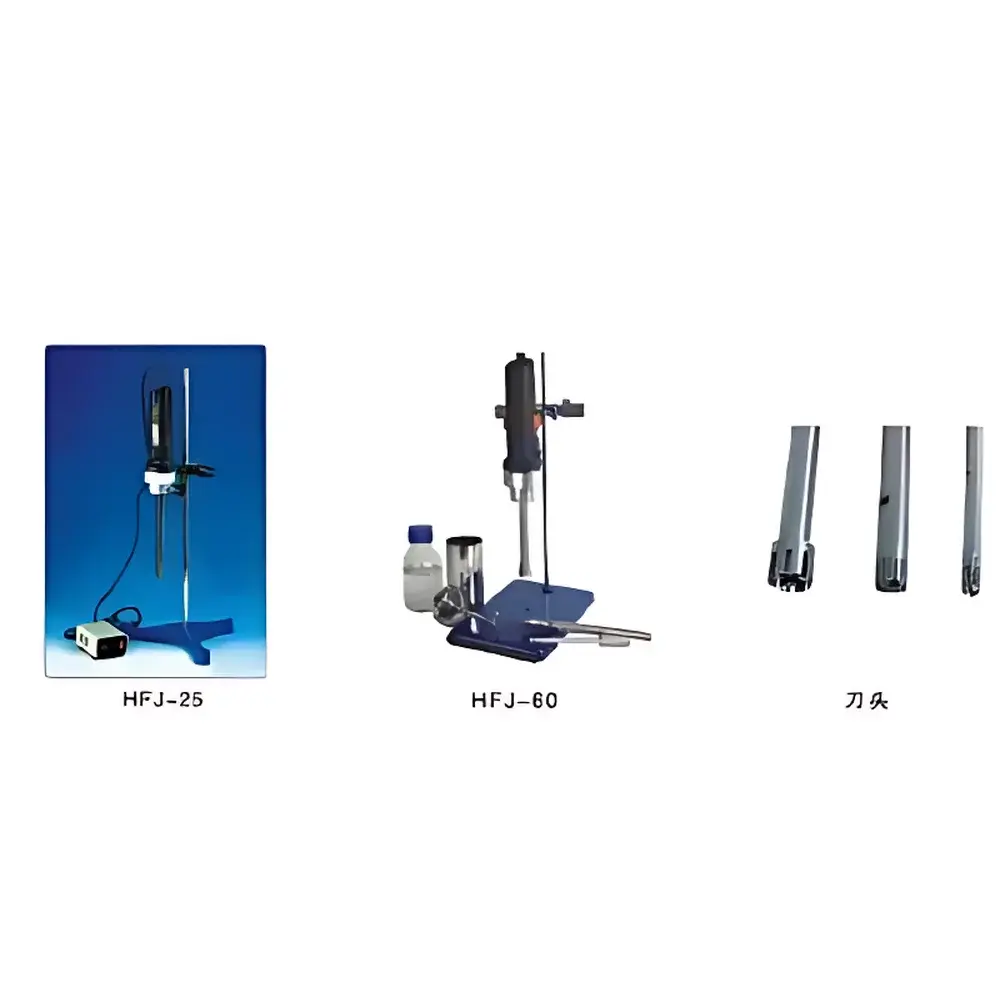
HFJ-60 Benchtop High-Shear Inline Homogenizer
| Origin | Shanghai, China |
|---|---|
| Manufacturer Type | Authorized Distributor |
| Origin Category | Domestic (PRC) |
| Model | HFJ-60 |
| Price | USD 1,200 (FOB Shanghai) |
| Max. Processing Volume | 6,000 mL (water reference) |
| Drive Speed | 31,000 rpm |
| Probe Tip Diameter | 60 mm (sealed rotor-stator head) |
| Motor Power | 500 W |
| Wetted Materials | ASTM F899 Grade 316 Stainless Steel |
| Connection Interface | Quick-lock bayonet coupling |
Overview
The HFJ-60 Benchtop High-Shear Inline Homogenizer is an engineered solution for controlled mechanical disruption of biological and soft-material samples in laboratory-scale R&D and quality control environments. Operating on the principle of high-speed rotor-stator shear, the device generates intense hydrodynamic cavitation and turbulent flow within the sample stream, enabling efficient cell lysis, emulsification, dispersion, and particle size reduction. Unlike ultrasonic or bead-based systems, the HFJ-60 delivers consistent energy input via direct mechanical shearing—making it particularly suited for heat-sensitive biomolecules, viscous suspensions, and heterogeneous tissue matrices where thermal degradation or cross-contamination must be minimized. Its sealed probe design ensures containment during operation, supporting GLP-compliant workflows and reducing aerosol generation in biosafety-conscious settings.
Key Features
- High-performance 500 W brushless motor delivering stable 31,000 rpm at full load, with electronic speed regulation across the operational range.
- Interchangeable sealed rotor-stator probe (60 mm tip diameter) fabricated entirely from ASTM F899-certified 316 stainless steel—resistant to corrosion from organic solvents, mild acids, and saline buffers.
- Optimized fluid-dynamic geometry: rotor and stator feature precision-machined, angled cutting edges that enhance laminar-to-turbulent transition and maximize localized shear stress distribution.
- Quick-lock bayonet coupling enables tool-free probe attachment/detachment in under 5 seconds—facilitating rapid cleaning, sterilization (autoclavable up to 134°C/273°F), and method transfer between sample types.
- Benchtop footprint (280 × 220 × 450 mm) with integrated anti-slip base and ergonomic handle; compliant with IEC 61000-6-3 (EMC) and IEC 61000-6-2 (immunity) standards.
Sample Compatibility & Compliance
The HFJ-60 accommodates a broad spectrum of sample matrices—including animal soft tissues (liver, spleen, muscle), fibrous plant material (roots, stems, leaves), microbial pellets, and low-viscosity emulsions (e.g., oil-in-water formulations). It is routinely employed in protocols aligned with ISO 11290-2 (Listeria detection), AOAC 990.11 (microbial homogenization), and USP sterility testing preparation. All wetted surfaces meet FDA 21 CFR Part 11 requirements for material traceability and surface finish (Ra ≤ 0.8 µm). The unit supports validation documentation packages—including IQ/OQ protocols—and integrates with standard lab SOPs for GMP-aligned bioprocessing labs.
Software & Data Management
While the HFJ-60 operates as a stand-alone analog-controlled instrument (no embedded microprocessor), its mechanical repeatability enables full integration into validated digital workflows. Users may log operating parameters—including duration, speed setting, and probe type—via LIMS or ELN platforms using standardized metadata fields (e.g., “Homogenization_Cycle_Time_s”, “Rotor_Stator_ID”). Optional external RPM monitoring modules (0–35,000 rpm range, ±1% accuracy) provide audit-ready speed verification compatible with 21 CFR Part 11 electronic signature requirements when paired with time-stamped acquisition software.
Applications
- Pre-analytical sample preparation for genomic DNA extraction from mammalian tissues and plant biomass.
- Homogenization of clinical specimens (e.g., stool, biopsy cores) prior to PCR-based pathogen detection.
- Formulation development in food science: stabilization of nutraceutical emulsions, dairy alternatives, and functional beverage suspensions.
- Cell disruption in upstream bioprocessing for recombinant protein release from E. coli or yeast lysates (complementary to high-pressure homogenization).
- Routine QC testing in pharmaceutical manufacturing—e.g., uniformity of suspension dosage forms per USP .
FAQ
Is the HFJ-60 suitable for sterile processing?
Yes—the entire probe assembly is autoclavable at 134°C for 15 minutes. All seals are silicone-free and rated for repeated sterilization cycles without dimensional drift.
Can it process viscous samples above 5,000 cP?
It is optimized for viscosities ≤ 2,000 cP. For higher-viscosity materials, pre-dilution or stepwise processing with intermediate cooling is recommended to maintain thermal stability.
What maintenance intervals are specified for the rotor-stator assembly?
Under standard use (≤ 2 hrs/day), visual inspection and passivation cleaning every 200 operating hours is advised; full replacement is recommended after 1,000 cumulative hours or upon measurable edge wear (>5 µm deviation per ISO 4287 profilometry).
Does the unit comply with electrical safety standards for EU laboratories?
Yes—it carries CE marking per EN 61010-1:2019 and meets RoHS 3 Directive (EU 2015/863) for hazardous substance restrictions.
Is technical support available for method development?
Authorized distributors provide application notes, protocol templates, and parameter optimization guides aligned with common regulatory frameworks (ISO, USP, ASTM). Remote troubleshooting and on-site validation assistance are available under extended service agreements.



