
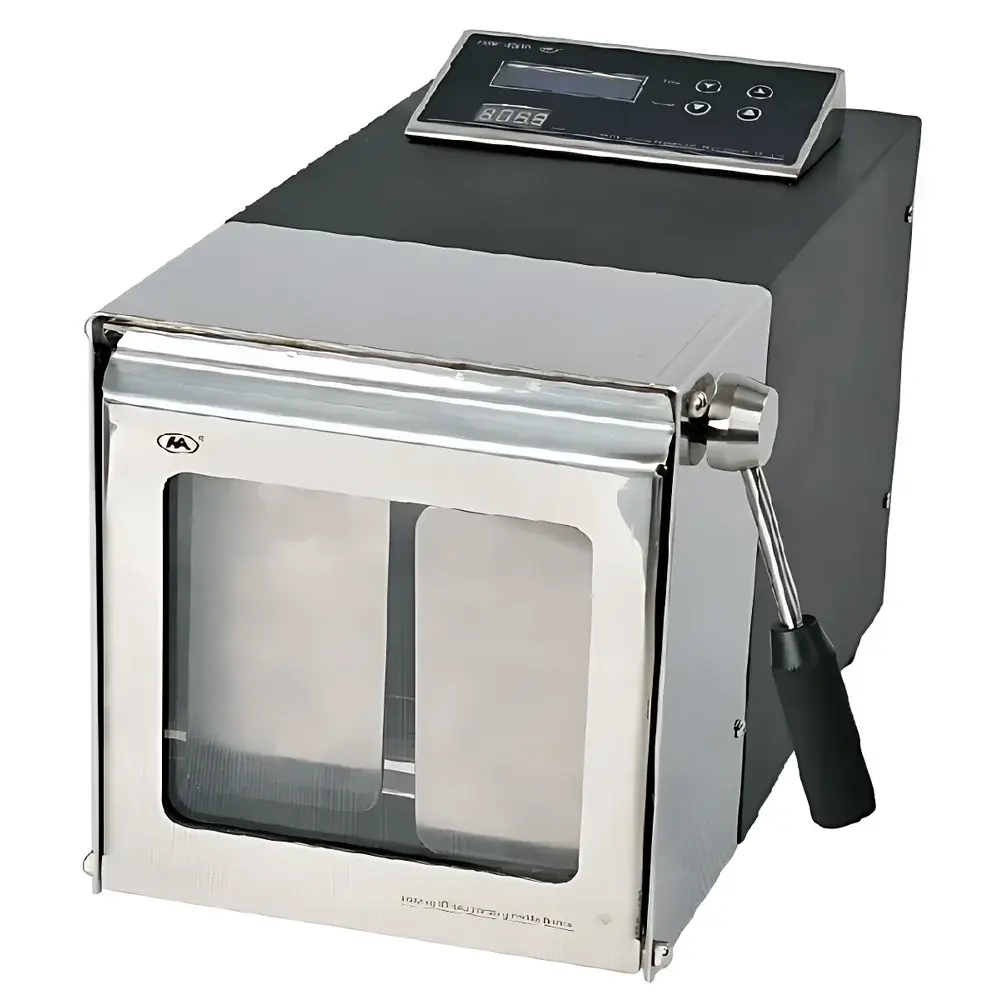
Chu Ding Technology HBM-400B Adjustable-Plate Pulsed-Action Homogenizer
| Brand | Chu Ding Technology |
|---|---|
| Origin | Shanghai, China |
| Manufacturer Type | Authorized Distributor |
| Product Category | Domestic |
| Model | HBM-400B |
| Instrument Type | Pulsed-Action (Stomacher-Type) |
| Dimensions (W×D×H) | 450 × 270 × 290 mm |
| Sample Volume Range | 30–400 mL |
| Time Settings | 10, 30, 60, 90, 120, 180, 600 s or Continuous Mode (8 presets) |
| Pulse Frequency | 6–9 pulses/s (customizable 3–12 pulses/s) |
| Power | 200 W |
| Voltage/Frequency | 220 V / 50 Hz |
| Net Weight | 16.5 kg |
| Sterile Bag Size | 30 × 17 cm |
Overview
The Chu Ding Technology HBM-400B Adjustable-Plate Pulsed-Action Homogenizer is a precision-engineered laboratory instrument designed for the mechanical disruption and homogenization of solid and semi-solid biological, food, and environmental samples using controlled percussive force. Operating on the stomacher principle—where sample-containing sterile filter bags are subjected to repetitive, bidirectional impact between two parallel plates—the HBM-400B delivers reproducible, low-shear homogenization that preserves microbial viability while ensuring maximal release of microorganisms from food matrices, soil aggregates, tissue fragments, or biofilm-laden surfaces. Its adjustable plate gap mechanism allows precise optimization of mechanical energy transfer across varying sample viscosities and particulate loads, making it especially suitable for standardized microbiological testing workflows compliant with ISO 6887-1, FDA BAM Chapter 3, and AOAC Official Method 990.12.
Key Features
- Digitally controlled pulse timing with eight discrete preset durations (10–600 s) plus continuous mode for flexible method development and SOP adherence.
- Adjustable inter-plate clearance with integrated digital gap indicator—enabling fine-tuned optimization for low-volume (30 mL) or high-volume (400 mL) samples without hardware recalibration.
- Variable pulse frequency (6–9 Hz standard; optional 3–12 Hz range) ensures compatibility with delicate samples (e.g., probiotic cultures) and resilient matrices (e.g., raw meat, leafy greens).
- Full-access front door with transparent polycarbonate viewport permits real-time monitoring of bag integrity and homogenization progress without interrupting operation.
- Integrated spill containment tray captures minor bag leakage, minimizing cross-contamination risk and simplifying decontamination protocols.
- Automatic Hall-effect safety cutoff halts pulsation immediately upon door opening—meeting IEC 61000-6-2 EMC and EN 61000-6-4 functional safety requirements for laboratory equipment.
- Non-contact processing architecture: no internal wetted parts; only single-use, gamma-irradiated sterile filter bags (30 × 17 cm) interface with the sample—eliminating carryover and reducing cleaning validation burden.
- Ergonomic design with low acoustic emission (<65 dB(A)) and vibration-damped base supports placement in shared lab environments and laminar flow hoods.
Sample Compatibility & Compliance
The HBM-400B accommodates a broad spectrum of sample types—including fresh produce, dairy products, seafood, poultry carcass rinses, environmental swabs, and soil suspensions—within its 30–400 mL operational range. All processing occurs exclusively within certified sterile, low-binding polyethylene filter bags with 80 µm pore-rated mesh, ensuring retention of target microorganisms while permitting efficient elution into downstream plating or molecular extraction buffers. The system supports GLP-compliant documentation when paired with validated electronic logbooks and meets essential requirements for ISO/IEC 17025-accredited microbiology laboratories. It is routinely deployed in accordance with national food safety standards (GB 4789 series), EU Regulation (EC) No 2073/2005, and USP Microbiological Examination of Nonsterile Products.
Software & Data Management
While the HBM-400B operates via an embedded digital control panel (no PC connectivity), its parameter lockout function enables secure method storage for up to three user-defined protocols—ensuring consistent execution across shifts and operators. Time and pulse settings are retained during power cycling, and all operational events (start/stop timestamps, selected duration, pulse count) are logged internally with non-volatile memory. For audit readiness, users may export logs via optional RS-232 interface (available on request) to integrate with LIMS platforms supporting ASTM E1482 or FDA 21 CFR Part 11-compliant electronic records—provided supplementary signature and audit-trail modules are implemented at the host system level.
Applications
This homogenizer is extensively utilized in food safety laboratories for pathogen enrichment preparation (e.g., Salmonella, Listeria monocytogenes, E. coli O157:H7), pesticide residue extraction support, and mycotoxin sample dispersion prior to immunoaffinity cleanup. It is also applied in academic research for microbial community profiling (16S rRNA sequencing input prep), environmental monitoring of water and sediment microbiota, and QC/QA workflows in contract testing labs serving ISO 22000-certified manufacturers. Its robustness and repeatability make it a preferred choice for proficiency testing schemes administered by FAPAS and NORDFOD.
FAQ
What sterile bag specifications are compatible with the HBM-400B?
Standardized 30 × 17 cm polyethylene filter bags with 80 µm mesh are recommended; alternative sizes require mechanical verification of plate coverage and gap uniformity.
Can the HBM-400B be validated for use in GMP-regulated environments?
Yes—when operated with documented IQ/OQ protocols, calibrated pulse counters, and traceable bag lots, it satisfies foundational equipment qualification requirements per Annex 15 of the EU GMP Guide.
Is maintenance required beyond routine cleaning of the chamber and plates?
No scheduled preventive maintenance is specified; however, periodic inspection of the Hall sensor alignment and plate surface flatness is advised every 6 months under heavy-use conditions.
Does the adjustable plate mechanism affect reproducibility between runs?
No—digital gap readout and mechanical stop limits ensure ±0.1 mm positional repeatability; inter-run CVs for CFU recovery remain ≤8% when tested per ISO 13356.
How does the HBM-400B compare to rotary-blade homogenizers for microbial recovery?
Pulsed-action homogenization minimizes thermal and shear-induced cell lysis, yielding higher viable counts from stressed or fragile organisms—particularly relevant for regulatory compliance testing where recovery efficiency directly impacts pass/fail determinations.



