
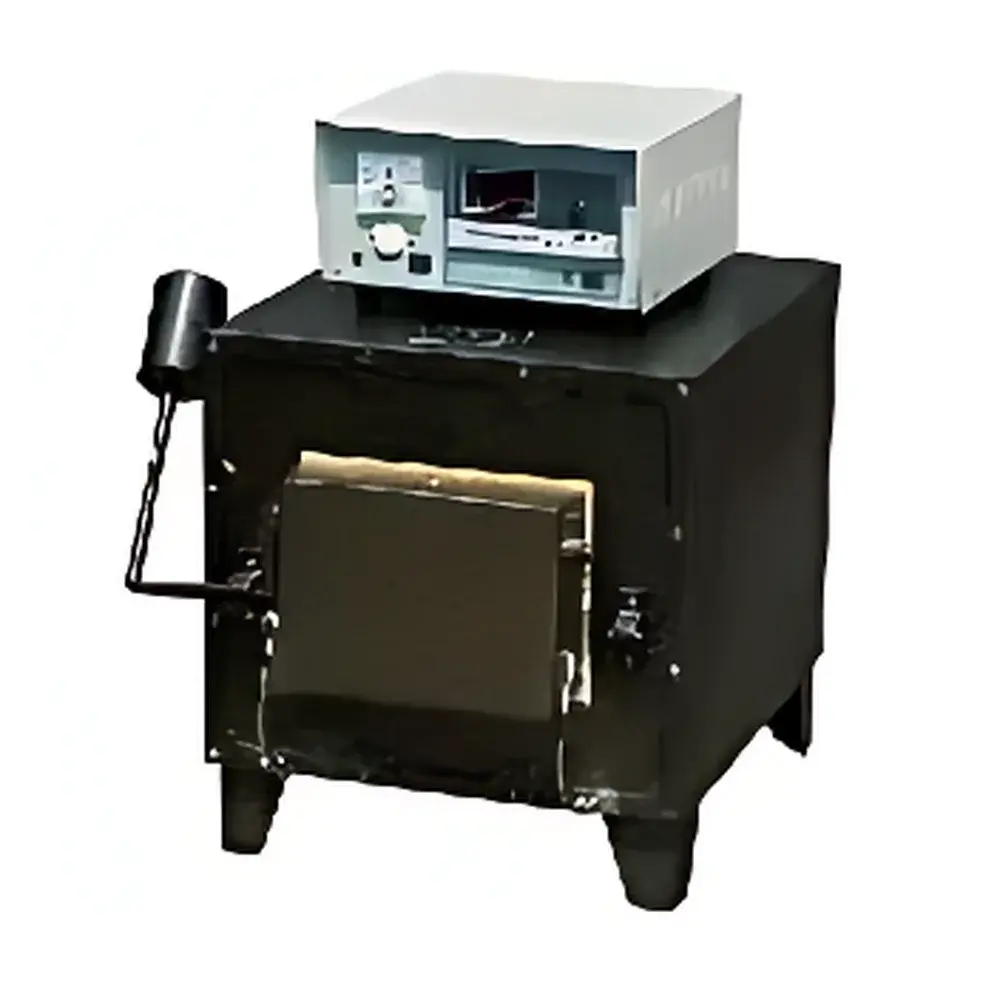
SX-10-12 High-Temperature Box-Type Resistance Furnace (Muffle Furnace)
| Origin | Shanghai, China |
|---|---|
| Manufacturer Type | Authorized Distributor |
| Country of Origin | PRC |
| Model | SX-10-12 |
| Rated Temperature | 1200 °C |
| Power Supply | 380 V AC, 10 kW |
| Internal Chamber Dimensions | 400 × 250 × 160 mm (W × D × H) |
| Heating Element | Kanthal A1 or Equivalent High-Temp Alloy Wire |
| Insulation | Refractory Ceramic Fiber + Firebrick Lining |
| Compliance | Meets General Requirements of GB/T 10066.1–2004 & ASTM E1142–22 for Laboratory Furnaces |
Overview
The SX-10-12 High-Temperature Box-Type Resistance Furnace is a robust, front-loading muffle furnace engineered for precise, repeatable thermal processing in laboratory and light industrial environments. Operating on the principle of resistive Joule heating, it employs high-stability alloy heating elements embedded within a thermally insulated chamber to deliver uniform temperature distribution across its 400 × 250 × 160 mm working volume. Designed for continuous operation up to 1200 °C, the furnace utilizes a multi-layer insulation architecture—comprising low-conductivity ceramic fiber modules and dense refractory brick lining—to minimize thermal loss and ensure stable setpoint maintenance with typical deviation ≤ ±5 °C at maximum rated temperature. Its rigid steel enclosure, finished with electrostatic epoxy coating, provides mechanical durability and corrosion resistance under routine lab conditions. The furnace complies with fundamental safety and performance benchmarks outlined in GB/T 10066.1–2004 (General Requirements for Electric Resistance Furnaces) and aligns with thermal stability expectations defined in ASTM E1142–22 (Standard Guide for Selection and Use of Laboratory Furnaces).
Key Features
- Front-access, counterweighted door mechanism with integrated lever latch—enables smooth, tool-free opening/closing while maintaining tight thermal seal against the furnace mouth
- Modular refractory chamber constructed from high-purity alumina-silica firebrick (Al₂O₃ ≥ 45%) and 1260 °C-rated ceramic fiber blanket for optimized heat retention and reduced warm-up time
- High-reliability Kanthal® A1 or equivalent Fe-Cr-Al alloy heating elements mounted on ceramic insulators, providing extended service life and consistent watt density distribution
- Independent over-temperature protection circuit with fail-safe cut-off (set at 1250 °C), compliant with IEC 61000-6-2 immunity requirements for electromagnetic compatibility
- Standard DIN 43700-compliant terminal block for secure power connection; compatible with external programmable controllers via 0–10 V analog output interface
Sample Compatibility & Compliance
The SX-10-12 accommodates crucibles, boats, and sintering trays made from alumina, silicon carbide, quartz, or stainless steel (up to 304 grade), supporting both inert-atmosphere and air-based thermal treatments. It is routinely employed in applications requiring adherence to ISO/IEC 17025-accredited testing protocols—including ash content determination (AOAC 942.05), loss-on-ignition (LOI) analysis per ASTM C114, and pre-treatment of catalyst supports prior to BET surface area measurement. While not intrinsically rated for Class I Div 1 hazardous locations, the unit meets general-purpose electrical safety standards per GB 4706.1–2005 (equivalent to IEC 60335-1). For GLP/GMP-regulated workflows, optional data logging integration enables audit-ready temperature traceability.
Software & Data Management
The furnace operates with a standard digital PID temperature controller featuring dual-display (setpoint/actual), ramp-soak programming (up to 8 segments), and manual power adjustment. Optional RS485 Modbus RTU interface allows integration into centralized LabVIEW™, MATLAB®, or SCADA-based monitoring systems. When paired with certified third-party data loggers (e.g., Omega OM-DAQPRO-5300), full temperature history—including timestamps, deviations, and alarm events—is recorded in CSV format, satisfying basic FDA 21 CFR Part 11 requirements for electronic records when used with appropriate user access controls and audit trail configuration.
Applications
- Thermal treatment of metallurgical samples: annealing, tempering, and stress-relief of small steel components (≤500 g)
- Inorganic residue analysis: gravimetric determination of ash in food, soil, and polymer matrices per USP and EPA Method 200.7
- Ceramic and powder metallurgy: sintering of ferrites, zirconia compacts, and metal oxide precursors
- Calibration reference: conditioning of thermocouple wires and calibration standards prior to NIST-traceable verification
- Research-grade calcination: decomposition of carbonate precursors (e.g., CaCO₃ → CaO) and synthesis of mixed-metal oxides
FAQ
What is the maximum recommended continuous operating temperature?
The SX-10-12 is rated for continuous operation at 1200 °C. Sustained use above this limit will accelerate element degradation and compromise insulation integrity.
Can this furnace be used under inert gas or vacuum conditions?
It is designed for ambient air operation only. For controlled-atmosphere applications, a dedicated sealed tube furnace with gas inlet/outlet ports and pressure relief is required.
Is the chamber floor load-bearing? What is the maximum safe payload?
The hearth plate supports up to 10 kg distributed load. Concentrated mass exceeding 3 kg should be placed centrally to avoid localized thermal stress on the refractory base.
Does the unit include a thermocouple port or provision for external sensor integration?
Yes—a standard 6 mm diameter thermowell is factory-installed at the rear wall, accommodating Type K or S thermocouples for independent verification of chamber temperature uniformity.
What maintenance intervals are recommended for optimal performance?
Visual inspection of heating elements and insulation integrity every 200 operational hours; cleaning of door gasket contact surfaces monthly; annual calibration of the built-in controller using a NIST-traceable reference thermometer.



