
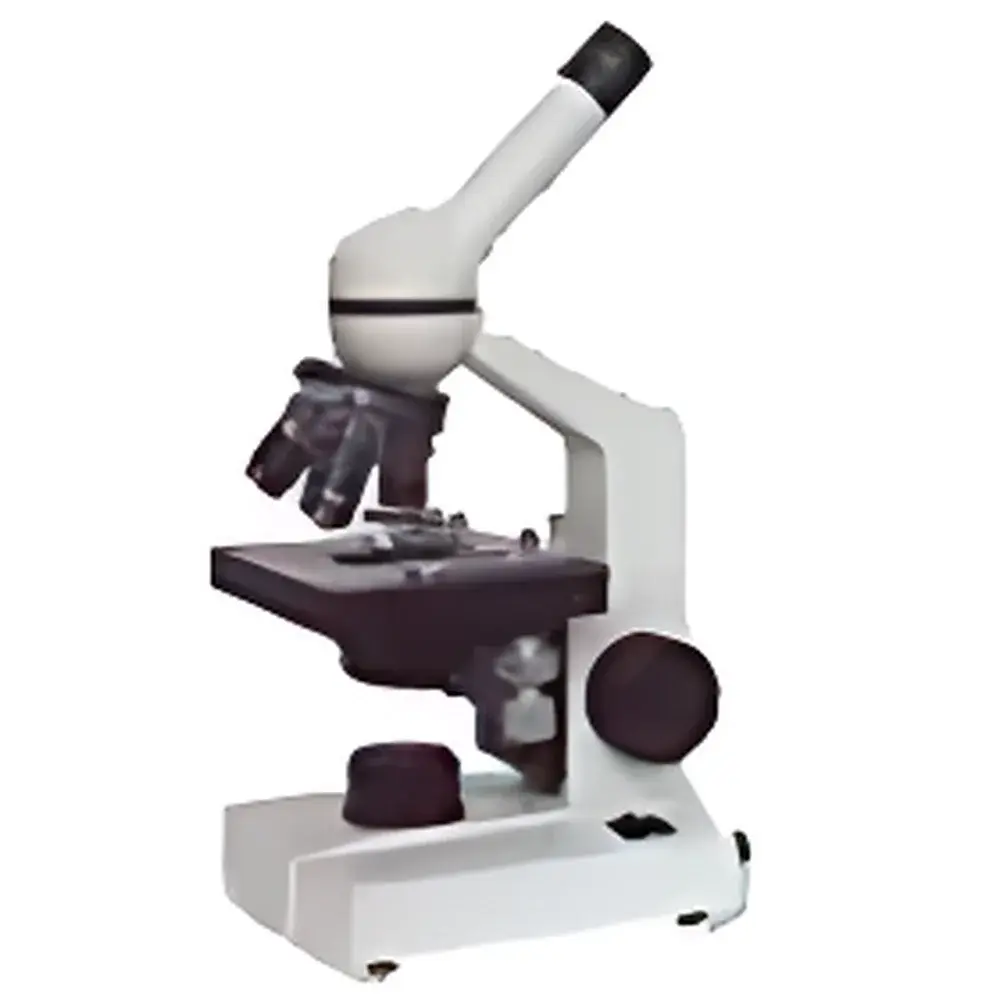
XSP-1CA Monocular Biological Microscope
| Origin | Shanghai, China |
|---|---|
| Manufacturer Type | Distributor |
| Origin Category | Domestic (China) |
| Model | XSP-1CA |
| Price | USD 95 (approx.) |
| Eyepiece | Huygens eyepieces (H5×, H10×, H16×) |
| Objective Lenses | Achromatic objectives (10×, 40×S, 100×S) |
| Condenser | Abbe condenser with adjustable iris diaphragm and color filter holder |
| Illumination | 6 V / 20 W halogen lamp |
| Power Supply | External AC adapter (no built-in battery) |
| Tube Type | Monocular straight tube |
| Focus Mechanism | Coaxial coarse/fine focus knobs with 2 mm coarse travel and 0.002 mm fine adjustment resolution |
Overview
The XSP-1CA Monocular Biological Microscope is a rigorously engineered entry-level upright microscope designed for routine brightfield observation of fixed and stained biological specimens in academic teaching laboratories, clinical training environments, and quality control settings. It operates on the fundamental principle of transmitted light microscopy: illumination passes vertically through a thin, transparent specimen mounted on a glass slide, then traverses the objective lens and eyepiece to produce a magnified, inverted image. Its optical architecture adheres to standard finite-conjugate (160 mm mechanical tube length) design conventions, ensuring compatibility with widely available achromatic objective lenses and standardized accessories. The instrument delivers consistent image contrast and acceptable chromatic correction across its three standard magnification tiers—100× (10× eyepiece × 10× objective), 400×, and 1000× (with oil immersion)—making it suitable for observing cellular morphology, tissue sections, protozoa, and basic microbiological preparations.
Key Features
- Monocular straight-tube optical system optimized for single-user operation and ergonomic seated viewing;
- Three high-quality achromatic objective lenses (10×, 40×S, 100×S) featuring spring-loaded front elements for slide protection and standardized RMS threading (0.796″–36 TPI);
- Huygens-type wide-field eyepieces (H5×, H10×, H16×) with 18 mm field number and rubber eyecups for user comfort and stray-light reduction;
- Abbe condenser (NA 1.25) with integrated iris diaphragm and removable filter holder—enabling precise control of numerical aperture, depth of field, and contrast via Köhler illumination alignment;
- Stable cast-metal base with dual coaxial focus controls: coarse focus (2 mm travel per revolution) and precision fine focus (0.002 mm graduation, 10 µm minimum detectable movement);
- Dedicated 6 V / 20 W halogen illumination system with stable color temperature (~2800 K), dimmable intensity control, and heat-absorbing filter to minimize thermal load on live or thermosensitive samples.
Sample Compatibility & Compliance
The XSP-1CA supports standard 1″ × 3″ (25 × 76 mm) glass microscope slides and #1.5 cover slips (0.17 mm thickness). Its 100×S oil-immersion objective requires Type A cedarwood oil (n = 1.515) for optimal resolution at ~0.4 µm lateral limit (calculated per Abbe diffraction limit). While not certified for ISO 13485 or FDA 510(k) regulatory pathways—given its classification as general-purpose educational instrumentation—the microscope conforms to IEC 61010-1:2010 safety requirements for laboratory electrical equipment. Its mechanical design permits integration into GLP-aligned workflows when paired with documented calibration procedures, logbook entries, and user training records. No CE marking is affixed; however, the power supply complies with IEC 60950-1 safety standards.
Software & Data Management
The XSP-1CA is a standalone optical instrument with no native digital imaging capability or embedded firmware. It is fully compatible with third-party USB CMOS cameras (e.g., 1.3 MP to 5 MP sensors) via standard C-mount (1″, 32 TPI) adapters. When coupled with open-source acquisition platforms such as Micro-Manager or commercial solutions like Ocular Imaging Software (OIS), users can perform time-lapse capture, basic measurement (length, area, particle count), and annotation. All image metadata—including objective magnification, exposure time, and timestamp—is recorded externally. Audit trails and electronic signatures are managed within the host software environment, supporting compliance with institutional documentation policies but not full 21 CFR Part 11 requirements without additional validation.
Applications
- Undergraduate biology and histology lab instruction: identification of plant/animal cell structures, mitotic stages, and connective tissue components;
- Clinical assistant training: peripheral blood smear analysis, urinalysis sediment screening, and basic parasitology;
- Industrial QC in food safety labs: detection of mold hyphae, yeast colonies, and foreign particulates in filtered extracts;
- Environmental education: plankton enumeration in freshwater samples and algal morphology assessment;
- Pharmaceutical raw material inspection: verification of excipient particle uniformity and absence of fibrous contaminants in powdered APIs.
FAQ
Is the XSP-1CA suitable for fluorescence observation?
No—it lacks an epi-illumination path, excitation/emission filter cubes, and a fluorescence-capable objective lens set. It is strictly configured for transmitted brightfield only.
Can immersion oil be used with the 40× objective?
No—only the 100×S objective is designed for oil immersion; using oil with the 40×S may damage lens coatings and degrade image quality.
What is the maximum usable magnification without significant empty magnification?
Approximately 1000× under optimal Köhler illumination and oil immersion; beyond this, resolution does not improve due to inherent limitations of visible-light wavelength and optical aberrations.
Does the microscope include stage micrometer or graticule calibration tools?
No—these are optional accessories; users must procure a 10× eyepiece graticule and stage micrometer separately for quantitative measurement validation.
Is the halogen lamp replaceable by the end user?
Yes—the 6 V / 20 W halogen bulb is accessible via the base compartment and follows G4 bi-pin specifications; replacement requires power disconnection and static-safe handling.





