
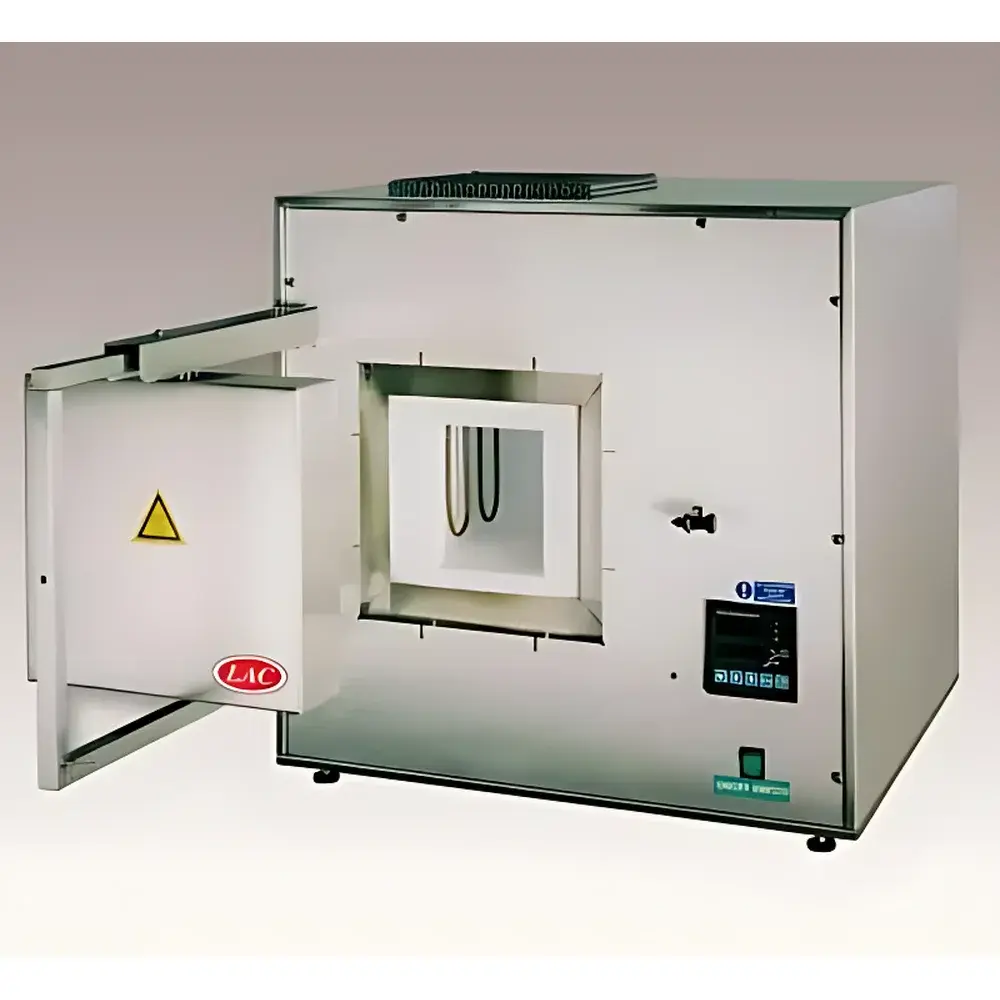
LAC VP-70-17 High-Temperature Muffle Furnace (1700 °C, 70 L Chamber)
| Origin | Czech Republic |
|---|---|
| Manufacturer Type | Authorized Distributor |
| Origin Category | Imported |
| Model | VP-70-17 |
| Voltage | 380 V |
| Power | 14 kW |
| Max Temp | 1700 °C |
| Chamber Volume | 70 L |
| Internal Dimensions | 400 × 300 × 600 mm |
| External Dimensions | 1100 × 1650 × 1070 mm |
| Weight | 350 kg |
| Temperature Control Accuracy | ±1 °C (at steady state) |
| Heating Element | Kanthal Super (Fe–Cr–Al alloy) |
| Thermocouple Type | Type B (Pt–Rh/Pt–Rh), mounted at chamber top |
| Controller | Industrial programmable PID controller with real-time clock, 30 stored programs, up to 15 segments per program |
| Optional | RS-232/RS-485 interface, thermal cycle logging software, graphical temperature recorder, inert gas purge kit |
Overview
The LAC VP-70-17 is a high-precision, industrial-grade muffle furnace engineered for sustained operation at temperatures up to 1700 °C in research laboratories, materials science facilities, and advanced manufacturing QA/QC environments. Designed and manufactured by LAC s.r.o.—a Czech-based ISO 9001:2001 certified producer with over 15 years of specialization in high-temperature thermal equipment—the VP-70-17 employs resistive heating via premium Kanthal Super Fe–Cr–Al alloy wire wound on ceramic mandrels, ensuring long-term stability and minimal drift under thermal cycling. Its muffle architecture isolates the sample chamber from combustion byproducts and external air currents, enabling precise, repeatable heat treatment in controlled atmospheres—including optional inert gas purging (N₂ or Ar). The furnace complies with EN 60519-1 (safety requirements for industrial electroheating equipment) and supports GLP-compliant workflows through traceable temperature logging and programmable thermal profiles.
Key Features
- 70-liter working chamber with optimized internal geometry (400 × 300 × 600 mm) for uniform thermal distribution—validated by ASTM E220 calibration methodology across ≥95% of chamber volume
- Double-layer insulation system comprising high-purity alumina fiber modules (≥1400 °C rated) and low-conductivity ceramic board, reducing surface temperature to <55 °C at ambient conditions and minimizing standby energy loss
- Robust frameless construction reinforced with stainless steel retaining bands—eliminating weld-induced stress points and enhancing structural integrity during repeated thermal expansion cycles
- Integrated safety architecture: door-mounted limit switch de-energizes heating elements upon opening; automatic overtemperature cut-off (OTC) set 50 °C above user-defined max; cooling fan activated post-cycle to accelerate cooldown without compromising insulation lifespan
- Industrial PID controller with real-time clock synchronization, supporting 30 independent thermal programs—each configurable with up to 15 ramp/soak/hold steps, ramp rates from 0.1 to 30 °C/min, and soak tolerances down to ±1 °C
- Type B thermocouple (platinum–rhodium 30/6) permanently installed at chamber ceiling for direct measurement of radiant zone temperature—calibration traceable to NIST standards via optional certificate
Sample Compatibility & Compliance
The VP-70-17 accommodates diverse sample forms including crucibles (alumina, silicon carbide, graphite), sintering boats, ceramic green bodies, metallurgical specimens, dental alloys, and refractory test bars. Its sealed muffle design ensures compatibility with oxidation-sensitive processes such as brazing, sintering of tungsten carbide compacts, ashing of polymer composites, and pre-firing of zirconia dental frameworks. The furnace meets CE marking requirements under the EU Machinery Directive 2006/42/EC and Electromagnetic Compatibility Directive 2014/30/EU. Optional inert gas inlet ports enable operation under ASTM F2628 (controlled-atmosphere sintering) and ISO 2738 (ceramic sintering standard) protocols. All electrical components conform to IEC 61000-6-2/6-4 immunity and emission limits.
Software & Data Management
When equipped with the RS-485 interface module, the VP-70-17 integrates seamlessly into centralized lab automation systems via Modbus RTU protocol. The optional thermal cycle logging software provides FDA 21 CFR Part 11–compliant audit trails—including user login history, parameter change logs, timestamped temperature curves, and electronic signature capability. Graphical recorders generate EN 14683–aligned thermal maps showing spatial deviation across three axial planes. Raw data exports are supported in CSV and XML formats for downstream analysis in MATLAB, Python (NumPy/Pandas), or LIMS platforms. Firmware updates are performed offline via USB port to maintain cybersecurity integrity in regulated environments.
Applications
- High-temperature sintering of advanced ceramics (e.g., Si₃N₄, Al₂O₃, ZrO₂) and hardmetals (WC–Co)
- Thermal gravimetric analysis (TGA) pre-conditioning and residue quantification per ISO 11358
- Dental laboratory processing: casting investment burnout, porcelain firing, and metal alloy annealing
- Materials qualification per ASTM C1171 (refractory testing) and ISO 506 (fire resistance of building materials)
- Research-scale glass melting and homogenization (borosilicate, phosphate, chalcogenide compositions)
- Heat treatment of tool steels and superalloys under controlled oxidizing or inert atmospheres
- Calibration reference furnaces for secondary thermocouple verification per ISO/IEC 17025
FAQ
What is the maximum continuous operating temperature of the VP-70-17?
The furnace is rated for continuous operation at 1700 °C, with a short-term peak tolerance of 1720 °C for ≤30 minutes per cycle.
Does the VP-70-17 support inert gas purging?
Yes—optional gas inlet fittings (ISO-KF 25 or VCR 1/4″) allow connection to regulated N₂ or Ar supply lines; flow rate control and pressure monitoring require external instrumentation.
Can the controller store custom thermal profiles for unattended operation?
Yes—the embedded controller retains 30 user-defined programs with full time/date scheduling; each program supports up to 15 segments with independent ramp rates, soak durations, and hold tolerances.
Is the furnace suitable for GMP-regulated pharmaceutical testing?
When configured with audit-trail-enabled software, calibrated thermocouples, and documented IQ/OQ protocols, it fulfills core requirements for USP , EP 2.6.3, and Annex 15 validation frameworks.
What maintenance intervals are recommended for optimal performance?
Heating element resistance should be verified quarterly; insulation integrity assessed annually via thermal imaging; thermocouple calibration recommended every 6 months or after 200 thermal cycles above 1500 °C.



