
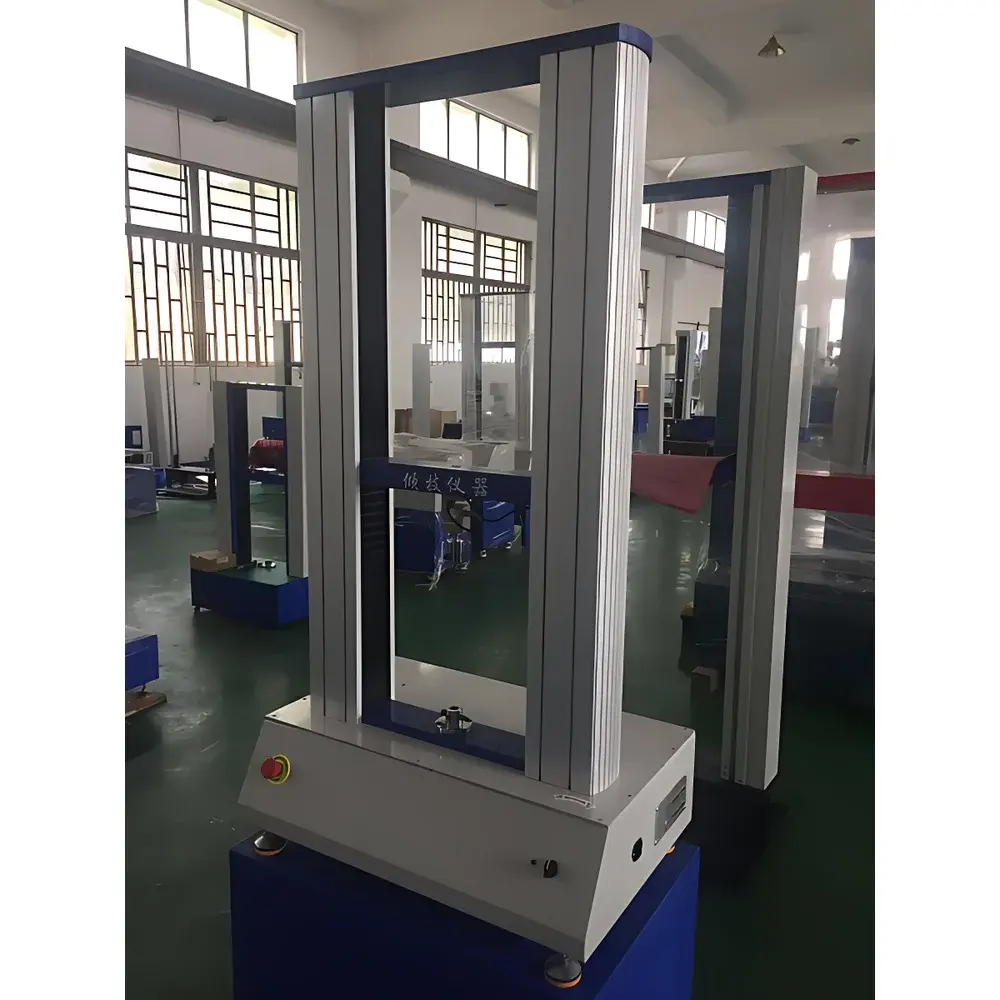
QJ211S Universal Testing Machine for Polymer Materials
| Origin | Shanghai, China |
|---|---|
| Manufacturer Type | Authorized Distributor |
| Origin Category | Domestic (PRC) |
| Model | QJ211S |
| Price | USD 5,000 (FOB Shanghai) |
| Instrument Type | Electromechanical Universal Testing Machine |
| Load Capacity | 30 kN (configurable) |
| Load Cell Accuracy | 0.01% FS |
| Test Accuracy | < ±0.5% |
| Control Interface | Windows-based PC Software |
| Effective Test Width | 420 mm |
| Effective Tensile Stroke | 800 mm |
| Speed Range | 0.001–500 mm/min |
| Speed Accuracy | ±0.5% |
| Displacement Measurement Accuracy | ±0.5% |
| Strain Measurement Accuracy | ±0.5% |
| Safety Features | Electronic stroke limit, emergency stop button, overload auto-shutdown |
| Machine Weight | ~140 kg |
Overview
The QJ211S Universal Testing Machine is an electromechanical materials testing system engineered for precision mechanical characterization of polymeric materials under tension, compression, flexure, peel, puncture, and shear loading conditions. Based on closed-loop servo-controlled actuation and high-fidelity load cell transduction, it operates in accordance with fundamental principles of uniaxial mechanical testing as defined in ASTM D638, ISO 527-1, ISO 604, ISO 178, and ASTM D903. Its modular architecture supports standardized specimen geometries per ISO 37, ASTM D412, and ASTM D882, enabling reproducible determination of tensile strength, elongation at break, Young’s modulus, yield stress, compressive modulus, and bending stiffness. Designed for laboratory-scale R&D, quality control, and incoming material verification, the QJ211S delivers traceable force-displacement data without hydraulic complexity or pneumatic dependency—making it suitable for ISO/IEC 17025-accredited environments where instrument calibration, measurement uncertainty, and audit-ready documentation are mandatory.
Key Features
- Electromechanical drive system with brushless AC servo motor and precision ball-screw transmission, ensuring smooth motion control across the full speed range (0.001–500 mm/min).
- High-resolution 30 kN load cell calibrated to 0.01% full-scale accuracy, compliant with ISO 7500-1 Class 0.5 requirements.
- Real-time dynamic display of force, displacement, strain (with extensometer interface), and time-based curves during test execution.
- Automatic return-to-initial-position upon specimen fracture, eliminating manual repositioning between tests.
- Auto-zeroing and auto-ranging functions triggered at test initiation, reducing operator-induced baseline error.
- Dual-limit protection: programmable electronic stroke limits plus mechanical hard-stop safeguards, aligned with EN ISO 12100 risk assessment criteria.
- Overload safety shutdown activated when applied load exceeds 105% of selected capacity, preventing sensor damage and data corruption.
- Modular fixture compatibility—including wedge-action grips, compression platens, three-point bend fixtures, and peel test jigs—for multi-standard compliance.
Sample Compatibility & Compliance
The QJ211S accommodates standard polymer specimens per ISO 527 (dog-bone, rectangular, and dumbbell shapes), ASTM D638 (Type I–V), ASTM D882 (thin films), and ISO 37 (vulcanized rubber). Specimen widths up to 420 mm and maximum gauge lengths of 800 mm support both rigid thermoplastics (e.g., ABS, PC, PP) and elastomeric compounds (e.g., silicone, TPU, natural rubber). All mechanical measurements adhere to GLP-relevant traceability protocols: raw data files retain timestamped metadata, operator ID, environmental conditions (if logged externally), and calibration certificate references. The system supports generation of PDF reports compliant with ISO 14644-1 cleanroom documentation standards and meets foundational requirements for FDA 21 CFR Part 11 readiness when deployed with validated software and electronic signature modules.
Software & Data Management
Control and analysis are performed via Windows-native software compliant with IEC 62304 Class B medical device software guidelines. The application provides intuitive test method templates aligned with ASTM, ISO, and GB/T standards; customizable parameter sets for multi-step cyclic or creep protocols; and real-time curve overlay for comparative analysis. Raw ASCII (.txt) and Excel-compatible (.csv) data exports include synchronized timestamps, filtered analog inputs, and digital event markers (e.g., yield point, break detection). Audit trails record all user actions—including method edits, calibration events, and report generation—with immutable timestamps. Optional add-ons include DIC (Digital Image Correlation) integration for full-field strain mapping and automated pass/fail logic based on pre-defined specification limits.
Applications
- Tensile property validation of injection-molded polymer components per ISO 527-2 and ASTM D638.
- Compressive behavior analysis of foamed polymers and structural composites (ISO 604).
- Flexural modulus and strength evaluation of thermoset laminates and fiber-reinforced plastics (ISO 178).
- Peel adhesion quantification for pressure-sensitive tapes and laminated packaging films (ASTM D903, ISO 8510-2).
- Puncture resistance testing of medical-grade elastomeric membranes and barrier films (ISO 22313).
- Creep and stress-relaxation profiling under controlled temperature (when integrated with environmental chamber).
- Quality assurance screening for incoming raw materials in automotive, medical device, and packaging manufacturing facilities.
FAQ
What standards does the QJ211S support out-of-the-box?
Preconfigured test methods cover ASTM D638, D882, D903, D412; ISO 527-1, 527-2, 604, 178, 37, and GB/T 1040. Custom method creation is supported via scripting interface.
Is the system compatible with third-party extensometers?
Yes—it features analog and digital (LVDT/TTL) input channels supporting contact and non-contact extensometers meeting ISO 9513 Class 1 or better.
How is calibration traceability maintained?
Load cells ship with NIST-traceable calibration certificates; displacement encoders are verified using laser interferometry. Annual recalibration services include uncertainty budgets per ISO/IEC 17025.
Can test data be exported to LIMS or ERP systems?
Yes—via ODBC-compliant database export, REST API (optional), or direct file transfer to shared network drives with configurable naming conventions and folder structures.
What maintenance is required during routine operation?
Monthly visual inspection of grip surfaces and screw lubrication; biannual verification of encoder linearity and load cell zero drift; annual full-system metrological recalibration recommended.



