
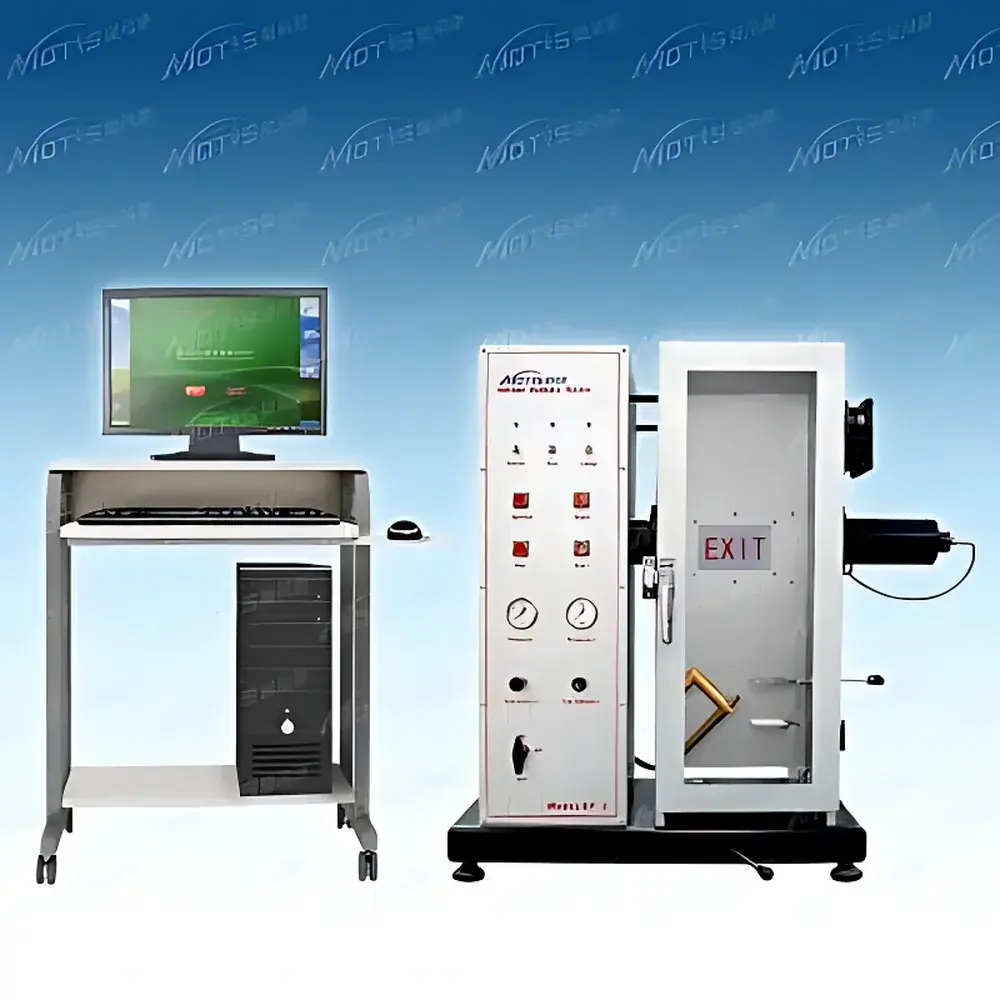
MOTIS XP-2 Smoke Density Chamber for Building Materials
| Brand | MOTIS |
|---|---|
| Origin | Shanghai, China |
| Model | XP-2 |
| Compliance | ASTM D2843 |
| Chamber Coating | PTFE (Teflon®) Interior |
| Light Source | Calibrated Tungsten Filament Lamp |
| Detector | Cosine-Corrected Silicon Photodiode with Visible-Spectrum Bandpass Filter (380–780 nm) |
| Main Burner Pressure | 256 kPa |
| Auxiliary Burner | Integrated for Dripping Combustion Control |
| Data Acquisition Interval | 15 s |
| Output | SDR (Smoke Density Rating) Integral & Time-Resolved Curve |
| Software | ASTM-D2843-Compliant Reporting Suite with Multi-Sample Overlay, Comparative Analysis, and CFR 21 Part 11–Ready Audit Trail |
Overview
The MOTIS XP-2 Smoke Density Chamber is a precision-engineered physical property testing instrument designed specifically for quantifying smoke generation from building materials under controlled flaming combustion conditions. It operates in strict accordance with ASTM D2843, “Standard Test Method for Determining Smoke Density of Materials by the Single-Chamber Furnace Method.” The measurement principle is rooted in the Beer–Lambert law: as smoke particles accumulate in the vertically oriented test chamber during combustion, they attenuate a collimated visible-light beam; the resulting transmittance decay is continuously monitored and mathematically integrated to compute the Smoke Density Rating (SDR)—a dimensionless index representing cumulative optical obscuration over time. Unlike legacy systems developed in the 1970s, the XP-2 integrates modern optoelectronic architecture—including thermally stabilized illumination, cosine-corrected photodetection, and real-time spectral filtering—without compromising metrological traceability to the standard. Its design prioritizes long-term stability, inter-laboratory reproducibility, and compliance-ready data integrity.
Key Features
- PTFE-coated dual-chamber interior ensures exceptional resistance to acidic and halogenated corrosion from pyrolysis byproducts, extending service life and maintaining optical calibration fidelity across thousands of test cycles.
- Integrated “EXIT” signage on chamber base—white text on red background—provides unambiguous visual reference for assessing smoke layer stratification and obscuration onset via the front quartz observation window.
- Calibrated tungsten-filament light source coupled with a silicon photodiode detector featuring factory-applied cosine correction and a bandpass filter (380–780 nm) ensures high-fidelity spectral matching to the CIE photopic luminosity function—critical for human-relevant smoke hazard assessment.
- Dual-burner configuration: primary burner delivers precisely regulated 256 kPa flame impingement on the specimen; auxiliary burner independently ignites dripping or molten residues, enabling full compliance with ASTM D2843’s stipulation for sustained flaming of drips.
- Real-time acquisition at 15-second intervals yields high-resolution transmittance time-series data, directly convertible to SDR curves per ASTM calculation algorithms (integral of [100 − %T] dt).
Sample Compatibility & Compliance
The XP-2 accommodates standard ASTM D2843 specimens: rigid boards (25.4 × 25.4 × 6.4 mm), flexible sheets, foams, and coated substrates mounted on stainless-steel holders. All mechanical, thermal, and optical subsystems are validated against NIST-traceable references. The system supports GLP and GMP environments through configurable user access levels, electronic signatures, and immutable audit trails compliant with FDA 21 CFR Part 11. Full documentation—including IQ/OQ protocols, calibration certificates, and ASTM D2843 verification reports—is supplied with each unit.
Software & Data Management
The embedded Windows-based software provides native ASTM D2843 workflow execution: automatic SDR calculation, real-time transmittance plotting, and post-test curve integration. It enables synchronized analysis of up to three replicate tests—overlaying SDR curves, computing mean ± SD, and performing pass/fail evaluation against specification thresholds (e.g., SDR ≤ 75 for Class A fire-rated materials). Export functions support CSV, PDF, and XML formats; all reports include metadata (operator ID, timestamp, calibration status, environmental logs) and are digitally signed. Audit trail records capture every parameter change, result modification, or report generation event—fully searchable and exportable for regulatory review.
Applications
The XP-2 is deployed in fire safety laboratories, building code certification bodies (e.g., UL, FM Global, CE Notified Bodies), and R&D departments of insulation, cladding, ceiling tile, and cable jacket manufacturers. It supports product development for ASTM E84/UL 723 corridor wall assemblies, EN 13501-1 classification, and ISO 5659-2 correlation studies. Its robustness and repeatability make it suitable for proficiency testing programs and interlaboratory round-robin validation per ISO/IEC 17043.
FAQ
Does the XP-2 meet current ASTM D2843 revision requirements?
Yes—the XP-2 implements all mandatory provisions of ASTM D2843–22, including burner pressure tolerances, chamber geometry, photometric calibration procedures, and SDR integration methodology.
Can the system be integrated into a LIMS environment?
Yes—via standardized OPC UA and HL7-compliant APIs, enabling bidirectional data exchange with laboratory information management systems.
Is PTFE coating maintenance required during routine operation?
No—PTFE provides passive corrosion resistance; no re-coating or surface renewal is needed within the specified 10-year operational lifespan under normal use conditions.
How is photometric calibration verified?
Each unit ships with NIST-traceable neutral density filters and a documented calibration certificate; annual verification is performed using the included calibration kit and software-guided procedure.
What environmental conditions must be maintained during testing?
Ambient temperature: 23 ± 2°C; relative humidity: ≤ 50%; no direct airflow or vibration sources within 1 m of the chamber—per ASTM D2843 Annex A1.



