
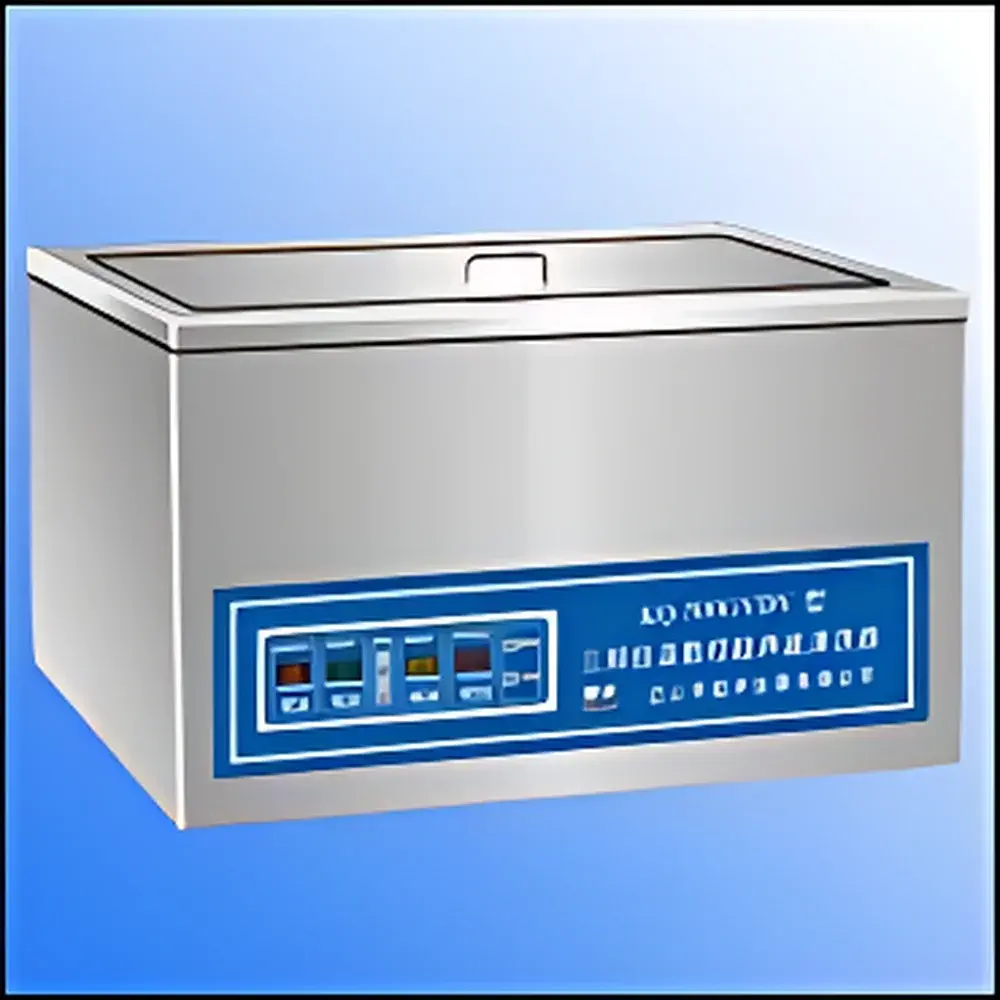
KQ-600GVDV Dual-Frequency Temperature-Controlled Ultrasonic Cleaner with Active Cooling
| Origin | Shanghai, China |
|---|---|
| Manufacturer Type | Authorized Distributor |
| Origin Category | Domestic (PRC) |
| Model | KQ-600GVDV |
| Price | USD 10,900 (FOB Shanghai) |
| Dimensions (L×W×H) | 840×410×400 mm |
| Tank Internal Dimensions (L×W×H) | 500×300×180 mm |
| Tank Capacity | 27 L |
| Ultrasonic Frequencies | 28 kHz & 45 kHz (switchable or simultaneous) |
| Ultrasonic Power Output | 600 W |
| Power Adjustment Range | 40–100% in 1% increments |
| Heating Power | 1000 W |
| Cooling Power | 300 W |
| Temperature Control Range | 0–80 °C (±0.5 °C stability) |
| Timer Range | 1–480 min |
| Transducer Unit Power | 50 W per element |
| Material | 316L stainless steel tank and mesh basket |
| Safety Features | Low-level liquid detection, over-voltage/over-current protection, auto-shutdown on dry-run or temperature excursion |
| Data Logging | Cumulative operating time (up to 999,999 h), frequency switching interval (1–999 s), real-time display of setpoint vs. actual temperature |
Overview
The KQ-600GVDV Dual-Frequency Temperature-Controlled Ultrasonic Cleaner with Active Cooling is an engineered solution for laboratories requiring precise thermal management during ultrasonic processing. Unlike conventional ultrasonic cleaners—where bath temperature rises uncontrollably due to acoustic energy dissipation—the KQ-600GVDV integrates a closed-loop thermoregulation system combining Peltier-based active cooling and resistive heating. This architecture enables stable, programmable bath temperatures from 0 °C to 80 °C with ±0.5 °C stability over extended operation, eliminating thermal drift during critical processes such as degassing, cell lysis, nanoparticle dispersion, or solvent-sensitive sample preparation. Its dual-frequency transduction (28 kHz and 45 kHz) allows selective excitation of cavitation bubbles across different size regimes: lower frequency delivers higher shear forces for robust particulate removal, while the higher frequency generates finer, more uniformly distributed cavitation for delicate surface cleaning and micro-emulsification. The unit operates on the principle of piezoelectric transduction, where high-frequency alternating current drives ceramic transducers bonded to the tank bottom, generating pressure waves that induce transient cavitation in the cleaning medium.
Key Features
- Dual-frequency ultrasonic generation (28 kHz / 45 kHz) with programmable switching intervals (1–999 seconds) or simultaneous dual-mode operation
- Active temperature control via integrated thermoelectric (Peltier) cooling module (300 W) and precision PID-controlled heating (1000 W)
- Stainless steel 316L ultrasonic tank (500 × 300 × 180 mm internal) with seamless deep-drawn construction and electropolished finish for corrosion resistance and acoustic coupling efficiency
- High-efficiency transducer array: twelve 50 W elements distributed across the tank base, delivering uniform energy distribution (measured spatial uniformity ≥85% per ASTM E1729)
- Full digital interface with real-time display of setpoint/actual temperature, elapsed time, frequency mode, power level, and system status diagnostics
- Comprehensive safety architecture: automatic shutdown on low fluid level, over-temperature, over-voltage, over-current, and dry-run conditions
- Removable 316L stainless steel mesh basket with argon-welded frame; sound-dampening lid with fluorosilicone gasket compliant with ISO 10993-5 biocompatibility requirements
- Drain valve with 316L stainless steel ball valve assembly for controlled, residue-free tank evacuation
- Cumulative operational logging (up to 999,999 hours) supporting preventive maintenance scheduling and GLP audit trails
Sample Compatibility & Compliance
The KQ-600GVDV is validated for use with aqueous, alcoholic, and low-viscosity organic solvents (e.g., isopropanol, acetone, ethanol, and aqueous surfactant solutions). It is unsuitable for highly viscous media (>50 mPa·s at 25 °C), halogenated hydrocarbons, or strong oxidizers without prior compatibility testing. The tank geometry and frequency pairing support immersion of standard laboratory glassware (vials, beakers, cuvettes), metal components (precision optics mounts, MEMS substrates), and biological carriers (tissue culture plates, microfluidic chips). All wetted surfaces meet USP Class VI and ISO 10993-1 biocompatibility standards. The unit complies with IEC 61000-6-3 (EMC emissions), IEC 61000-6-1 (immunity), and UL 61010-1 (safety for laboratory equipment). Optional calibration certificates traceable to NIST standards are available for temperature and timer functions.
Software & Data Management
While the KQ-600GVDV operates as a standalone instrument with embedded microcontroller firmware (8-bit RISC architecture), its digital interface supports RS-232 serial output for external data capture. Time-stamped logs—including temperature setpoint/actual, frequency mode, power level, and elapsed cycle time—can be exported to CSV format via terminal emulation software. When integrated into regulated environments (e.g., pharmaceutical QC labs), the unit’s deterministic behavior, hardware-enforced safety interlocks, and non-volatile memory for parameter retention satisfy foundational requirements of FDA 21 CFR Part 11 for electronic records (audit trail capability requires external logging server). Firmware updates are performed via secure UART protocol with checksum validation; no cloud connectivity or remote access functionality is implemented.
Applications
- Ultrasonic degassing of HPLC mobile phases and microscopy mounting media to eliminate microbubbles affecting optical clarity and pump performance
- Cell disruption and homogenization in molecular biology workflows, including bacterial lysis and organelle isolation under temperature-controlled conditions to preserve enzyme activity
- Surface decontamination of semiconductor wafers, optical lenses, and surgical instruments where thermal stress must be minimized to avoid warping or coating delamination
- Nanomaterial processing: dispersion stabilization of carbon nanotubes, graphene oxide, and metal-organic frameworks in aqueous colloids without thermal aggregation
- Extraction optimization in natural product chemistry—accelerating solvent-based recovery of thermolabile phytochemicals (e.g., flavonoids, terpenes) via pulsed dual-frequency sonication
- Microfluidic device cleaning, removing photoresist residues and polymer debris from PDMS and glass microchannels without compromising channel integrity
FAQ
What is the maximum allowable solvent volume for optimal cavitation efficiency?
The 27 L tank achieves peak acoustic coupling and uniform cavitation field when filled to 80–90% capacity (21.6–24.3 L). Overfilling dampens wave propagation; underfilling reduces transducer cooling and risks dry-run damage.
Can the unit maintain sub-ambient temperatures continuously?
Yes—the Peltier cooling subsystem sustains stable operation down to 0 °C ambient-equivalent bath temperature for up to 480 minutes, provided ambient room temperature remains ≤25 °C and ventilation clearances (≥10 cm on all sides) are maintained.
Is dual-frequency operation synchronous or sequential?
Both modes are supported: users may select fixed-frequency operation (28 kHz only or 45 kHz only), alternating mode (programmable dwell time per frequency), or true simultaneous emission using phase-synchronized drivers.
How is temperature uniformity verified across the tank?
Factory calibration includes multi-point thermistor mapping (9 locations) per ISO/IEC 17025 procedures; typical spatial deviation is ≤±0.8 °C at 25 °C and ≤±1.2 °C at 60 °C.
Does the unit comply with GMP documentation requirements?
The embedded logging system meets ALCOA+ principles for raw data integrity. For full GMP compliance, we recommend pairing the instrument with a validated external data acquisition system supporting electronic signatures and change control—documentation packages (DQ/IQ/OQ) are available upon request.



