
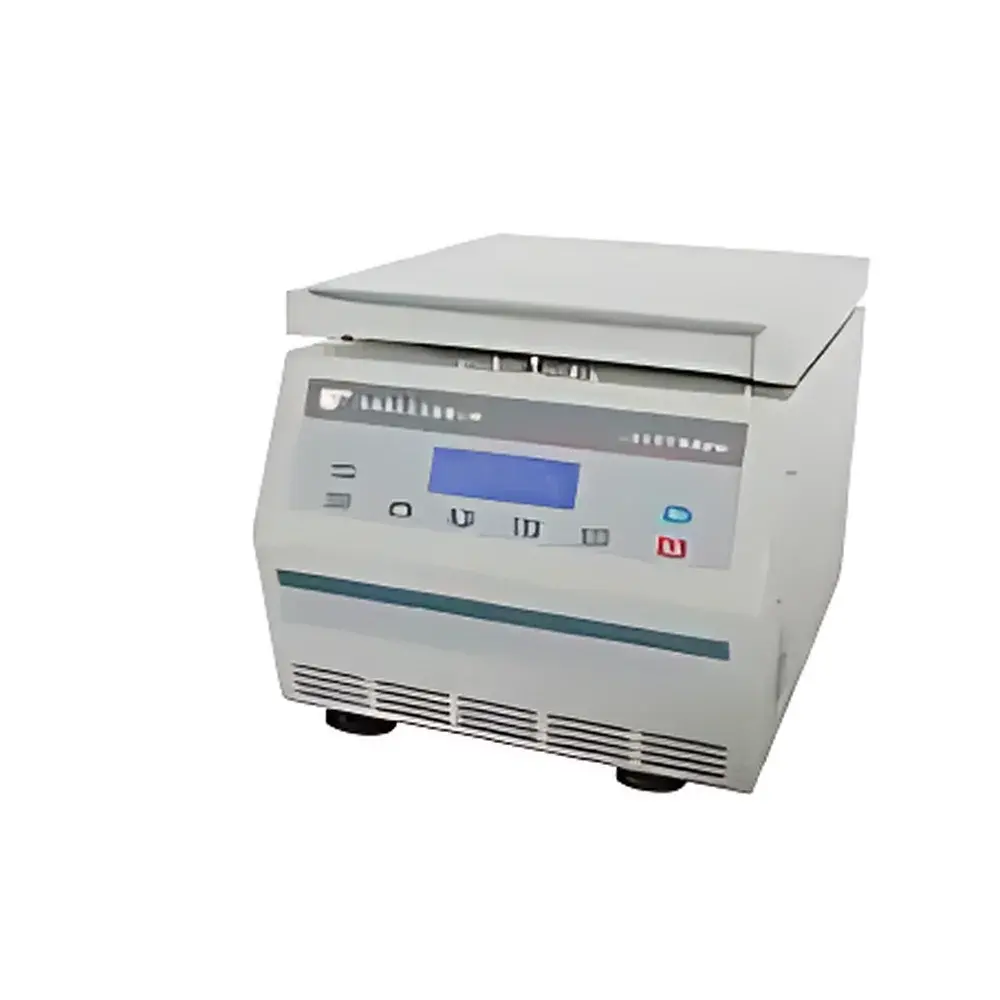
Feige KA-1000C Benchtop Low-Speed Centrifuge
| Max. Speed | 4000 rpm |
|---|---|
| Max. RCF | 2220 ×g |
| Rotor Capacity | 8 × 15 mL |
| Timer Range | 0–99 min |
| Power Supply | 220 V, 50 Hz, 180 W |
| Dimensions (L×W×H) | 380 × 480 × 330 mm |
| Weight | 25 kg |
Overview
The Feige KA-1000C is a benchtop low-speed centrifuge engineered for routine separation tasks in clinical diagnostics, biomedical research, and pharmaceutical quality control laboratories. It operates on the principle of sedimentation under controlled centrifugal force, enabling efficient separation of suspended particles—such as blood cells, precipitated proteins, or cellular debris—from liquid phases based on density and size differentials. Designed for stability at rotational speeds up to 4000 rpm and a maximum relative centrifugal force (RCF) of 2220 ×g, the KA-1000C delivers consistent performance for applications requiring gentle yet reliable pelleting without shear-induced damage to sensitive biological matrices. Its compact footprint and low-noise operation (<65 dB(A) at full speed) make it suitable for shared lab environments where acoustic comfort and space efficiency are critical.
Key Features
- Brushless DC motor with electronic speed control ensures long service life, minimal maintenance, and high reproducibility across repeated runs.
- Microprocessor-based timing system offers precise interval control from 0 to 99 minutes, with automatic rotor deceleration and audible end-of-run alert.
- Robust aluminum alloy rotor housing and balanced stainless-steel chamber provide structural integrity and corrosion resistance during extended use with aqueous and mild reagent solutions.
- Ergonomic lid design incorporates dual interlock safety mechanisms: mechanical latch and electronic sensor verification, preventing operation unless fully closed and secured.
- Integrated imbalance detection halts rotation immediately if mass asymmetry exceeds ±5% tolerance, protecting both sample integrity and instrument longevity.
- Front-panel LED display provides real-time feedback of set speed, actual RCF, elapsed time, and error codes for rapid troubleshooting.
Sample Compatibility & Compliance
The KA-1000C accommodates standard conical-bottom polypropylene tubes (15 mL capacity) in an 8-position fixed-angle rotor, supporting common protocols for serum/plasma separation, cell harvesting, and buffer exchange in pre-analytical workflows. It complies with IEC 61010-1:2010 for laboratory electrical equipment safety and meets EN 61326-1:2013 electromagnetic compatibility requirements. While not certified for GLP/GMP production environments, its operational consistency and audit-ready timer logs support documentation needs in ISO 15189-accredited clinical labs and academic research settings adhering to Good Laboratory Practice (GLP) principles. All rotors are autoclavable at 121°C for 20 minutes, facilitating decontamination between biosafety level 1 (BSL-1) and BSL-2 procedures.
Software & Data Management
The KA-1000C operates as a standalone instrument with no external software dependency. However, its embedded firmware supports traceable operation through non-volatile memory storage of the last 10 run parameters—including speed, time, date, and rotor ID—accessible via diagnostic mode. For integration into larger laboratory information management systems (LIMS), optional RS-232 serial output (available upon request) enables basic data export for record retention. The device does not implement FDA 21 CFR Part 11-compliant electronic signatures or audit trails; users requiring full regulatory compliance should pair it with validated third-party data capture tools or upgrade to networked centrifuge platforms.
Applications
- Routine serum and plasma preparation from whole blood samples in hospital core labs and point-of-care testing units.
- Preliminary isolation of peripheral blood mononuclear cells (PBMCs) prior to density gradient centrifugation.
- Clarification of cell lysates and culture supernatants in molecular biology workflows.
- Sedimentation of precipitated antibodies or antigen-antibody complexes in immunoassay development.
- Buffer exchange and desalting steps in protein purification pipelines using gel filtration or dialysis-compatible protocols.
- Quality assurance testing of pharmaceutical suspensions and emulsions under standardized sedimentation conditions per USP <724>.
FAQ
What is the maximum tube volume supported by the KA-1000C?
The unit accepts eight 15 mL conical centrifuge tubes with a recommended fill level of ≤12 mL per tube to ensure optimal balance and rotor clearance.
Can this centrifuge be used for centrifuging infectious samples?
Yes—when operated with sealed tube caps and within a certified biosafety cabinet, the KA-1000C is appropriate for BSL-2 agents; however, users must follow institutional biosafety protocols and perform post-run decontamination.
Is rotor calibration required before first use?
No factory calibration is needed; the rotor is pre-balanced and certified for nominal speed range. Users should verify tube symmetry and load distribution prior to each run.
Does the KA-1000C support variable acceleration/deceleration rates?
No—it features fixed ramp profiles optimized for low-speed stability; soft-start and coast-down deceleration prevent resuspension of delicate pellets.
What maintenance schedule is recommended?
Inspect rotor threads and lid gasket monthly; clean chamber interior weekly with 70% ethanol; lubricate door hinge annually; replace carbon brushes only after ≥10,000 operating hours or per manufacturer’s service bulletin.



