
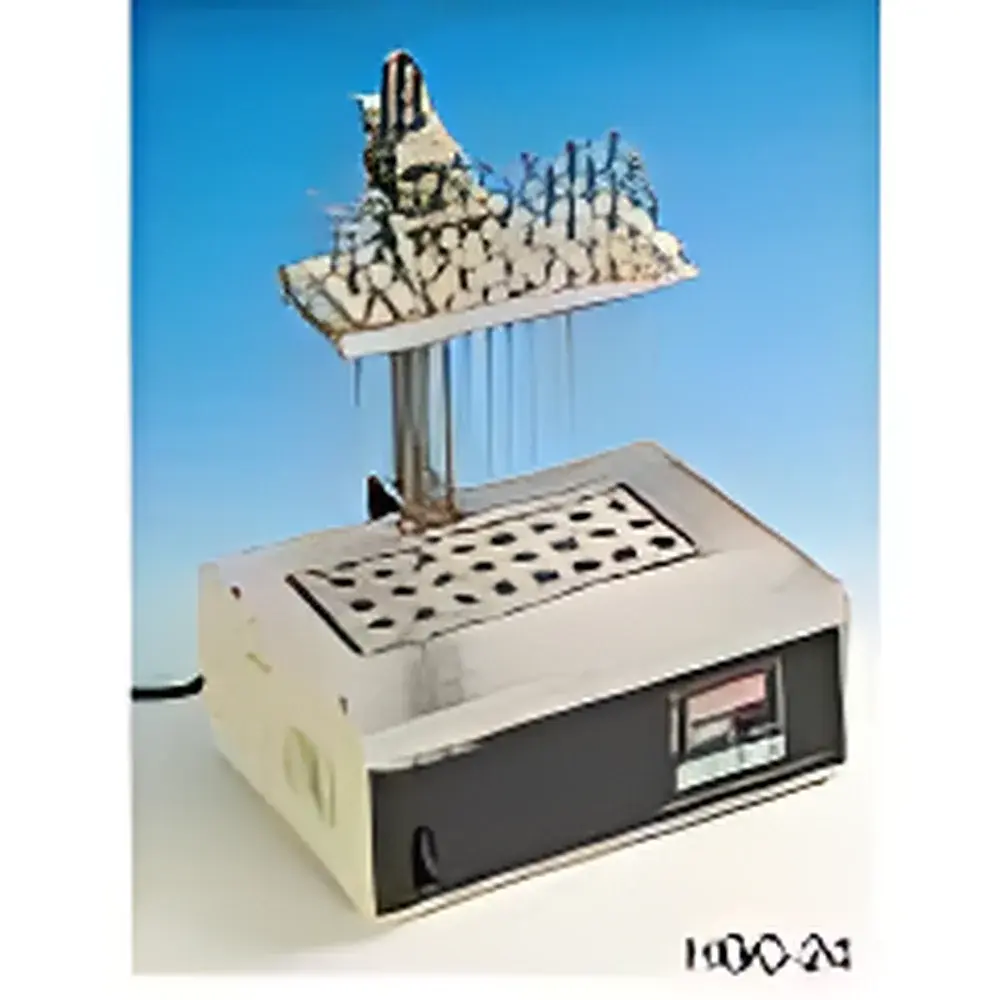
Chu Ding HGC-24A 24-Position Dry-Block Nitrogen Evaporator
| Brand | Chu Ding |
|---|---|
| Origin | Shanghai, China |
| Model | HGC-24A |
| Sample Capacity | 24 positions |
| Heating Blocks | 2 |
| Nitrogen Flow Rate | 0–10 L/min |
| Power Consumption | 200 W |
| Standard Block Orifice Diameters | φ15 mm, φ17 mm, φ21 mm (customizable) |
| Temperature Control | Digital PID controller with dual LED display and over-temperature alarm |
| Construction Materials | 316 stainless steel gas manifolds, anodized aluminum heating blocks, plastic-coated housing components |
Overview
The Chu Ding HGC-24A is a precision-engineered dry-block nitrogen evaporator designed for high-throughput sample concentration in analytical laboratories. It operates on the principle of gentle, inert gas-assisted solvent evaporation—introducing controlled streams of nitrogen directly above heated sample vessels to accelerate solvent removal without thermal degradation or cross-contamination. Unlike water bath systems, the dry-block architecture eliminates risks associated with water spillage, microbial growth, temperature gradient inconsistencies, and maintenance-intensive fluid management. The HGC-24A employs two independently controllable aluminum heating blocks, each accommodating 12 sample tubes, enabling simultaneous processing of up to 24 samples at user-defined temperatures ranging from ambient +5 °C to 150 °C (typical operational range: 30–120 °C). Its modular gas distribution manifold ensures uniform flow delivery across all 24 channels, with individual needle height adjustment and per-channel on/off capability for flexible experimental design.
Key Features
- Dual-zone dry-block heating system with independent temperature control for each 12-position block, supporting method development and parallel processing of dissimilar sample matrices.
- Digital PID temperature controller featuring dual LED display (setpoint & actual temperature), ±0.5 °C accuracy, and programmable over-temperature cutoff to protect samples and instrumentation.
- Gas manifold constructed entirely from 316 stainless steel—resistant to corrosion from organic solvents, acids, and halogenated compounds—ensuring long-term reliability and compliance with ISO 17025 traceability requirements.
- Modular, interchangeable aluminum heating blocks with standard orifice diameters (φ15 mm, φ17 mm, φ21 mm); custom bore patterns (e.g., conical, tapered, or multi-diameter) available upon order to accommodate vials, GC autosampler tubes, or microcentrifuge formats.
- Adjustable vertical positioning of the gas distribution head (±40 mm travel) to maintain optimal distance between nitrogen needle tip and liquid surface—critical for reproducible evaporation kinetics and minimal splashing.
- Front-panel flowmeter with fine-tuning valve per channel group (0–10 L/min total capacity), calibrated for consistent laminar flow across all 24 ports; compatible with standard laboratory nitrogen generators or compressed gas cylinders equipped with pressure regulators.
Sample Compatibility & Compliance
The HGC-24A supports common analytical sample containers including 10–15 mL glass test tubes, 13 × 100 mm culture tubes, 1.5–2.0 mL microcentrifuge tubes, and 4–6 mL GC vials. Its dry-block design meets key regulatory expectations for cleanroom-adjacent environments: no water ingress risk, minimal particulate generation, and non-porous surfaces that support validated cleaning protocols per FDA 21 CFR Part 11 Annex 11 and EU GMP Annex 15 guidelines. All electrical components comply with IEC 61010-1 safety standards for laboratory equipment. The instrument is routinely deployed in workflows aligned with ASTM D5865 (coal analysis), USP (residual solvents), and EPA Method 502.2 (purge-and-trap VOC analysis), where precise endpoint control and documentation integrity are essential.
Software & Data Management
While the HGC-24A operates as a standalone benchtop unit with analog/digital hybrid controls, it integrates seamlessly into regulated environments via optional RS-232 or USB-to-serial interface modules (sold separately). When paired with validated third-party data acquisition software, the device supports time-stamped temperature logging, flow rate verification reports, and audit-trail-enabled parameter change records—meeting GLP/GMP requirements for method validation and routine QC. The dual digital display retains last-set parameters after power cycling, reducing setup variability between shifts. No embedded firmware updates are required; calibration certificates for temperature and flow sensors can be issued by accredited metrology labs per ISO/IEC 17025.
Applications
- Pre-concentration of environmental water extracts (e.g., EPA 8081B, 8270D) prior to GC-ECD or GC-MS analysis.
- Residual solvent removal in pharmaceutical stability batches under ICH Q5C conditions.
- Fatty acid methyl ester (FAME) cleanup in biodiesel QA/QC per ASTM D6584.
- Forensic toxicology sample prep—evaporation of ethyl acetate or hexane extracts from blood or urine matrices prior to LC-MS/MS injection.
- High-throughput clinical research workflows involving plasma protein precipitation followed by acetonitrile removal.
- Environmental forensics: concentration of PAHs and PCBs from silica gel-cleaned extracts prior to quantification.
FAQ
What is the maximum recommended operating temperature for the HGC-24A heating blocks?
The aluminum heating blocks are rated for continuous operation up to 150 °C; however, for optimal longevity and thermal uniformity across all 24 positions, sustained use above 120 °C is not advised unless validated for specific solvent systems.
Can the HGC-24A be used with corrosive solvents such as concentrated HCl or trifluoroacetic acid?
The 316 stainless steel gas manifolds and passivated aluminum blocks provide resistance to mild organic and aqueous acids; however, prolonged exposure to strong mineral acids or halogenated solvents at elevated temperatures may compromise surface integrity—use only with appropriate fume hood ventilation and post-run decontamination.
Is calibration documentation included with shipment?
A factory calibration report covering temperature accuracy (at 40 °C, 70 °C, and 100 °C) and flow linearity (at 2 L/min, 5 L/min, and 8 L/min) is provided; full ISO/IEC 17025-accredited calibration is available as an add-on service.
How often should the O-rings and needle seals be replaced?
Under normal usage (8 hrs/day, 5 days/week), fluorosilicone O-rings at the gas inlet manifold require replacement every 12 months; nitrogen needle tips should be inspected quarterly for clogging or deformation and cleaned ultrasonically in isopropanol.
Does the HGC-24A meet CE or UL certification requirements?
The instrument complies with CE marking directives (2014/30/EU EMC, 2014/35/EU LVD) and carries a Declaration of Conformity; UL listing is not held but conforms to equivalent safety principles outlined in UL 61010-1.



