
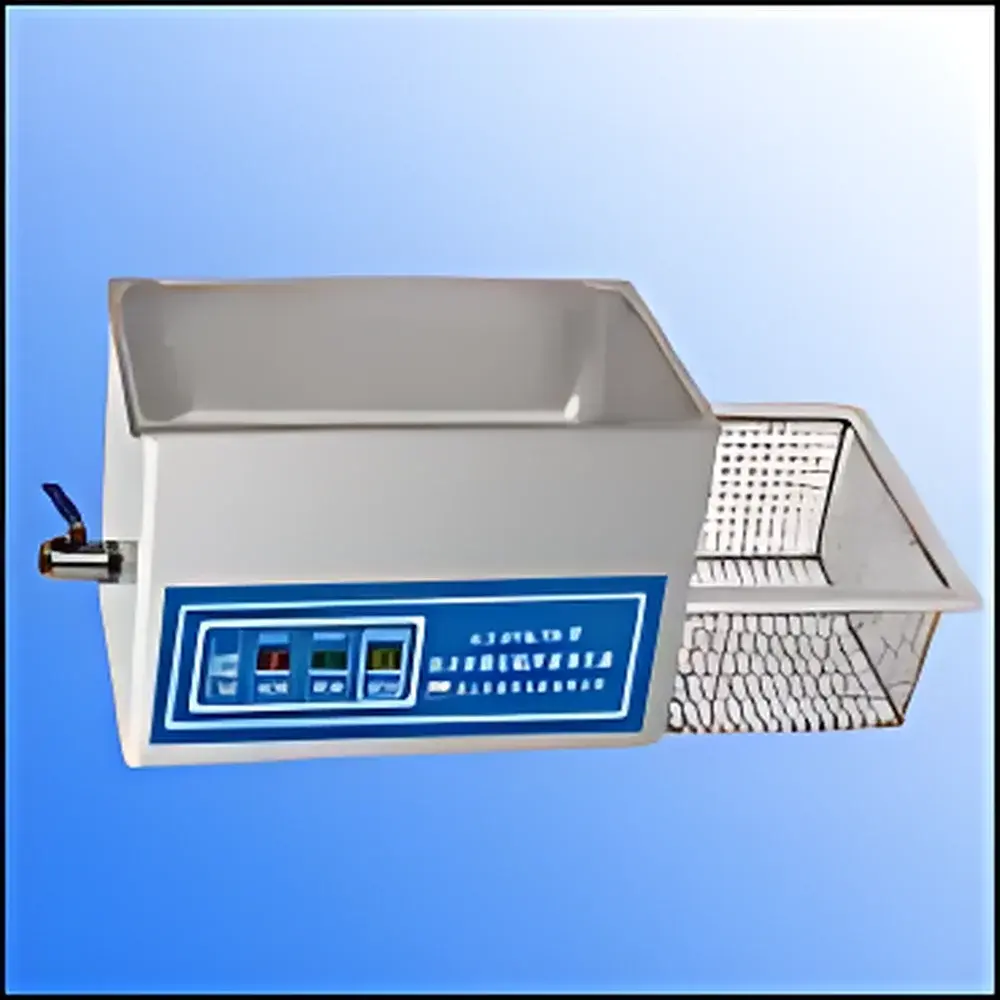
KQ-300TDV / KQ-500TDV / KQ-600TDV / KQ-700TDV Benchtop Dual-Frequency Programmable Ultrasonic Cleaner
| Origin | Shanghai, China |
|---|---|
| Manufacturer Type | Authorized Distributor |
| Product Origin | Domestic (PRC) |
| Models | KQ-300TDV / KQ-500TDV / KQ-600TDV / KQ-700TDV |
| Price | USD 3,600–5,200 (FOB Shanghai) |
| Ultrasonic Frequency | 60 kHz |
| Power Output Range | 300–700 W (adjustable 40–100%) |
| Heating Power | 600–1000 W |
| Temperature Control Range | 20–80 °C ±0.5 °C |
| Tank Internal Dimensions (L×W×H) | 500×300×180 mm |
| Tank Capacity | 27 L |
Overview
The KQ-300TDV, KQ-500TDV, KQ-600TDV, and KQ-700TDV are benchtop dual-frequency programmable ultrasonic cleaners engineered for laboratories requiring precise thermal stability and consistent cavitation performance during extended cleaning cycles. Unlike conventional single-frequency units, these models integrate a dual-mode thermal regulation system—combining PTC heating elements with active cooling capability—to maintain bath temperature within ±0.5 °C across operational durations exceeding 120 minutes. This architecture eliminates thermal drift caused by prolonged ultrasonic energy input, a common limitation in standard ultrasonic systems where acoustic power deposition directly elevates liquid temperature. The transducers operate at a fixed 60 kHz frequency, optimized for high-efficiency cavitation in aqueous and mild solvent-based media, enabling effective removal of particulate contaminants, organic residues, biofilms, and sub-micron debris from delicate instrumentation components, optical substrates, microfluidic devices, and analytical sample holders.
Key Features
- Dual-mode thermal management system: Automatically switches between heating and cooling modes to sustain setpoint temperature (20–80 °C) with <±0.5 °C accuracy over continuous operation
- Microcontroller-based digital control interface with non-volatile memory: Stores user-defined parameters including ultrasonic power (40–100% adjustable), cycle duration (1–999 seconds), and target temperature
- Stainless steel tank (304 grade) with argon-welded mesh rack for uniform part suspension and mechanical durability
- Integrated sound-dampening lid constructed from corrosion-resistant stainless steel and elastomeric sealing gasket to reduce ambient noise to ≤65 dB(A) at 1 m
- Manual stainless steel ball valve for controlled drain functionality; compatible with laboratory floor drain connections
- Uniform transducer distribution: Each unit employs multiple 50 W piezoelectric transducers mounted on the tank bottom, delivering homogeneous acoustic energy density across the full 27 L working volume
- Compliance-ready design: All electrical components meet IEC 61010-1 safety standards for laboratory equipment; CE marking available upon request
Sample Compatibility & Compliance
These cleaners accommodate a broad range of sample types—including glassware (vials, cuvettes, chromatography columns), metal calibration standards, silicon wafers, ceramic filters, and polymer-based microplates—without risk of surface pitting or etching when operated within recommended parameters. The 60 kHz frequency minimizes erosion on soft materials while ensuring sufficient cavitation intensity for contaminant detachment. Units conform to ISO 13485–aligned manufacturing practices and support GLP-compliant documentation workflows through timestamped parameter logging (when integrated with optional RS-232/USB data export). While not certified for sterile processing per ISO 17664 or EN 285, they are routinely deployed in pre-sterilization cleaning steps prior to autoclaving or ethylene oxide treatment in pharmaceutical QC labs. No regulatory claims are made regarding disinfection efficacy; users must validate microbial reduction performance per ASTM E2571 or AOAC Official Method 995.13 using site-specific protocols.
Software & Data Management
The embedded microcontroller firmware supports repeatable method recall via numeric keypad input and real-time display of actual vs. setpoint temperature, elapsed time, and active power level. Optional firmware upgrade enables ASCII-formatted serial output (RS-232 or USB virtual COM port) for integration into LIMS or ELN platforms. Logged data includes start time, duration, final temperature, and fault codes (e.g., overtemperature, low fluid level, transducer impedance anomaly). Audit trail functionality complies with FDA 21 CFR Part 11 requirements when paired with validated third-party software that enforces electronic signature, role-based access control, and immutable record retention. Calibration certificates for temperature sensors (traceable to NIST standards) and power output verification reports are available upon request.
Applications
- Precision cleaning of HPLC/GC autosampler vials, syringe filters, and flow cell components
- De-gassing of mobile phase solvents and buffer solutions prior to filtration
- Cell lysis and tissue homogenization in molecular biology workflows (e.g., RNA extraction prep)
- Removal of photoresist residues and developer films from photomasks and semiconductor wafers
- Ultrasonic-assisted extraction of botanical analytes and environmental contaminants from solid matrices
- Dispersion and de-agglomeration of nanomaterials and colloidal suspensions
- Pre-cleaning of electron microscopy grids and TEM sample holders
FAQ
What is the maximum allowable operating temperature for continuous ultrasonic operation?
The system maintains stable operation up to 80 °C with active thermal regulation; however, for optimal transducer longevity and cavitation efficiency, sustained use above 60 °C is recommended only with low-surface-tension solvents and verified compatibility testing.
Can the unit be used with flammable solvents such as acetone or ethanol?
No. These models are designed exclusively for aqueous solutions and water-miscible solvents with flash points >60 °C. Use with volatile organic compounds requires explosion-proof certification not provided in this configuration.
Is the temperature sensor calibrated traceable to national standards?
Yes—optional factory calibration certificate provides NIST-traceable verification at three points (25 °C, 45 °C, 65 °C) with uncertainty ≤±0.3 °C.
How often should the stainless steel mesh rack be inspected for structural integrity?
Visual inspection is recommended before each use; scheduled replacement every 12 months is advised under daily high-load conditions to prevent weld fatigue or deformation.
Does the unit support external trigger input for synchronized operation with other lab instruments?
Not natively; however, the RS-232 interface allows command-driven start/stop and parameter adjustment via host PC script, enabling semi-automated integration into multi-step protocols.



