
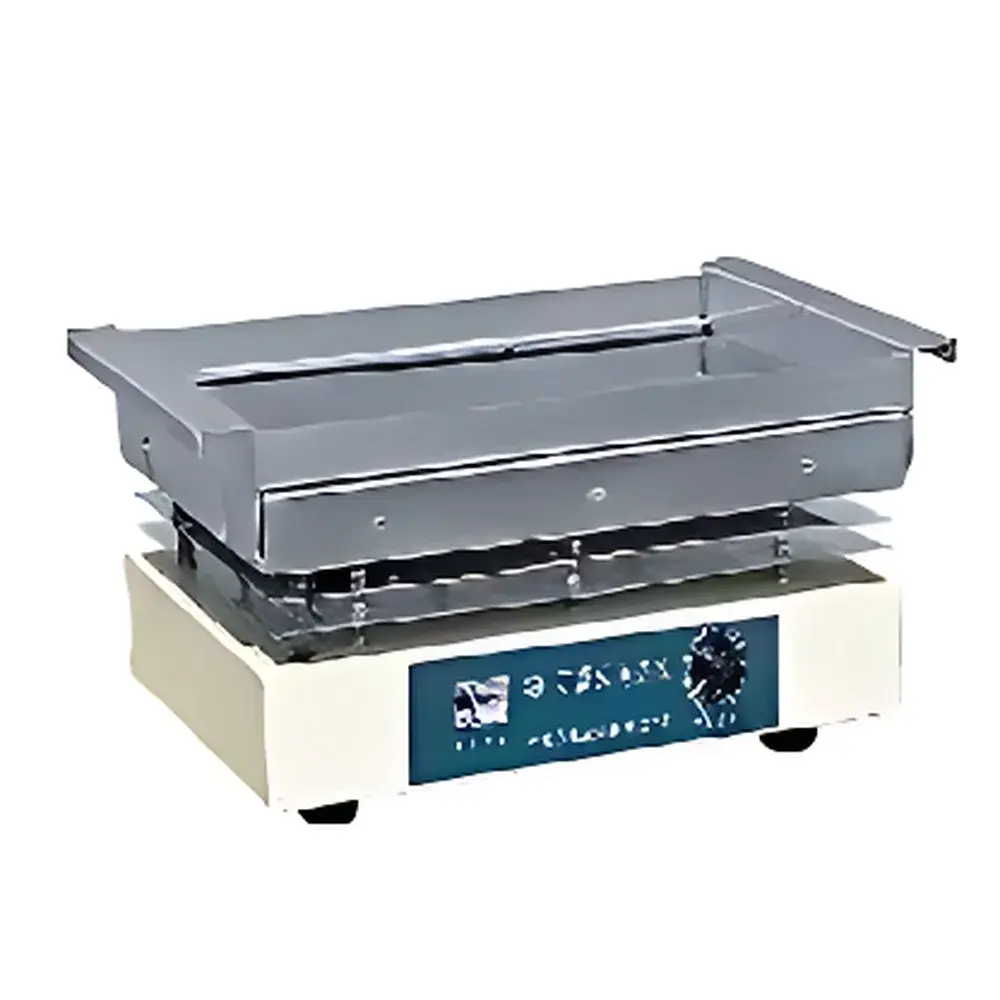
Chu Ding Technology GM-0505 / DB-II Stainless Steel Electric Heating Plate
| Brand | Chu Ding Technology |
|---|---|
| Origin | Shanghai, China |
| Model | GM-0505 / DB-II |
| Surface Max Temperature | 400 °C |
| Heating Area | 450 × 350 mm |
| Power Rating | 2000 W |
| Control Method | Silicon Controlled Rectifier (SCR) Continuous Power Regulation |
| Housing Finish | Electrostatic Powder Coating |
| Construction Material | 304 Stainless Steel Top Plate |
| Application Class | Laboratory & Industrial Benchtop Heating |
Overview
The Chu Ding Technology GM-0505 / DB-II Stainless Steel Electric Heating Plate is a robust, benchtop thermal platform engineered for precise and stable conductive heating in controlled laboratory and light industrial environments. Unlike open-coil or ceramic plate heaters, this unit employs a fully enclosed resistive heating element embedded beneath a solid 304 stainless steel top plate—eliminating exposed heating wires and minimizing oxidation, contamination risk, and thermal gradient inconsistencies across the surface. The device operates on the principle of Joule heating, where electrical energy is converted to thermal energy within a high-resistivity alloy element; heat is then uniformly conducted through the dense, non-porous stainless steel surface. Designed for continuous-duty operation at up to 400 °C surface temperature, it supports applications requiring repeatable thermal input without flame, radiant emission, or volatile organic emissions—making it suitable for solvent evaporation, sample digestion pre-heating, reagent warming, and controlled drying protocols under ISO/IEC 17025-compliant laboratory conditions.
Key Features
- Monolithic 304 stainless steel heating surface (450 × 350 mm) offering corrosion resistance, mechanical durability, and easy decontamination between uses.
- Enclosed heating architecture with no exposed coils or ceramic insulation—reducing particle shedding and enhancing safety in cleanroom-adjacent workflows.
- Silicon Controlled Rectifier (SCR)-based continuous power regulation enables smooth, stepless temperature control from ambient to 400 °C surface temperature, supporting method-defined ramping profiles.
- Electrostatic powder-coated mild steel housing provides mechanical protection, thermal insulation, and long-term finish integrity under routine lab handling.
- Integrated over-temperature protection circuitry limits surface excursion beyond setpoint by automatically reducing power output when thermal drift is detected—compliant with IEC 61000-4-2 ESD immunity requirements.
- Low electromagnetic interference (EMI) design ensures compatibility with nearby analytical instrumentation such as balances, pH meters, and spectrophotometers.
Sample Compatibility & Compliance
The GM-0505 / DB-II accommodates standard laboratory vessels including borosilicate glass beakers (up to 2 L), stainless steel crucibles, aluminum digestion blocks, and polypropylene trays—provided vessel bases are flat and thermally conductive. Its uniform surface temperature distribution (±8 °C across central 80% area per ASTM E220 calibration practice) ensures reproducible heating outcomes for QC/QA procedures. The unit meets general electrical safety requirements per GB 4706.1–2005 (China National Standard equivalent to IEC 60335-1), and its construction materials comply with USP for extractables testing in pharmaceutical support equipment. While not intrinsically rated for hazardous locations, it is routinely deployed in non-explosive zones (Zone 2 / Class I, Division 2) when operated with appropriate ventilation and procedural controls.
Software & Data Management
This analog-controlled heating plate does not incorporate digital firmware, microprocessor-based PID logic, or data logging capability. Temperature monitoring and process documentation must be performed externally using calibrated contact thermometers (e.g., Pt100 probes per ISO 17025 traceability) or infrared pyrometers (with emissivity correction for stainless steel). For laboratories operating under FDA 21 CFR Part 11 or GLP/GMP frameworks, manual log entries—including operator ID, start/end time, setpoint, observed surface temperature, and vessel identification—must be maintained in bound, signed, and version-controlled hardcopy or validated electronic lab notebook (ELN) systems. No USB, RS-232, or Ethernet interface is provided.
Applications
- Pretreatment heating of soil, water, or biological samples prior to acid digestion (EPA Method 3050B, 3051A).
- Controlled evaporation of solvents from HPLC fractions or TLC eluates in analytical chemistry workflows.
- Pre-warming of culture media, buffers, or enzymatic reagents in microbiology and molecular biology labs.
- Thermal conditioning of metal or polymer test specimens before tensile or hardness evaluation (ASTM E10, E18).
- Support heating for reflux, distillation, or Soxhlet extraction setups where flame-free operation is mandated.
- General-purpose benchtop heating in teaching laboratories, quality control facilities, and R&D pilot lines.
FAQ
Does this heating plate support programmable temperature ramps or hold steps?
No. It features analog SCR-based continuous power adjustment only—users manually set and maintain temperature via front-panel rotary control.
Is the surface temperature uniform across the entire plate?
Yes, within ±8 °C across the central 80% of the heating area when measured per ASTM E220 methodology using a calibrated surface probe.
Can it be used with corrosive reagents such as concentrated HNO₃ or HF?
The 304 stainless steel surface resists mild acids but is not resistant to hydrofluoric acid or hot chlorides. Use appropriate secondary containment and verify material compatibility per NACE MR0175/ISO 15156 for extended exposure.
What is the expected service life under continuous 2000 W operation?
Rated for >10,000 hours of cumulative operational time when operated within ambient temperatures ≤35 °C and relative humidity ≤80% non-condensing.
Is third-party calibration certification available?
Chu Ding Technology provides factory verification reports; accredited calibration per ISO/IEC 17025 requires engagement with an external calibration laboratory using traceable surface temperature standards.



