
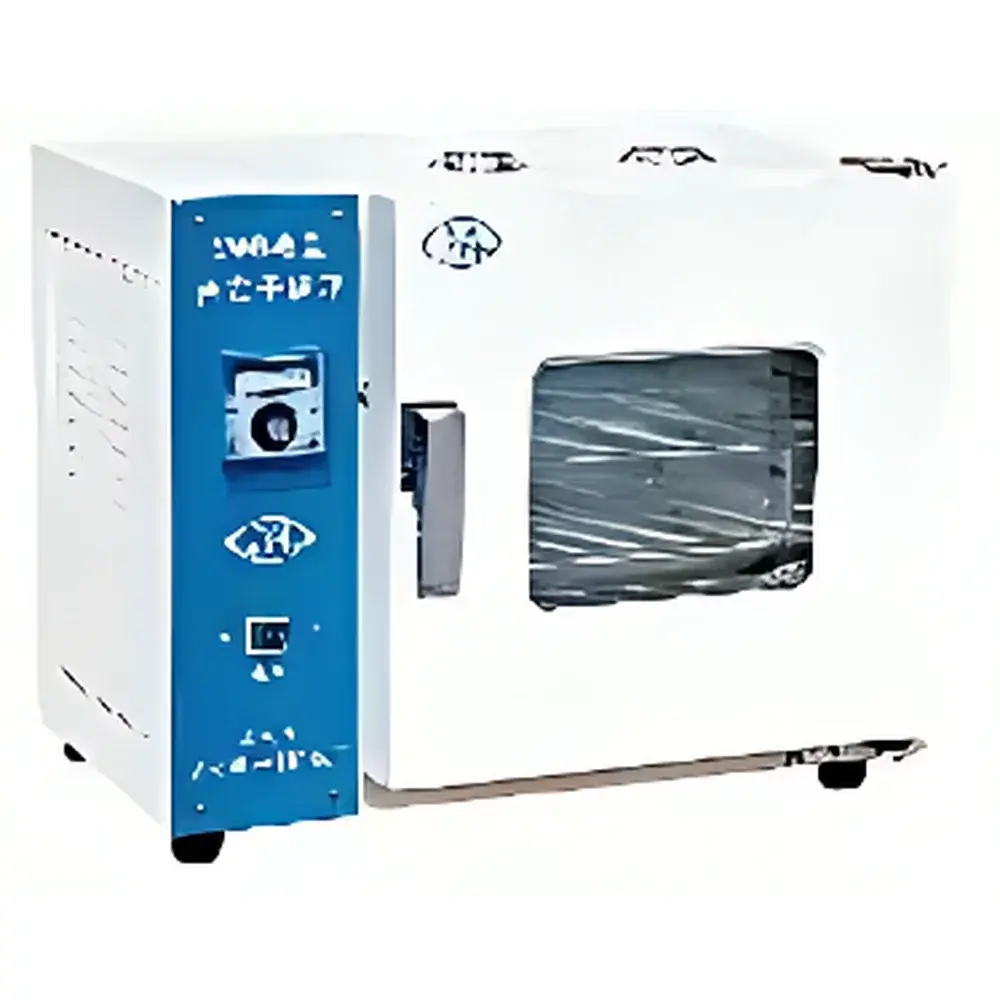
Shanghai-made 101-4ABS High-Temperature Forced-Air Drying Oven
| Origin | Shanghai, China |
|---|---|
| Manufacturer Type | Authorized Distributor |
| Product Origin | Domestic (China) |
| Model | 101-4ABS |
| Temperature Range | Ambient +10°C to 300°C |
| Internal Chamber Dimensions | 800 × 800 × 1000 mm (W×D×H) |
| Power Supply | 220 V / 50 Hz / 8 kW |
| Temperature Uniformity | ±2°C |
| External Dimensions | 1310 × 1235 × 1391 mm (W×D×H) |
| Chamber Material | Stainless Steel (Grade 304) |
| Control System | Digital PID Temperature Controller |
| Viewing Window | Integrated Double-Glazed Observation Port |
Overview
The Shanghai-made 101-4ABS High-Temperature Forced-Air Drying Oven is an industrial-grade laboratory drying system engineered for precision thermal processing across research, quality control, and manufacturing environments. Operating on the principle of forced convection—where a high-efficiency axial fan circulates heated air uniformly throughout the chamber—the oven ensures consistent heat distribution and rapid thermal equilibration. Designed for applications requiring elevated temperature stability up to 300°C, it supports critical processes including moisture removal, thermal curing of polymers and coatings, sterilization of glassware and instruments, wax melting, and pre-conditioning of samples prior to analytical testing (e.g., gravimetric moisture analysis per ASTM D2216 or ISO 11465). Its robust architecture complies with fundamental safety and performance expectations for Class II laboratory ovens under IEC 61010-1 and GB/T 5170.2–2017 (Chinese national standard for temperature testing equipment). The unit is not intended for explosive or volatile organic solvent use without additional explosion-proof certification.
Key Features
- Stainless steel interior chamber (AISI 304) resistant to oxidation, corrosion, and thermal cycling—ensuring long-term dimensional stability and ease of cleaning.
- Electrostatically coated cold-rolled steel exterior with durable, chip-resistant finish for enhanced mechanical protection and laboratory aesthetics.
- Double-glazed observation window with tempered safety glass, enabling real-time visual monitoring without compromising thermal integrity or operator safety.
- Digital PID temperature controller with programmable setpoint, auto-tuning capability, and ±0.5°C repeatability over repeated cycles—supporting GLP-compliant documentation when integrated with external data loggers.
- High-capacity axial circulation fan with adjustable airflow baffle system to optimize uniformity across the full 800 × 800 × 1000 mm working volume.
- Over-temperature cut-off protection and independent mechanical safety thermostat prevent uncontrolled thermal excursions in accordance with EN 60519-1 guidelines for industrial heating equipment.
Sample Compatibility & Compliance
The 101-4ABS accommodates a broad range of sample types—including petri dishes, weighing boats, crucibles, metal trays, and bulk material containers—within its spacious stainless steel chamber. It is routinely deployed in pharmaceutical QC labs for residual solvent evaporation (per USP ), in materials science for binder burnout in ceramic green bodies, and in environmental labs for soil moisture determination (EPA Method 9095B). While not certified to ATEX or UL 1203 for hazardous locations, the oven meets general-purpose electrical safety requirements for non-explosive atmospheres. Its temperature uniformity profile (±2°C at 300°C, measured per ISO 17025-accredited validation protocols) supports routine calibration traceability to NIST-traceable reference thermometers. Documentation packages include factory calibration certificates and user-accessible adjustment procedures for sensor offset compensation.
Software & Data Management
The 101-4ABS operates via a standalone digital controller with front-panel keypad interface and LED display—no proprietary software or PC dependency required. However, optional RS-485 Modbus RTU output enables integration into centralized lab infrastructure via SCADA or LIMS platforms. When connected to compliant data acquisition systems, the unit supports audit-trail generation for temperature setpoints, dwell times, and alarm events—aligning with FDA 21 CFR Part 11 requirements for electronic records when paired with appropriate validation and access controls. Firmware updates are performed manually using standardized hex files; no cloud connectivity or remote firmware deployment is implemented, preserving network security and regulatory boundary integrity.
Applications
- Thermal drying of biological tissues, filter papers, and chromatography media prior to gravimetric or spectrophotometric analysis.
- Curing of epoxy resins, powder coatings, and printed circuit board substrates under controlled ramp-hold-cool profiles.
- Sterilization of reusable labware (glass, stainless steel) where steam autoclaving is unsuitable—validated per ISO 14644-1 cleanroom particulate limits.
- Melt conditioning of paraffin, beeswax, and polymer pellets in histology and formulation laboratories.
- Pre-drying of hygroscopic standards (e.g., potassium hydrogen phthalate) before primary standardization in titrimetry.
- Accelerated aging studies for packaging materials and adhesives under ISO 11341 and ASTM G154 conditions.
FAQ
What is the maximum continuous operating temperature?
The 101-4ABS is rated for continuous operation at up to 300°C, with thermal insulation designed to maintain surface temperatures below 60°C under nominal load conditions.
Is the chamber volume validated for temperature uniformity?
Yes—uniformity is verified at nine standardized points (per ISO 17025 Annex C) during factory acceptance testing; a certificate of uniformity is provided with each unit.
Can the oven be used for inert-atmosphere processing?
No. The unit lacks gas inlet/outlet ports or pressure-sealed construction; it is configured exclusively for ambient-air convection.
Does it support programmable ramp-and-soak cycles?
The base model includes single-setpoint control only; multi-stage profiling requires an optional upgrade to the advanced PID controller module (Part No. CTL-PRO-101X).
What maintenance intervals are recommended?
Fan bearing lubrication every 12 months, door gasket inspection quarterly, and annual verification of temperature sensor drift using a calibrated reference thermometer.



