
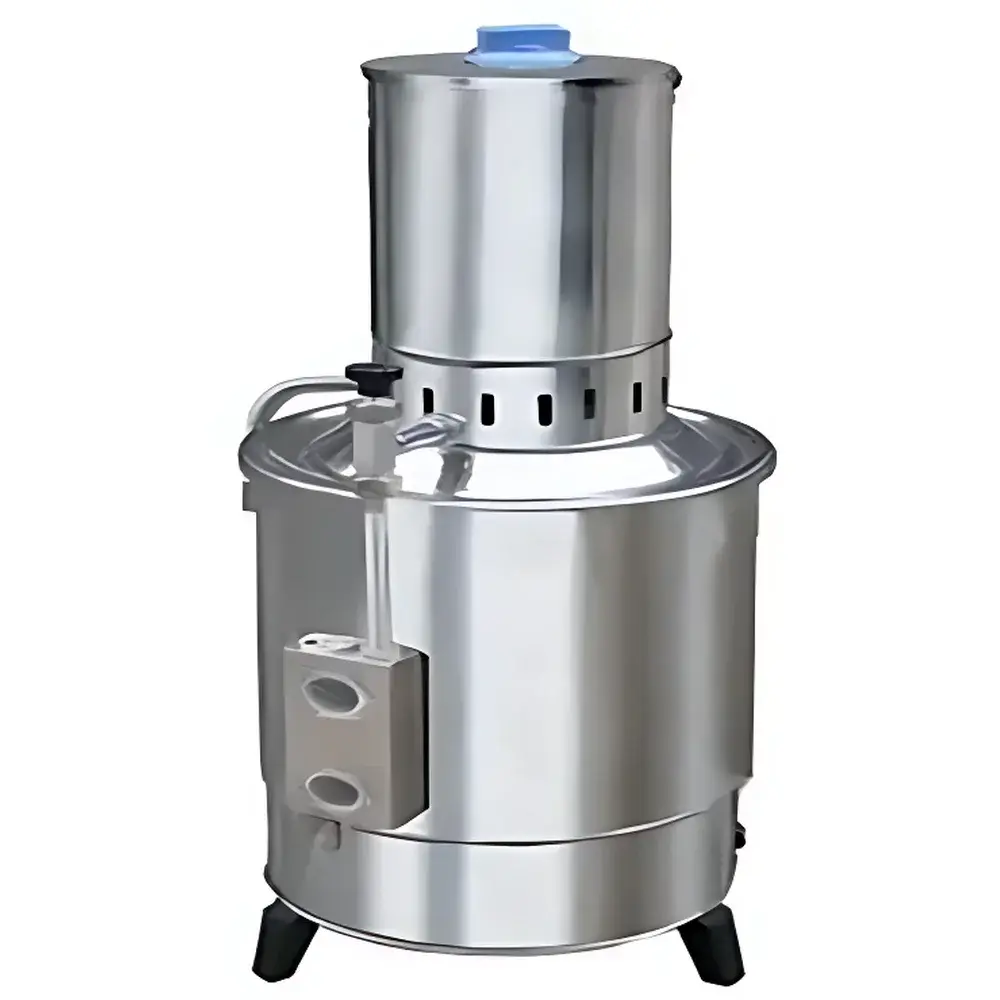
YA.ZD-10 Fully Stainless Steel Electrically Heated Distillation Apparatus (10 L/h)
| Origin | Shanghai, China |
|---|---|
| Manufacturer Type | Distributor |
| Origin Category | Domestic (China) |
| Model | YA.ZD-10 |
| Output Capacity | 10 L/h |
| Power Supply | 380 V AC |
| Heating Power | 7.5 kW |
| Net Weight | 9 kg |
| Dimensions (L×W×H) | 830 × 360 × 370 mm |
| Construction Material | AISI 304 Stainless Steel |
| Flow Control | Dual-direction adjustable bypass valve |
| Internal Design | Integrated分流-type vapor separation structure |
Overview
The YA.ZD-10 Fully Stainless Steel Electrically Heated Distillation Apparatus is a benchtop-scale, continuous-duty laboratory distillation system engineered for the reliable production of Type III purified water (as defined by ISO 3696 and ASTM D1193) in research, quality control, and routine analytical laboratories. Operating on the principle of single-stage thermal distillation, the unit heats feed water—typically tap or deionized water—to boiling, separates generated steam from non-volatile contaminants via a precisely engineered internal vapor diversion chamber, and condenses the purified vapor into high-purity distilled water at a nominal rate of 10 liters per hour. Its all-AISI 304 stainless steel construction ensures long-term corrosion resistance against chlorides, scaling agents, and trace organics commonly present in municipal water supplies, while eliminating leachable metal ions that could compromise downstream applications such as buffer preparation, spectrophotometry, or cell culture media formulation.
Key Features
- Fully welded AISI 304 stainless steel housing, boiler chamber, condenser coil, and collection reservoir—no painted, plated, or polymer-lined components
- Integrated分流-type (bypass-flow) steam separation architecture that enhances phase separation efficiency and minimizes carryover of entrained droplets or volatile impurities
- Dual-direction adjustable flow control valve enabling precise regulation of both feed water inflow and distillate outflow to stabilize operating pressure and optimize energy efficiency
- Industrial-grade heating element with over-temperature cut-off protection and redundant thermal fusing compliant with IEC 61000-6-2 electromagnetic immunity requirements
- Modular assembly design supporting field maintenance without specialized tools; boiler access panel facilitates periodic descaling and inspection
- Compact footprint (830 × 360 × 370 mm) optimized for standard laboratory bench integration, with reinforced base plate for vibration-dampened operation
Sample Compatibility & Compliance
The YA.ZD-10 accepts potable water, softened water, or pre-deionized feed sources with total dissolved solids (TDS) ≤ 500 ppm and free chlorine ≤ 2 ppm. It is not intended for direct use with seawater, brackish water, or chemically pretreated industrial effluents. The apparatus conforms to GB/T 14881–2013 (General Hygienic Standard for Food Production), and its material certification complies with FDA 21 CFR §178.3570 (stainless steel contact surfaces). While not certified to ISO/IEC 17025 as a testing instrument, its consistent output meets the purity specifications for Type III water under ISO 3696:1987 and ASTM D1193–22 Grade III, including maximum conductivity ≤ 5.0 µS/cm at 25 °C and silica ≤ 0.1 mg/L. Documentation supports GLP-compliant water logbook entries when paired with calibrated conductivity and TOC verification protocols.
Software & Data Management
This is a manually operated, analog-control distillation apparatus with no embedded microprocessor, touchscreen interface, or digital data logging capability. Operational parameters—including feed flow rate, heating power status, and visual distillate level—are monitored via mechanical gauges and sight glasses. For regulated environments requiring audit trails, users are advised to integrate external calibrated temperature sensors (e.g., Pt100 RTDs) and conductivity meters (ASTM D5391-compliant) into their SOPs, with manual recording aligned with 21 CFR Part 11–aligned electronic lab notebook (ELN) systems. The unit’s passive architecture eliminates firmware vulnerabilities and ensures uninterrupted operation during power fluctuations typical in shared facility infrastructure.
Applications
- Preparation of reagent-grade water for HPLC mobile phase preparation, titrant standardization, and calibration standard dilution
- Supplying purified water to autoclaves, glassware washers, and environmental chambers where low-ion-content water prevents mineral deposition
- Supporting ISO 17025-accredited testing laboratories requiring documented, reproducible water quality for pH meter calibration and conductivity reference solutions
- Providing stable feedstock for secondary purification systems, including ultrapure water (UPW) generators employing EDI, UV oxidation, and 0.22 µm filtration stages
- Teaching laboratories demonstrating fundamental thermodynamic principles of phase change, latent heat transfer, and mass balance in chemical engineering curricula
FAQ
What feed water quality is required to ensure optimal service life and distillate purity?
Feed water should have TDS ≤ 500 ppm and free chlorine ≤ 2 ppm. Pre-filtration through activated carbon and softening is recommended if local supply exceeds these limits.
Is the YA.ZD-10 suitable for GMP-regulated pharmaceutical manufacturing?
It produces Type III water appropriate for non-sterile ancillary processes (e.g., equipment cleaning, HVAC humidification); however, it does not meet WFI (Water for Injection) or Purified Water (PW) monograph requirements per USP without additional validation and qualification.
How often must the boiler be descaled?
Under typical municipal water conditions (hardness 100–200 mg/L CaCO₃), descaling every 200–300 operating hours is recommended using citric acid-based solutions per manufacturer guidelines.
Can the unit operate continuously for 24/7 duty cycles?
Yes—designed for unattended operation with thermal cutoff safety interlocks; however, feed water supply must be maintained via float-controlled reservoir or pressurized line to prevent dry-boil conditions.
Does the apparatus include a built-in conductivity monitor?
No—conductivity verification requires external inline or grab-sample measurement per ISO 3696 Annex A protocols.



