
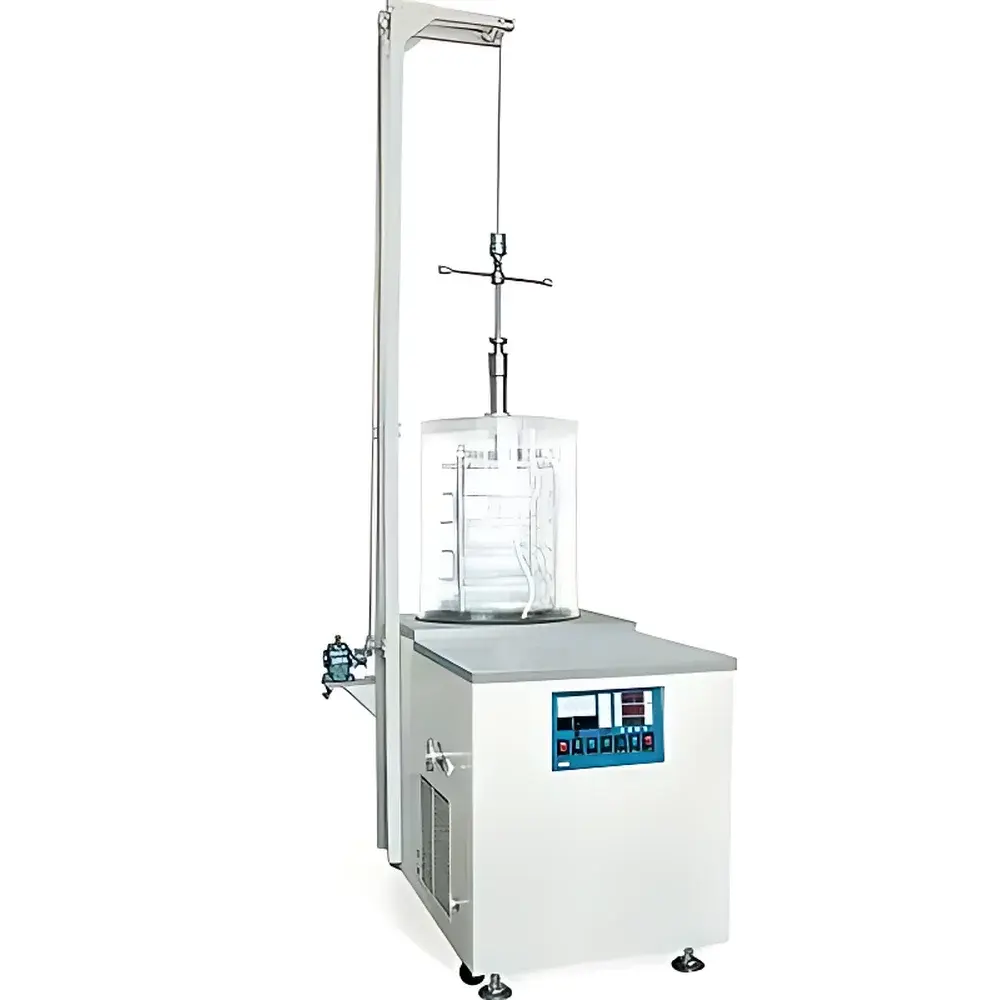
English Product Name
| Origin | Shanghai, China |
|---|---|
| Manufacturer Type | Authorized Distributor |
| Origin Category | Domestic (China) |
| Model | FD-3 |
| Price | USD 12,200 (FOB Shanghai) |
| Freeze-Drying Area | 0.3 m² |
| Condenser Temperature | ≤ −45 °C |
| Ultimate Vacuum (No-Load) | ≤ 13 Pa |
| Water Capture Capacity | 10 kg/24 h |
| Tray Diameter | Φ280 mm |
| Power Supply | 380 V, 50 Hz, 3 kW |
| Dimensions (W×D×H) | 1250 × 660 × 800 mm (plus 1000 mm height for chamber + 515 mm for condenser base) |
| Cooling Method | Air-Cooled |
| Construction | Full Stainless Steel Condenser & Chamber |
| Control System | Programmable Temperature-Time Profile with Triple Thermal Protection |
Overview
The LaboTech FD-3 Production-Scale Freeze Dryer is an engineered solution for intermediate-scale lyophilization in pharmaceutical development, biologics manufacturing, and food R&D laboratories. It operates on the principle of sublimation-based dehydration—where water is removed from frozen samples under deep vacuum without passing through the liquid phase. This preserves structural integrity, bioactivity, and chemical stability of thermolabile substances including monoclonal antibodies, live-virus vaccines, enzyme formulations, plasma-derived therapeutics, and probiotic cultures. Designed for reproducible batch processing, the FD-3 bridges the gap between benchtop pilot units and industrial freeze dryers, supporting process transfer, formulation optimization, and small-batch GMP-compliant production (up to 5–10 L per cycle). Its modular architecture integrates a high-efficiency air-cooled refrigeration system, stainless steel condenser chamber, and programmable shelf temperature control—all housed within a compact footprint suitable for ISO Class 7 cleanroom integration.
Key Features
- Imported hermetic scroll compressor refrigeration unit delivering stable ≤ −45 °C condenser performance and ≥10 kg/24 h ice capture capacity.
- Full stainless steel construction (AISI 304) for condenser, drying chamber, and shelf assembly—compliant with ASME BPVC Section VIII and EU Annex 1 surface finish requirements (Ra ≤ 0.8 µm).
- Programmable shelf temperature control via oil-heated plates with ±0.5 °C uniformity across 0.3 m² active area; supports ramp-hold-freeze-dry profiles with up to 20 user-defined segments.
- Triple-layer thermal protection system: independent shelf sensor, condenser temperature monitoring, and ambient overheat cutoff—ensuring sample safety during extended cycles.
- Manual hydraulic press-down lid mechanism enabling sterile-grade vial sealing under vacuum (compatible with rubber stoppers and aluminum crimps).
- Air-cooled condenser eliminates dependency on external chiller water circuits—reducing infrastructure complexity and maintenance overhead.
- GMP-ready design: smooth welds, sloped surfaces for drainage, non-porous insulation, and validated leak rate < 0.05 mbar·L/s (helium leak tested).
Sample Compatibility & Compliance
The FD-3 accommodates standard pharmaceutical glass vials (10–50 mL), serum bottles, and custom trays up to Φ280 mm diameter. It supports lyophilization of aqueous solutions, suspensions, and emulsions with total solids content up to 25% w/v. Process validation documentation—including IQ/OQ protocols, calibration certificates for PT100 sensors and Pirani vacuum gauges, and material traceability records—is provided upon request. The system meets key regulatory expectations for analytical and clinical manufacturing environments: alignment with USP , ISO 22057 (lyophilization terminology), and ICH Q5C (stability of biotechnological products). While not certified as a Class A cleanroom device, its construction and operational parameters support integration into ISO 14644-1 Class 7 or better controlled environments when coupled with HEPA-filtered air handling.
Software & Data Management
The FD-3 is equipped with an embedded PLC-based controller featuring a 7-inch color touchscreen HMI. All process parameters—including shelf temperature, condenser temperature, chamber pressure, elapsed time, and vacuum level—are logged at user-configurable intervals (1–60 s) and stored internally for ≥30 days. Export options include USB-stick CSV files compatible with Excel, MATLAB, or commercial process analytics tools (e.g., SIMCA, JMP). Audit trail functionality complies with FDA 21 CFR Part 11 requirements when used with optional password-protected user roles (Administrator, Operator, Reviewer) and electronic signature capability. Raw data archives include timestamped metadata, operator ID, and version-controlled firmware logs—enabling full traceability for GLP/GMP audits.
Applications
- Pharmaceutical: Lyophilization of clinical trial batches (Phase I–II), reference standards, and stability study samples under defined ICH Q1A(R3) conditions.
- Biotechnology: Stabilization of recombinant proteins, viral vectors, and cell lysates without denaturation or aggregation.
- Diagnostic Reagents: Preservation of ELISA kits, lateral flow assay components, and PCR master mixes with extended shelf life.
- Food Science: Dehydration of functional ingredients (e.g., lactic acid bacteria, anthocyanin extracts) while retaining antioxidant activity and sensory attributes.
- Academic Research: Method development for novel cryoprotectant screening, collapse temperature mapping (Tc), and residual moisture analysis by Karl Fischer titration.
FAQ
What is the maximum batch volume the FD-3 can process per cycle?
The FD-3 supports up to 5 L of aqueous solution (assuming 10% solids concentration) across its 0.3 m² shelf area—equivalent to approximately 200 × 20 mL vials or 12 × Φ280 mm trays.
Does the FD-3 meet GMP requirements for manufacturing use?
Yes—the unit’s mechanical design, material certifications (EN 10204 3.1), and documentation package align with EU GMP Annex 11 and FDA guidance for equipment qualification in non-sterile and sterile ancillary operations.
Can the FD-3 be integrated with a steam-in-place (SIP) system?
No—the FD-3 does not include SIP capability; however, its stainless steel chamber and sealed joints permit external SIP integration via third-party autoclave-compatible manifolds.
Is remote monitoring supported?
Standard Ethernet port enables Modbus TCP communication for SCADA integration; optional Wi-Fi module and cloud-based telemetry (via MQTT) are available under extended service contracts.
What maintenance intervals are recommended?
Refrigeration oil change every 3,000 operating hours; vacuum pump oil replacement every 500 hours; annual calibration of all PT100 sensors and Pirani gauge against NIST-traceable references.



