
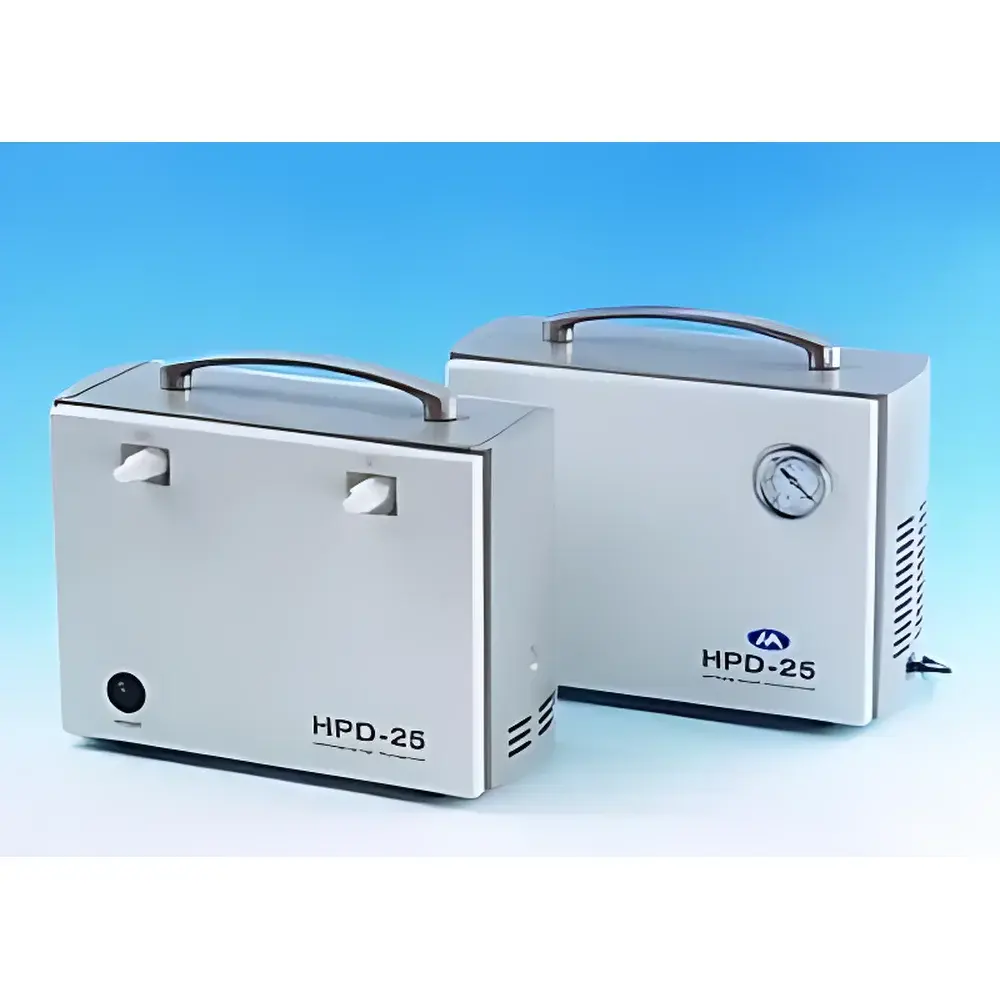
Chu Ding Technology HPD-25D Adjustable-Pressure Oil-Free Diaphragm Vacuum Pump
| Brand | Chu Ding Technology |
|---|---|
| Origin | Tianjin, China |
| Model | HPD-25D |
| Pump Type | Diaphragm Vacuum Pump |
| Oil-Free Design | Yes |
| Flow Rate | 25 L/min |
| Ultimate Vacuum Pressure | −0.08 MPa (gauge) |
| Power Consumption | 50 W |
| Application Scope | Vacuum Filtration, Solid-Phase Extraction (SPE), Vacuum Drying, Rotary Evaporation Support |
| Regulatory Compliance | CE-marked per IEC 61000-6-3 (EMC) and IEC 61000-6-2 (Immunity) |
Overview
The Chu Ding Technology HPD-25D is an oil-free diaphragm vacuum pump engineered for precision and reliability in routine laboratory vacuum applications. It operates on the positive displacement principle: a motor-driven eccentric mechanism actuates a reinforced elastomeric diaphragm, generating cyclic volume changes within the pumping chamber to draw gas from the connected system and expel it through the exhaust valve. Unlike oil-lubricated rotary vane pumps, this design eliminates hydrocarbon vapor backstreaming, preventing sample contamination—critical for analytical workflows involving solvent-sensitive samples, volatile organic compounds (VOCs), or sterile filtration. With a rated ultimate vacuum of −0.08 MPa (gauge) and a consistent free-air flow rate of 25 L/min at atmospheric inlet pressure, the HPD-25D delivers stable suction performance suitable for medium-throughput vacuum filtration, SPE manifold operation, and low-temperature vacuum drying protocols. Its compact footprint (240 × 140 × 220 mm) and low operational noise (<52 dB(A)) support integration into fume hoods, biosafety cabinets, and shared instrumentation benches without acoustic interference.
Key Features
- Oil-free diaphragm architecture ensures zero risk of oil carryover, eliminating downstream contamination in HPLC mobile phase preparation, lyophilization pre-treatment, or microbiological filtration.
- Reinforced 3-mm-thick diaphragm composed of nitrile rubber with embedded woven textile reinforcement—optimized for high-cycle fatigue resistance and chemical compatibility with common lab solvents (e.g., methanol, acetone, ethyl acetate).
- Adjustable vacuum pressure control via integrated needle valve or optional external pressure regulator—enabling fine-tuned suction for delicate membranes (e.g., 0.22 µm PVDF) or viscous suspensions prone to filter clogging.
- Thermally managed 50 W induction motor with optimized winding design minimizes heat buildup during extended operation (>8 h continuous duty cycle), extending component service life.
- Modular exhaust configuration: standard muffler included; optional activated carbon filter kit available for VOC abatement in confined lab spaces.
Sample Compatibility & Compliance
The HPD-25D is compatible with all standard laboratory vacuum interfaces, including Bunsen-type hose barbs (6–10 mm ID), threaded NPT ports (¼″), and quick-connect fittings for SPE manifolds and Büchner funnel assemblies. It meets electromagnetic compatibility requirements per IEC 61000-6-3 (emission limits) and IEC 61000-6-2 (immunity to electrostatic discharge and RF fields), ensuring stable operation near sensitive analytical instruments such as mass spectrometers or microbalances. While not certified to ISO 8573-1 Class 0 for compressed air purity, its oil-free output satisfies ISO 8573-1 Class 1 requirements for particulate and oil aerosol content—making it suitable for non-GMP research-grade vacuum applications. For regulated environments, the pump supports audit-ready documentation packages aligned with GLP principles, including calibration traceability records and maintenance logs.
Software & Data Management
The HPD-25D is a standalone analog device with no embedded firmware or digital interface. However, it integrates seamlessly with third-party vacuum monitoring systems via optional analog 0–10 V or 4–20 mA pressure transducer outputs (available as field-installable add-ons). When paired with LabVIEW, Python-based SCADA, or ELN platforms like LabArchives, real-time vacuum level logging, duty-cycle tracking, and predictive maintenance alerts can be implemented using externally mounted pressure sensors and programmable logic controllers (PLCs). All mechanical adjustments—including pressure regulation and exhaust routing—are accessible without tools, supporting rapid reconfiguration between filtration, drying, and degassing protocols.
Applications
- Vacuum-assisted gravity filtration of cell lysates, nanoparticle dispersions, and polymer solutions where membrane integrity must be preserved under controlled differential pressure.
- Solid-phase extraction (SPE) across 1-, 6-, and 12-port manifolds—particularly for EPA Method 525.3 (pesticide residue analysis) and USP chromatographic method development.
- Pre-concentration of aqueous extracts prior to LC-MS/MS analysis, minimizing thermal degradation by enabling room-temperature evaporation under reduced pressure.
- Supporting benchtop rotary evaporators (e.g., Buchi R-100) requiring stable base vacuum in the 10–100 mbar range for efficient solvent removal from heat-labile compounds.
- Degassing of HPLC mobile phases and ultrapure water reservoirs to suppress bubble formation in low-pressure gradient systems.
FAQ
Is the HPD-25D suitable for continuous 24/7 operation?
It is rated for intermittent use up to 8 hours per session. For extended duty cycles, periodic cooling intervals (≥15 min every 4 h) are recommended to maintain diaphragm elasticity and motor insulation integrity.
Can this pump handle corrosive vapors such as HCl or HF?
No. The standard nitrile diaphragm and internal valves are not resistant to strong mineral acids or halogenated solvents. For such applications, consult the optional Viton®-equipped variant (HPD-25D-VF).
What maintenance is required?
No scheduled lubrication is needed. Annual inspection of the diaphragm for microcracks, valve seat sealing integrity, and muffler cleanliness is advised per ISO/IEC 17025 Clause 6.4.2.
Does it comply with FDA 21 CFR Part 11 for electronic records?
As a purely electromechanical device without data logging or user authentication features, it falls outside the scope of Part 11—but may be included in a validated system when paired with compliant pressure monitoring hardware and audit-trail-enabled software.
How does adjustable pressure improve filtration efficiency?
By reducing inlet pressure below the pump’s maximum vacuum, users prevent rapid blinding of fine-pore membranes (e.g., 0.1 µm nylon) during high-viscosity filtrations—extending usable membrane life and improving filtrate clarity reproducibility.



