
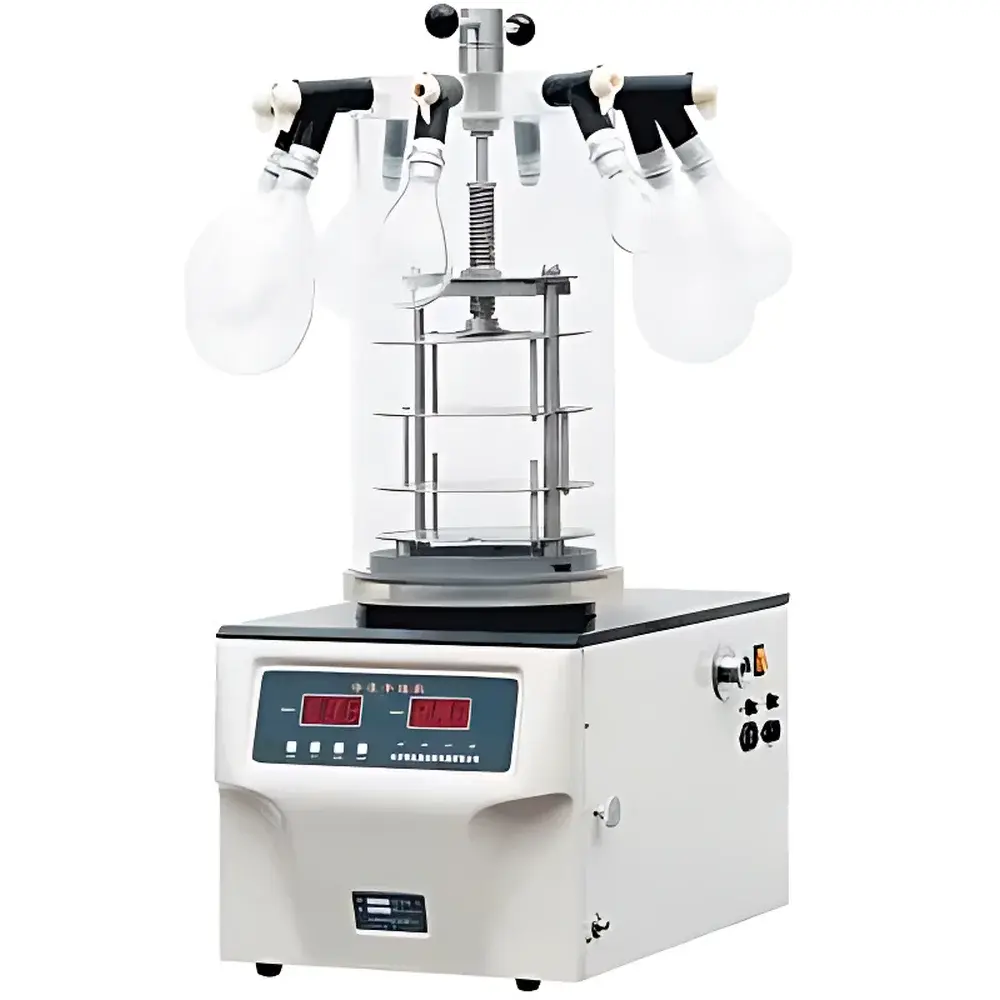
Chu Ding Technology FD-1D-50 / LGJ-12 Benchtop Lyophilizer with Stoppering and Manifold Configuration
| Brand | Chu Ding Technology |
|---|---|
| Origin | Shanghai, China |
| Model | FD-1D-50 / LGJ-12 |
| Cold Trap Temperature | ≤ −50 °C |
| Ultimate Vacuum | < 20 Pa |
| Freeze-Drying Area | 0.07 m² |
| Shelf Loading Capacity | 0.7 L (bulk) |
| Condenser Capacity | 3 kg/24 h |
| Condenser Dimensions | Φ220 × 130 mm |
| Shelf Diameter | Φ200 mm × 3 shelves |
| Manifold Ports | 8 × standard ground-glass ports (accepting 100/250/500/1000 mL flasks) |
| Power Supply | 220 V, 50 Hz, 850 W |
| Dimensions (W×D×H) | 380 × 600 × 345 mm |
| Construction | Stainless steel condenser chamber, transparent acrylic drying chamber, integrated pre-freezing capability |
Overview
The Chu Ding Technology FD-1D-50 / LGJ-12 is a compact, benchtop vacuum freeze dryer engineered for reliable lyophilization of heat-sensitive biological and pharmaceutical samples in research and quality control laboratories. It operates on the principle of sublimation under deep vacuum and low-temperature conditions—where ice transitions directly from solid to vapor without passing through the liquid phase. This process preserves structural integrity, bioactivity, and long-term stability of labile compounds including proteins, vaccines, monoclonal antibodies, enzymes, and microbial cultures. The system integrates a dedicated condenser capable of reaching ≤ −50 °C, ensuring efficient water vapor capture during primary drying and minimizing re-condensation risks. Its dual-mode configuration supports both bulk tray drying and manifold-based flask drying—enabling flexibility across sample formats while maintaining consistent process control within a footprint optimized for limited bench space.
Key Features
- Benchtop design with ergonomic footprint (380 × 600 × 345 mm), minimizing laboratory spatial requirements without compromising performance.
- Hermetically sealed, imported rotary compressor delivering stable refrigeration performance and low acoustic emission (< 55 dB(A)) for quiet operation in shared lab environments.
- Stainless steel condenser chamber (Φ220 × 130 mm) with smooth internal surface—no embedded cooling coils—to prevent frost accumulation and facilitate rapid cleaning and validation.
- Patented baffle-guided airflow architecture increases effective condensing surface area, accelerating moisture removal and improving batch reproducibility.
- Large-diameter cold trap opening enables direct pre-freezing of samples on shelves prior to vacuum initiation—eliminating the need for external ultra-low temperature freezers.
- Optically transparent acrylic drying chamber with reinforced safety seal allows real-time visual monitoring of sublimation progress and cake formation.
- Digital vacuum and condenser temperature display with ±0.5 °C and ±1 Pa resolution; optional shelf temperature probe available for process-critical applications requiring thermal profiling.
- Standardized KF-16 vacuum interface compatible with common lab-grade vacuum pumps—including optional integration with certified oil-free or turbomolecular systems meeting ISO 8573-1 Class 0 air purity standards.
- Imported solenoid-controlled inert gas inlet valve enabling controlled backfilling with dry nitrogen or argon post-drying—critical for oxygen-sensitive formulations and aseptic handling protocols.
Sample Compatibility & Compliance
The FD-1D-50 / LGJ-12 accommodates diverse sample geometries: bulk material on three removable Φ200 mm stainless steel shelves (total 0.07 m² active area), or up to eight conical flasks via its T-shaped manifold (compatible with 100 mL, 250 mL, 500 mL, and 1000 mL ground-glass neck vessels). Its design conforms to fundamental engineering requirements outlined in ISO 22042:2017 (freeze-drying equipment specifications) and supports alignment with Good Manufacturing Practice (GMP) and Good Laboratory Practice (GLP) workflows when operated with documented procedures and calibrated instrumentation. While not inherently 21 CFR Part 11 compliant, the system’s analog/digital interface permits integration with validated data acquisition platforms supporting electronic signatures, audit trails, and secure archiving—essential for regulated biopharmaceutical development and QC release testing.
Software & Data Management
This model operates as a stand-alone instrument with local digital readouts for condenser temperature and chamber pressure. For advanced process documentation, it is fully compatible with third-party PC-based data loggers equipped with RS-232 or USB-to-serial interfaces. Users may configure time-stamped logging of vacuum level, condenser temperature, and optional shelf thermocouple signals at user-defined intervals (e.g., 1–30 s). Such datasets support critical quality attribute (CQA) mapping, cycle optimization studies, and deviation investigations per ICH Q5C and Q5D guidelines. When paired with validated software suites, raw logs can be exported in CSV or PDF formats suitable for regulatory submission and internal review archives.
Applications
- Stabilization of diagnostic reagents, reference standards, and clinical trial materials requiring extended ambient storage stability.
- Preparation of lyophilized cell culture media components, growth factors, and transfection reagents without thermal degradation.
- Processing of microbial strains (bacteria, yeasts, fungi) for long-term cryopreservation and strain banking per ATCC and DSMZ protocols.
- Routine drying of HPLC fractions, natural product extracts, and synthetic intermediates prior to structural characterization (NMR, MS).
- Method development and small-batch production of sterile injectables, nasal sprays, and ophthalmic formulations under non-aseptic but controlled environmental conditions.
- Academic research in food science (e.g., probiotic powder formulation), material science (aerogel precursor synthesis), and nanotechnology (porous scaffold fabrication).
FAQ
What is the maximum allowable sample volume per batch in bulk mode?
The unit supports up to 0.7 L of aqueous solution loaded across three Φ200 mm shelves, assuming uniform distribution and optimal freezing conditions.
Can this system be used for terminal sterilization of vials?
No—it lacks steam sterilization capability, HEPA filtration, or isolator integration required for aseptic fill-finish operations. It is intended for non-sterile lyophilization followed by aseptic transfer under laminar flow.
Is the condenser temperature actively controllable or fixed?
The condenser operates at a fixed setpoint of ≤ −50 °C, maintained continuously by the dual-stage refrigeration circuit. No user-adjustable temperature ramping is provided.
Does the system include vacuum pump and accessories?
The FD-1D-50 / LGJ-12 is supplied as a主机 only. A vacuum pump, silicone vacuum tubing, manifold flasks, and stoppering tools are available as optional accessories or bundled configurations.
What maintenance intervals are recommended for long-term reliability?
Compressor oil inspection every 12 months; condenser cleaning after each 50 drying cycles or if visible frost buildup persists beyond normal defrost cycles; O-ring replacement every 24 months or upon signs of vacuum leakage.



