
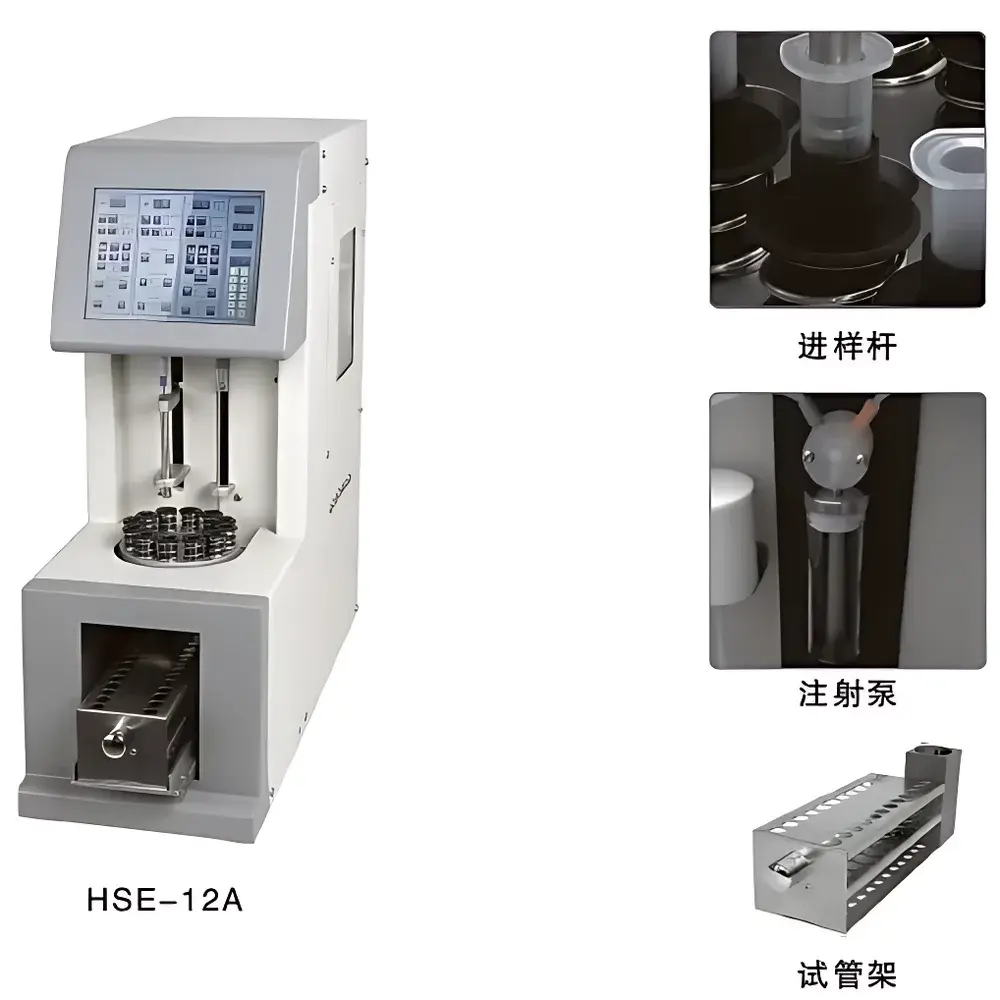
Chu Ding HSE-12A Fully Automated Solid Phase Extraction System
| Brand | Chu Ding |
|---|---|
| Origin | Shanghai, China |
| Manufacturer Type | Authorized Distributor |
| Product Origin | Domestic (China) |
| Model | HSE-12A |
| Price | USD 40,200 (FOB Shanghai) |
| Automation Level | Fully Automated |
| Channel Count | Single Channel |
| Extraction Mode | Cartridge-Based SPE |
| Flow Rate Control | 0.1–100 mL/min |
| Solvent Selection | 7 Independent Solvent Lines |
| Sample Capacity | 12 Positions |
| Sample Loading Volume | 0–25 mL per Cycle |
| Wetted Materials | PTFE Only |
| Pump Accuracy | ±0.5% |
| Column Compatibility | 1 mL & 3 mL SPE Cartridges |
| Pressure Monitoring Range | 0–2.0 MPa (Alarm Threshold: 0.2 MPa) |
| Drying Gas Input | 80 psi (552 kPa), Output: 30 psi (207 kPa) |
| Waste Collection | Three Independent Waste Streams (A/B/C) |
| Power Supply | 220 V AC / 50 Hz |
| Power Consumption | 100 W |
| Net Weight | 18 kg |
Overview
The Chu Ding HSE-12A Fully Automated Solid Phase Extraction System is an engineered solution for high-reproducibility sample preparation in regulated analytical laboratories. It implements positive-pressure, syringe-pump-driven cartridge-based solid phase extraction (SPE) — a method grounded in selective adsorption and elution principles defined by ISO 17025-compliant sample preparation workflows. Unlike vacuum manifold or gravity-fed systems, the HSE-12A applies controlled, programmable pressure via a precision PTFE-wetted plunger to drive samples and solvents through SPE cartridges, eliminating dead-volume carryover and ensuring consistent bed contact between eluent and sorbent. This architecture enables strict adherence to validated protocols such as GB/T 19648–2005 (446-pesticide multiresidue analysis in fruits/vegetables), NY/T 761–2004 (organophosphate and organochlorine residue quantification), and SC/T 3021–2004 (malachite green detection in aquaculture products). Designed for integration into LC-MS/MS, GC-MS, and HPLC workflows, the system reduces matrix interference, extends chromatographic column lifetime, and improves signal-to-noise ratios by delivering cleaner, concentrated extracts.
Key Features
- PTFE-only fluidic path ensures chemical inertness with aggressive solvents (e.g., acetonitrile, dichloromethane, methanol) and prevents metal leaching or adsorptive losses of polar analytes.
- Single-channel, high-precision syringe pump (±0.5% volumetric accuracy) delivers repeatable loading, washing, and elution volumes from 0 to 25 mL per cycle.
- 7-solvent selection valve with on-the-fly volumetric mixing capability (0–10 blending cycles per step) supports gradient elution and multi-step cleanup protocols.
- Pressure-sensing plunger mechanism dynamically adjusts contact force against SPE bed — accommodating variable packing densities across 1 mL and 3 mL cartridges without channeling or breakthrough.
- Automated 3-axis robotic handler with imported PTFE-coated lead screws enables precise positioning of sample vials, SPE cartridges, and collection tubes across all 12 positions.
- Real-time pressure monitoring (0–2.0 MPa range) with configurable alarm threshold (0.2 MPa) halts operation upon clogging detection, protecting hardware and preserving method integrity.
- Three independent waste streams (A/B/C) allow segregated disposal of conditioning, washing, and elution effluents — critical for solvent recycling or hazardous waste classification compliance.
- Touchscreen HMI with wireless interface supports full method programming: individual control of activation, loading, washing, and elution steps; pause/resume functionality; and visual step-by-step status tracking.
Sample Compatibility & Compliance
The HSE-12A accommodates complex, high-particulate matrices including homogenized plant tissues (tobacco, tea, herbal medicines), animal-derived samples (muscle, liver, serum), aquatic products (shrimp, fish fillets), and environmental water/sludge extracts. Its PTFE-sealed plunger design minimizes analyte adsorption for labile compounds (e.g., carbamates, triazoles, sulfonamides), while programmable flow rates (0.1–100 mL/min) support both slow-loading of viscous extracts and rapid solvent displacement during drying steps. The system meets core requirements of GLP and GMP environments: audit-trail-enabled software logs all user actions, method changes, and instrument events; electronic signatures are supported per FDA 21 CFR Part 11 when integrated with compliant LIMS. It conforms to ISO/IEC 17025:2017 Annex A.3 for method validation documentation and aligns with ASTM D7298–18 (standard practice for SPE in environmental analysis).
Software & Data Management
The embedded firmware provides a modular method editor supporting up to 40 stored protocols, each assignable to specific cartridge types and sample classes. Users define volume, flow rate, dwell time, solvent sequence, and collection tube mapping per step. All parameters — including mixing iterations, pause durations, and pressure thresholds — are editable and version-controlled. Method comparison tools highlight parameter deltas across revisions. During execution, the interface displays live progress indicators: syringe position, current solvent line, real-time pressure readout, and active collection tube index. Raw event logs (timestamped start/stop, error codes, pressure spikes) export in CSV format for QA review. No cloud dependency: all data resides locally on the onboard industrial-grade SSD, with optional USB backup.
Applications
- Pesticide multiresidue analysis in food safety testing labs (GB/T 19648–2005, EN 15662:2018).
- Veterinary drug residue quantification in aquaculture and livestock products (SC/T 3021–2004, EU Commission Decision 2002/657/EC).
- Environmental contaminant screening (PAHs, PCBs, PBDEs) in wastewater, sediment, and soil extracts per EPA Method 3535A.
- Biomonitoring studies requiring clean-up of human urine or plasma prior to LC-MS/MS analysis of mycotoxins or endocrine disruptors.
- Phytochemical isolation workflows in natural product research where fractionation reproducibility directly impacts downstream NMR or HRMS identification.
FAQ
Does the HSE-12A support method validation per ICH Q2(R2) guidelines?
Yes — its deterministic fluid handling, pressure-based endpoint detection, and full audit trail generation satisfy specificity, accuracy, precision, and robustness documentation requirements.
Can the system be integrated with third-party LIMS or CDS platforms?
It supports ASCII-based serial communication (RS-232) and Modbus TCP for bidirectional command exchange and status reporting.
What maintenance intervals are recommended for long-term reliability?
PTFE plungers and injection needles require inspection every 500 cycles; solvent lines should be flushed weekly with IPA/water; pressure sensor calibration is advised annually.
Is column over-pressurization protection configurable per method?
Yes — maximum allowable pressure can be set independently for each step (activation, load, wash, elute) to match sorbent compressibility and solvent viscosity.
How does the system handle particulate-laden samples?
Pre-filtration (0.45 µm PTFE membrane) is required upstream; the plunger’s positive-pressure delivery minimizes filter clogging compared to vacuum-based systems.



