
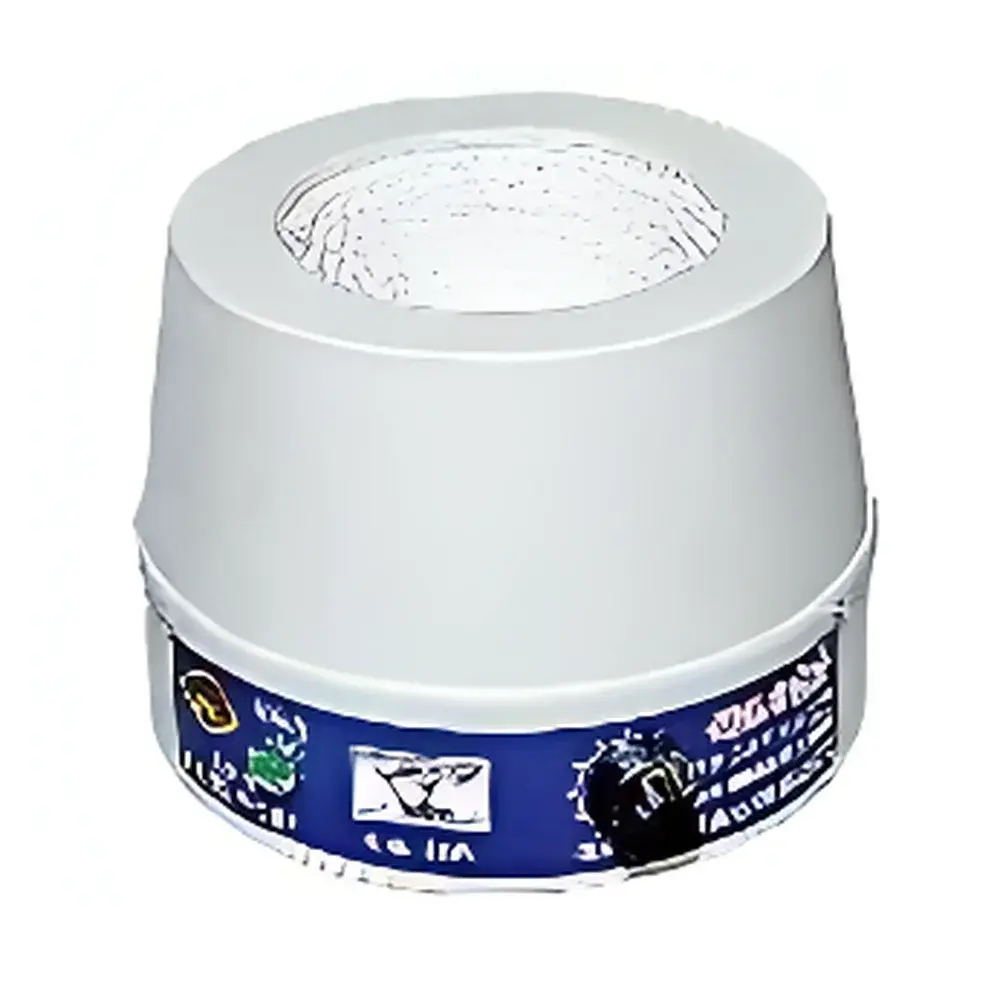
LabTech TempControl Pro Series 250 mL Adjustable Temperature Electric Heating Mantle
| Origin | Shanghai, China |
|---|---|
| Manufacturer Type | Authorized Distributor |
| Product Origin | Domestic (China) |
| Capacity | 250 mL |
| Max Operating Temperature | 380 °C |
| Heating Power | 150 W |
| Voltage | 220 V AC, 50 Hz |
| Temperature Control | Electronic PID with Analog Dial & Digital Readout |
| Housing Material | Cold-Rolled Steel with Electrostatic Epoxy Coating |
| Compliance | CE-marked, RoHS-compliant, IEC 61010-1 Safety Certified |
Overview
The LabTech TempControl Pro Series 250 mL Adjustable Temperature Electric Heating Mantle is a precision-engineered laboratory heating device designed for controlled, uniform thermal input to glassware during reflux, distillation, synthesis, and solvent evaporation procedures. Unlike open-flame or hotplate-based heating, this mantle employs resistive heating elements embedded within a flexible, conformal ceramic-fiber insulation matrix—ensuring optimal thermal coupling with round-bottom flasks and other cylindrical vessels. Its core operational principle relies on Joule heating combined with passive thermal mass stabilization and closed-loop electronic temperature regulation. Engineered for reproducibility in academic teaching labs, QC environments, and R&D settings, the unit delivers stable setpoint maintenance (±3 °C typical deviation across 50–350 °C range) without direct contact between heating elements and vessel surfaces—minimizing thermal shock risk and eliminating hot-spot formation. The 250 mL capacity variant is optimized for standard 250 mL round-bottom flasks (e.g., ASTM E287, ISO 1773), supporting applications requiring moderate volume throughput and precise thermal ramping profiles.
Key Features
- Robust cold-rolled steel housing with electrostatic epoxy powder coating—resistant to chemical splashes, abrasion, and long-term UV exposure in lab environments.
- Electronic PID temperature controller with analog adjustment dial and dual-digit LED display (0–380 °C range, 1 °C resolution), enabling repeatable setpoint programming and manual fine-tuning.
- Uniform heat distribution achieved via spiral-wound nickel-chromium resistance wire embedded in high-density ceramic fiber insulation—ensuring >92% thermal transfer efficiency to standard borosilicate glassware.
- No external moving parts or fans; convection-free operation eliminates airflow-induced cooling artifacts and maintains laminar thermal gradients around the flask.
- Integrated over-temperature protection circuit (independent of main controller) that automatically cuts power if internal sensor detects >400 °C—complying with IEC 61010-1 Clause 7.3.2 for Class II equipment.
- Low-profile ergonomic design with non-slip rubber base and integrated cable management slot—compatible with standard lab bench layouts and fume hood installations.
Sample Compatibility & Compliance
The TempControl Pro 250 mL mantle accommodates standard 250 mL round-bottom flasks (24/40 joint), as well as interchangeable adapters for 100 mL and 500 mL vessels (sold separately). It is compatible with borosilicate glass (e.g., Pyrex®, Duran®), quartz, and PTFE-coated containers rated for continuous use up to 380 °C. The device meets essential safety and electromagnetic compatibility requirements per CE Directive 2014/30/EU (EMC) and 2014/35/EU (LVD), and conforms to RoHS 2011/65/EU restrictions on hazardous substances. While not classified as GMP-grade instrumentation, its design supports GLP-aligned documentation practices—including traceable calibration records (recommended annually using NIST-traceable thermocouple probes) and audit-ready operational logs when paired with optional data logging accessories.
Software & Data Management
This model operates as a standalone analog-digital hybrid instrument with no embedded firmware or network interface. However, it is fully compatible with third-party USB thermocouple data loggers (e.g., Omega OM-DAQPRO-5300, Testo 176 T4) for time-stamped temperature profiling and export to CSV or Excel formats. For regulated environments requiring 21 CFR Part 11 compliance, LabTech offers an optional RS-485 communication module (TCM-250-485) enabling integration into LIMS or SCADA systems with full audit trail support—including user authentication, parameter change history, and electronic signature capability. All firmware updates and calibration certificates are distributed via LabTech’s secure customer portal—accessible only to registered institutional accounts.
Applications
- Controlled reflux reactions in organic synthesis (e.g., esterification, Grignard preparations) where consistent bath temperature prevents side-product formation.
- Solvent removal under reduced pressure using rotary evaporators—paired with vacuum-compatible mantles to avoid seal degradation at elevated temperatures.
- Standardized moisture content determination per ASTM D1555M (toluene distillation method) and ISO 12901-2 (industrial oils).
- Calibration of liquid-in-glass thermometers and RTDs using fixed-point reference baths (e.g., paraffin wax melt at 48 °C, stearic acid at 69 °C).
- Accelerated stability testing of pharmaceutical intermediates per ICH Q1A(R2), maintaining isothermal conditions for defined durations under inert atmosphere.
FAQ
What flask sizes are supported without adapters?
The 250 mL model is dimensionally optimized for standard 250 mL round-bottom flasks with 24/40 ground-glass joints. Flasks ranging from 150–300 mL may be used with acceptable thermal contact.
Is the unit suitable for use under inert gas or vacuum?
Yes—its sealed construction and absence of ventilation openings make it compatible with nitrogen-purged or vacuum-reflux setups, provided the flask and condenser are appropriately rated.
Does it include a calibration certificate?
Factory calibration is performed at three points (100 °C, 250 °C, 350 °C) using NIST-traceable reference thermometers; a certificate of conformance is included. Full ISO/IEC 17025 calibration is available upon request.
Can multiple units be daisy-chained for synchronized control?
No—each unit operates independently. Synchronized operation requires external PLC-level integration via the optional RS-485 module and custom scripting.
What maintenance is required?
Annual visual inspection of insulation integrity and terminal tightness is recommended. No routine lubrication or consumable replacement is needed due to solid-state construction.



