
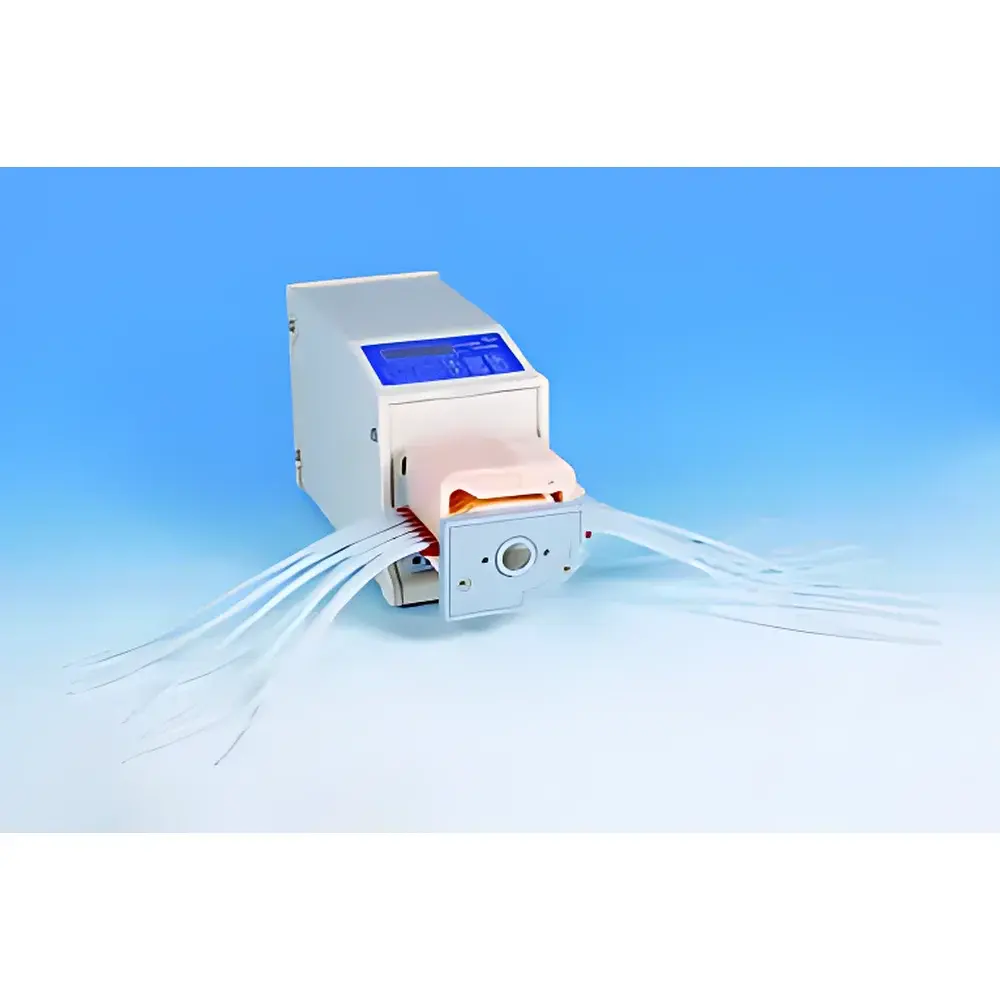
BT100-8 Eight-Channel Digital Constant-Flow Peristaltic Pump
| Origin | Shanghai, China |
|---|---|
| Manufacturer Type | Authorized Distributor |
| Country of Origin | China |
| Model | BT100-8 |
| Dimensions (W×D×H) | 120 × 310 × 120 mm |
| Channels | 8 independent channels with digital RPM display |
| Flow Rate per Channel | 0.3–5000 mL/h |
| Minimum Flow Resolution | 0.1 mL/h |
| Maximum Pressure | ≥2.5 kg/cm² (≈245 kPa) |
| Power Supply | AC 220 V ±10%, 50/60 Hz |
Overview
The BT100-8 Eight-Channel Digital Constant-Flow Peristaltic Pump is a precision-engineered laboratory fluid handling system designed for simultaneous, independent delivery of multiple reagents, buffers, or process streams under tightly controlled volumetric flow conditions. Based on the principle of peristaltic pumping—where rollers compress flexible tubing to generate positive displacement—the BT100-8 eliminates fluid contact with mechanical components, ensuring contamination-free operation and full chemical compatibility with a wide range of solvents, aqueous solutions, cell suspensions, and viscous media up to 5000 cP. Its constant-flow architecture maintains consistent volumetric output across varying backpressure conditions (up to 245 kPa), making it suitable for applications requiring high reproducibility in multi-stream infusion, continuous bioreactor feeding, parallel reaction monitoring, and automated sample preparation workflows.
Key Features
- Eight independent pump channels, each equipped with a dedicated digital LED display showing real-time rotational speed (RPM) and enabling precise channel-by-channel calibration.
- Wide adjustable flow range per channel: 0.3–5000 mL/h, achieved via stepless speed control (0–600 RPM typical range) and compatible with tubing inner diameters from 0.5 mm to 4.8 mm (e.g., PharMed® BPT, Tygon® LFL, Norprene®).
- Robust aluminum alloy chassis with optimized heat dissipation and low-vibration stepper motor drive, ensuring long-term stability and minimal pulsation (<5% peak-to-peak variation at mid-range flow rates).
- Front-panel membrane keypad with intuitive navigation; supports manual operation, preset program recall, and emergency stop functionality.
- Modular design allows seamless integration into OEM systems or custom lab automation racks; optional RS-485 serial interface available for remote command control (Modbus RTU protocol).
- Compliance-ready construction: CE-marked, RoHS-compliant, and built to meet IEC 61000-6-2 (EMC immunity) and IEC 61000-6-4 (EMC emission) standards.
Sample Compatibility & Compliance
The BT100-8 is inherently chemically inert—fluid path consists solely of certified pharmaceutical-grade tubing (user-supplied), eliminating metal or elastomer leaching risks. It accommodates shear-sensitive biological samples including mammalian cell cultures, enzyme solutions, and protein formulations without denaturation or foaming. For regulated environments, the pump supports GLP/GMP-aligned documentation practices: all operational parameters (channel ID, RPM, duration, start/stop timestamps) can be logged externally via serial output. While not FDA 21 CFR Part 11–certified out-of-the-box, its deterministic behavior, audit-trail-capable firmware (v2.3+), and hardware interlock design facilitate validation under ISO 13485 or Annex 11 requirements when deployed within validated systems.
Software & Data Management
Although the BT100-8 operates as a standalone instrument, its RS-485 interface enables bidirectional communication with third-party SCADA platforms, LabVIEW™ virtual instruments, or Python-based control scripts using open Modbus register mapping. Users may configure multi-stage flow profiles (e.g., ramp-up, hold, ramp-down) across selected channels and synchronize timing with external triggers (TTL input). All configuration settings—including channel-specific speed offsets for tubing wear compensation—are retained in non-volatile memory after power cycling. Optional PC software (BT-Control Suite v3.1) provides graphical real-time monitoring, CSV export of runtime logs, and batch export of calibration coefficients traceable to NIST-traceable flow standards.
Applications
- Parallelized chromatography fraction collection across eight HPLC or FPLC columns.
- Continuous nutrient feeding and pH-stat/peristaltic acid/base dosing in stirred-tank bioreactors (5–20 L scale).
- High-throughput screening (HTS) liquid handling in drug discovery labs—precise reagent addition to 96-/384-well plates via manifold manifolds.
- Environmental water quality monitoring: simultaneous dosing of titrants, buffers, and preservatives into multi-parameter analyzers.
- Chemical synthesis reactors requiring stoichiometric co-feeding of catalysts, monomers, and initiators under inert atmosphere.
- Educational laboratories demonstrating mass balance, residence time distribution (RTD), and cascade reaction kinetics.
FAQ
What tubing sizes are recommended for optimal performance at maximum flow (5000 mL/h)?
For sustained 5000 mL/h operation per channel, use silicone or thermoplastic elastomer tubing with an inner diameter of 4.8 mm (e.g., Masterflex® LS-17, ID 4.8 mm, wall thickness 2.4 mm) mounted on standard YZ15 or YZ25 pump heads.
Does the BT100-8 support flow calibration against gravimetric or volumetric standards?
Yes—each channel includes a user-accessible calibration mode allowing entry of correction factors derived from timed gravimetric measurements (ASTM D1193 Class III water, analytical balance ±0.001 g resolution). Calibration data is stored per channel.
Can individual channels be paused or reversed during operation?
Channels operate independently; pause/resume is supported per channel via front-panel controls or Modbus command. Reversal is not implemented—peristaltic pumps are unidirectional by mechanical design to preserve tubing life and flow linearity.
Is there a service interval recommendation for routine maintenance?
Inspect tubing compression and roller alignment every 500 operating hours; replace tubing proactively based on visible deformation or flow deviation >±2%. No lubrication or internal servicing is required during normal use.
How does the BT100-8 handle variable backpressure from inline filters or membrane modules?
Its constant-flow control algorithm dynamically adjusts motor torque to maintain set RPM—and thus volumetric flow—within ±1.5% accuracy across the specified pressure range (0–245 kPa), verified per ISO 8536-4 Annex C test protocols.



