
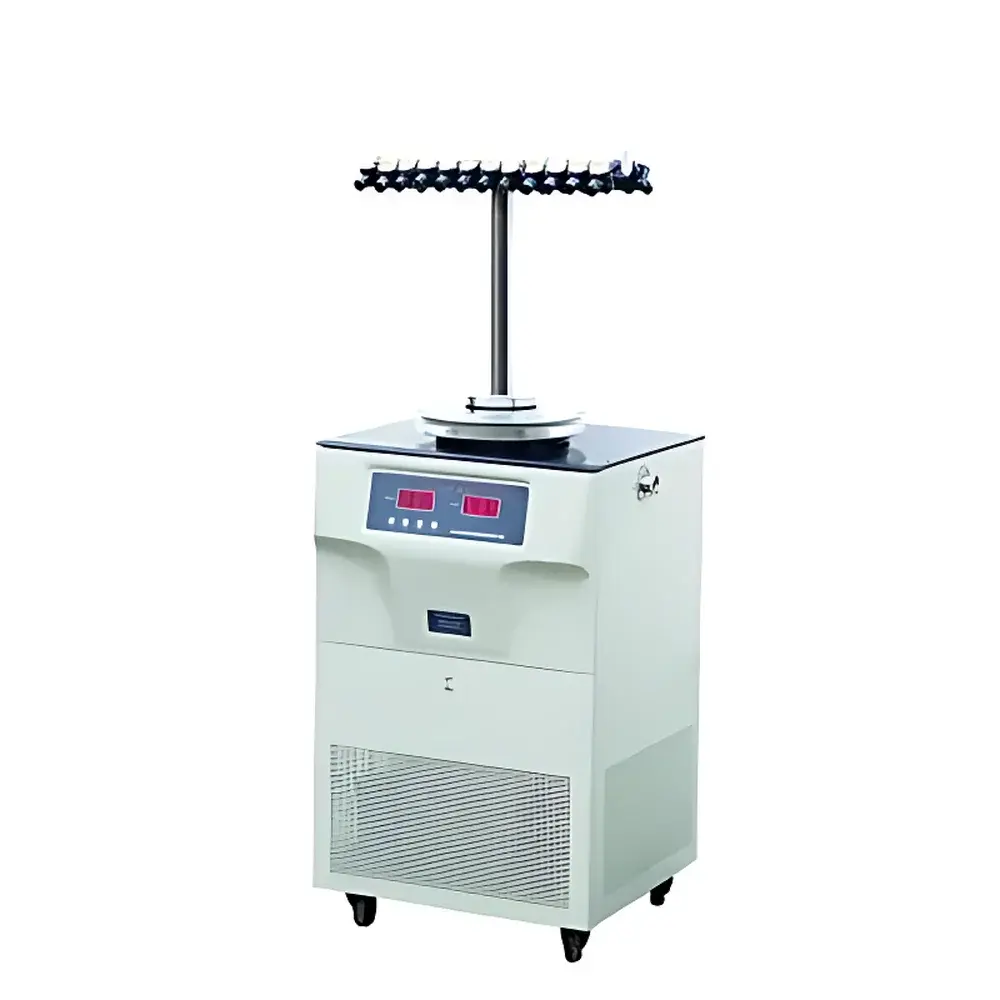
LabTech FD-1E-80 T-Manifold Ultra-Low Temperature Freeze Dryer
| Origin | Shanghai, China |
|---|---|
| Manufacturer Type | Authorized Distributor |
| Origin Category | Domestic (China) |
| Model | FD-1E-80 |
| Price | USD 7,050 (FOB Shanghai) |
| Condenser Temperature | ≤ −80 °C |
| Ultimate Vacuum | < 20 Pa |
| Ice Capacity | 4 kg/24 h |
| Condenser Dimensions | Φ200 × 200 mm |
| Chamber Material | Transparent Acrylic Bell Jar |
| Refrigeration System | Dual-Stage Cascade Compressor |
| Power Supply | 220 V, 50 Hz, 1300 W |
| Overall Dimensions | 492 × 540 × 800 mm |
| Sample Compatibility | T-manifold with up to 8× Ø24 mm glass vials or 24× standard culture tubes |
| Data Display | Digital LED panel for real-time condenser temperature and chamber pressure |
Overview
The LabTech FD-1E-80 T-Manifold Ultra-Low Temperature Freeze Dryer is a laboratory-scale lyophilization system engineered for precise, reproducible freeze drying of heat-sensitive biologicals, pharmaceutical intermediates, and organic-solvent-based formulations. It operates on the principle of sublimation under high vacuum: frozen water (or solvent) transitions directly from solid to vapor phase without passing through liquid state—preserving structural integrity, bioactivity, and chemical stability. The system employs a dual-stage cascade refrigeration architecture with two hermetically sealed compressors, enabling sustained condenser temperatures ≤ −80 °C—critical for efficient trapping of volatile solvents such as ethanol, acetone, or ethyl acetate commonly used in peptide synthesis or botanical extract processing. Unlike single-stage systems, this configuration ensures thermal stability during extended cycles and minimizes condenser frost buildup, thereby maintaining consistent vacuum integrity throughout primary and secondary drying stages.
Key Features
- Compact vertical footprint (492 × 540 × 800 mm) with integrated casters for flexible lab placement and mobility.
- Stainless-steel condenser chamber (Φ200 × 200 mm) featuring smooth, coil-free interior surface—enhancing cleanability, corrosion resistance, and ice release efficiency.
- Patented baffle-guided airflow design increases effective condensing surface area by >25%, accelerating vapor migration and reducing cycle time.
- T-shaped manifold interface with eight standardized 24/29 mm O-ring ports—compatible with borosilicate glass vials, serum bottles, and custom adapters per ISO 8362-1 and USP specifications.
- Digital LED control panel displaying real-time condenser temperature (±0.5 °C accuracy) and chamber pressure (0–100 Pa range, ±2 Pa resolution).
- Imported solenoid gas inlet valve supporting controlled backfilling with dry nitrogen or argon—enabling inert-atmosphere sealing post-drying per ICH Q5C stability guidelines.
- Acrylic bell-jar drying chamber with reinforced wall thickness (≥12 mm) and certified impact resistance—meets EN 61000-6-3 EMC safety requirements.
Sample Compatibility & Compliance
The FD-1E-80 supports diverse sample formats including microbiological cultures, monoclonal antibody solutions, enzyme preparations, small-molecule APIs, and botanical extracts dissolved in mixed aqueous-organic solvents. Its −80 °C condenser enables reliable capture of solvents with vapor pressures above 10 Pa at −40 °C (e.g., methanol, THF), extending applicability beyond aqueous-only systems. The unit complies with key regulatory expectations for lab-scale lyophilizers: vacuum interface conforms to ISO-KF16 standard; pressure sensors are NIST-traceable; stainless-steel wetted parts meet ASTM A240 Type 304 requirements. While not GMP-certified out-of-box, its architecture supports IQ/OQ documentation protocols and integrates seamlessly with GLP-compliant data loggers for 21 CFR Part 11–aligned audit trails when paired with validated external software.
Software & Data Management
The FD-1E-80 operates in standalone mode with no embedded firmware or proprietary software—ensuring long-term serviceability and eliminating vendor lock-in. All operational parameters (condenser temp, chamber pressure, runtime) are logged locally via analog output signals (0–5 V DC) compatible with third-party DAQ systems (e.g., National Instruments CompactDAQ, LabVIEW). Optional RS-485 Modbus RTU interface allows integration into centralized lab monitoring platforms. For full-cycle documentation, users may connect calibrated external thermocouples (Type T or K) to sample shelves and feed data into compliant ELN systems supporting electronic signatures and version-controlled SOP execution.
Applications
- Stabilization of thermolabile biologics: recombinant proteins, viral vectors, and live-attenuated vaccines prior to storage or transport.
- Preparation of reference standards for HPLC and mass spectrometry—minimizing degradation artifacts induced by residual moisture or solvent residues.
- Lyophilization of nanosuspensions and liposomal formulations where pore structure preservation directly impacts reconstitution kinetics.
- Routine dehydration of environmental samples (soil, water filters) for subsequent elemental analysis by ICP-MS or XRF.
- Process development support for scale-up to pilot-scale shelf dryers—leveraging identical condenser thermodynamics and vacuum dynamics.
FAQ
What types of solvents can be safely lyophilized using the FD-1E-80?
The −80 °C condenser effectively traps solvents with boiling points below 100 °C and vapor pressures ≤ 50 Pa at −40 °C—including acetonitrile, dichloromethane, and tert-butanol—provided appropriate pump oil conditioning and cold trap pre-chilling protocols are followed.
Is the system compatible with external vacuum pumps?
Yes. The KF16 vacuum port accepts standard ISO-KF fittings; recommended pump capacity is ≥ 4 m³/h with ultimate vacuum ≤ 5 × 10⁻² Pa (e.g., Edwards RV8 or Leybold DRA-100).
Can the T-manifold be replaced with other configurations?
The base unit supports interchangeable manifold modules: standard bell jar (FD-1A-80), stoppering chamber (FD-1C-80), and multi-port hanging flange (FD-1D-80)—all sharing identical refrigeration and vacuum subsystems.
Does the unit include validation documentation?
No factory-issued IQ/OQ documents are supplied; however, mechanical and electrical schematics, material certifications (RoHS/REACH), and CE Declaration of Conformity are provided upon request for internal validation use.
What maintenance intervals are recommended?
Compressor oil replacement every 3,000 operating hours; condenser cleaning after each 10–15 batches involving organic solvents; annual calibration of pressure sensor and temperature probe against traceable standards.



