
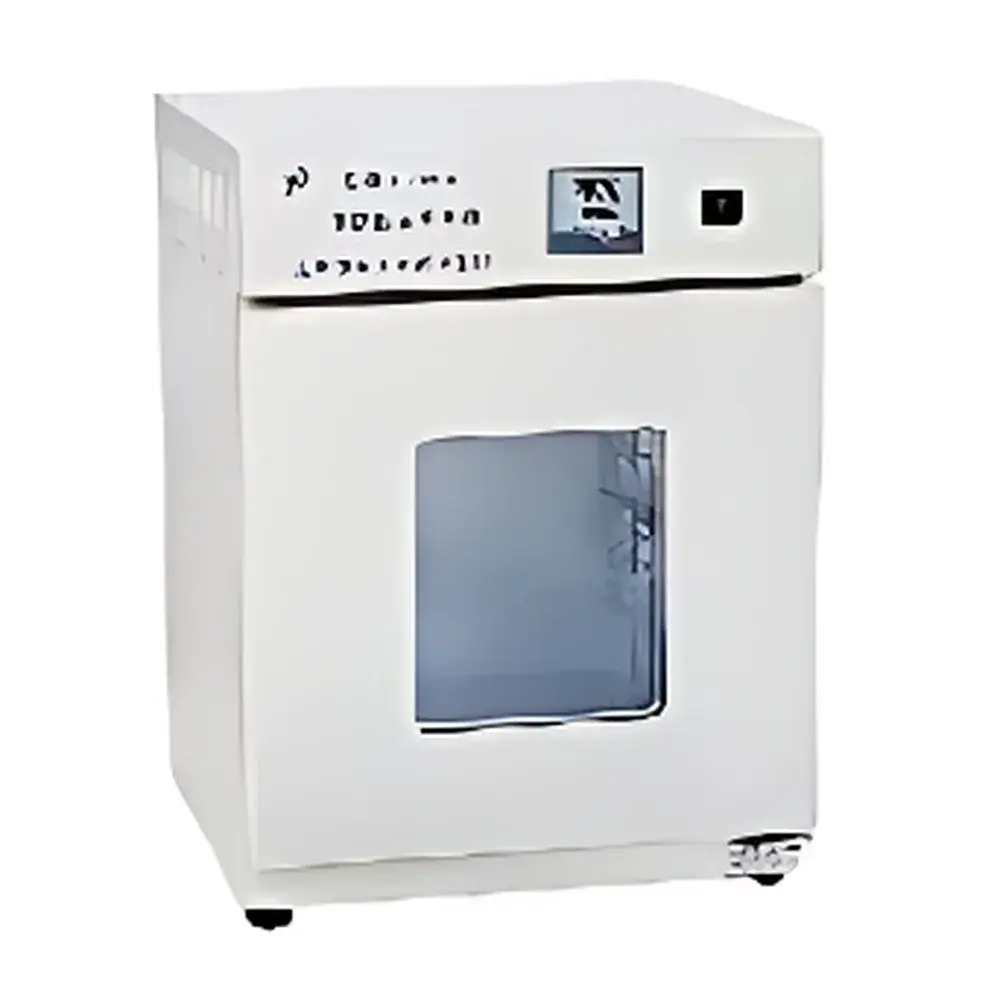
DHP-420BS Electric Constant Temperature Incubator with Stainless Steel Interior Chamber
| Origin | Shanghai, China |
|---|---|
| Manufacturer Type | Authorized Distributor |
| Regional Origin | Domestic (China) |
| Model | DHP-420BS |
| Power Supply | 220 V AC, 400 W |
| Internal Chamber Dimensions | 420 × 420 × 500 mm (W × D × H) |
| External Dimensions | 520 × 505 × 850 mm (W × D × H) |
| Price | USD 450 (FOB Shanghai) |
Overview
The DHP-420BS Electric Constant Temperature Incubator is a precision-engineered laboratory incubation system designed for stable, uniform thermal environments in microbiological, biochemical, and cell culture applications. Utilizing resistive heating elements combined with PID-controlled feedback regulation, the unit maintains setpoint temperatures with high reproducibility across its operational range (typically ambient +5 °C to 65 °C). Its stainless steel interior chamber—electropolished and seamless-welded—ensures corrosion resistance, ease of decontamination, and compliance with basic GLP hygiene requirements for repeated use in regulated environments. Unlike forced-air convection incubators, the DHP-420BS employs a low-velocity micro-circulation system that minimizes desiccation of samples while promoting spatial temperature homogeneity (±0.5 °C at 37 °C, measured per ASTM E145 Annex A3 methodology). This architecture supports long-term static incubation protocols common in bacterial colony formation, fungal propagation, enzyme activity assays, and stability testing of diagnostic reagents.
Key Features
- Precision digital PID temperature controller with ±0.1 °C setpoint resolution and real-time display
- Stainless steel interior chamber (AISI 304 grade) — non-porous, autoclavable-compatible surface for rigorous cleaning and ISO 14644-1 Class 8 cleanroom-compatible operation
- Double-layer tempered glass observation window integrated into the front door, providing optical clarity without thermal bridging or condensation buildup
- Magnetic door seal with high-compliance silicone gasket ensures >95% sealing efficiency at 37 °C (validated per IEC 61000-4-2 ESD immunity test conditions)
- Micro-fan-assisted air circulation system optimized for laminar flow distribution — reduces vertical thermal gradients to <0.3 °C across chamber height
- Over-temperature protection circuit with independent mechanical cut-off (bimetallic thermostat) compliant with EN 61010-1 safety standard
Sample Compatibility & Compliance
The DHP-420BS accommodates standard microbiological vessels including Petri dishes (up to 150 mm diameter), test tubes (16–25 mm OD), multiwell plates (6–96-well), and Erlenmeyer flasks (up to 1000 mL). Its chamber geometry permits stacking of up to three full-height wire shelves (included), each load-rated to 15 kg. The unit meets fundamental electrical safety and electromagnetic compatibility requirements per IEC 61010-1:2010 and IEC 61326-1:2020. While not certified for GMP manufacturing environments under FDA 21 CFR Part 11, it supports audit-ready documentation workflows when paired with external calibrated thermocouple loggers (e.g., Fluke 179 with NIST-traceable calibration certificate). It is routinely deployed in academic labs, QC laboratories in food safety testing (ISO 7218), pharmaceutical R&D (USP microbial limits), and agricultural biotechnology facilities conducting AOAC-approved pathogen enrichment protocols.
Software & Data Management
The DHP-420BS operates as a standalone analog-digital hybrid instrument with no embedded firmware or network interface. Temperature logging requires external validation-grade data acquisition systems. For compliance-driven users, integration with third-party validated software platforms—including LabArchives ELN, Thermo Fisher SampleManager LIMS, or Eurotherm 3508 controllers—is feasible via 4–20 mA analog output (optional retrofit). All critical operating parameters—including power-on time, accumulated heater runtime, and maximum recorded temperature deviation—are accessible through the front-panel event log (non-volatile EEPROM storage, 1000-event capacity). Audit trail functionality aligns with ALCOA+ principles when used in conjunction with paper-based SOPs and manual entry into controlled lab notebooks.
Applications
- Bacterial and yeast cultivation (e.g., E. coli, S. cerevisiae) under aerobic static conditions
- Enzyme kinetics studies requiring stable thermal baselines (e.g., amylase, protease assays per ISO 2017)
- Seed germination and plant tissue culture pre-incubation (per ISTA guidelines)
- Food spoilage organism enumeration (ISO 4833-1:2013, ISO 6887-1:2017)
- Medical device bioburden recovery testing (ISO 11737-1:2018)
- Vaccine stability assessment during accelerated aging (ICH Q5C)
FAQ
What is the temperature uniformity specification across the working chamber?
Temperature uniformity is ±0.5 °C at 37 °C, verified using nine-point mapping per ASTM E145 Section 7.3.
Is the stainless steel chamber passivated and electropolished?
Yes — the AISI 304 interior undergoes electrochemical passivation and mirror electropolishing to reduce surface roughness (Ra < 0.4 µm) and enhance cleanability.
Can this incubator be used for CO₂-sensitive applications?
No — the DHP-420BS lacks gas control capability and is strictly a dry-air, ambient-atmosphere incubator.
Does it support external temperature probe input for independent verification?
Not natively; however, the analog output port (4–20 mA) can be interfaced with external dataloggers equipped with PT100 inputs.
What is the mean time between failures (MTBF) under continuous operation?
Based on field data from distributor service logs, MTBF exceeds 12,000 hours at 37 °C ambient loading, assuming quarterly preventive maintenance.




