
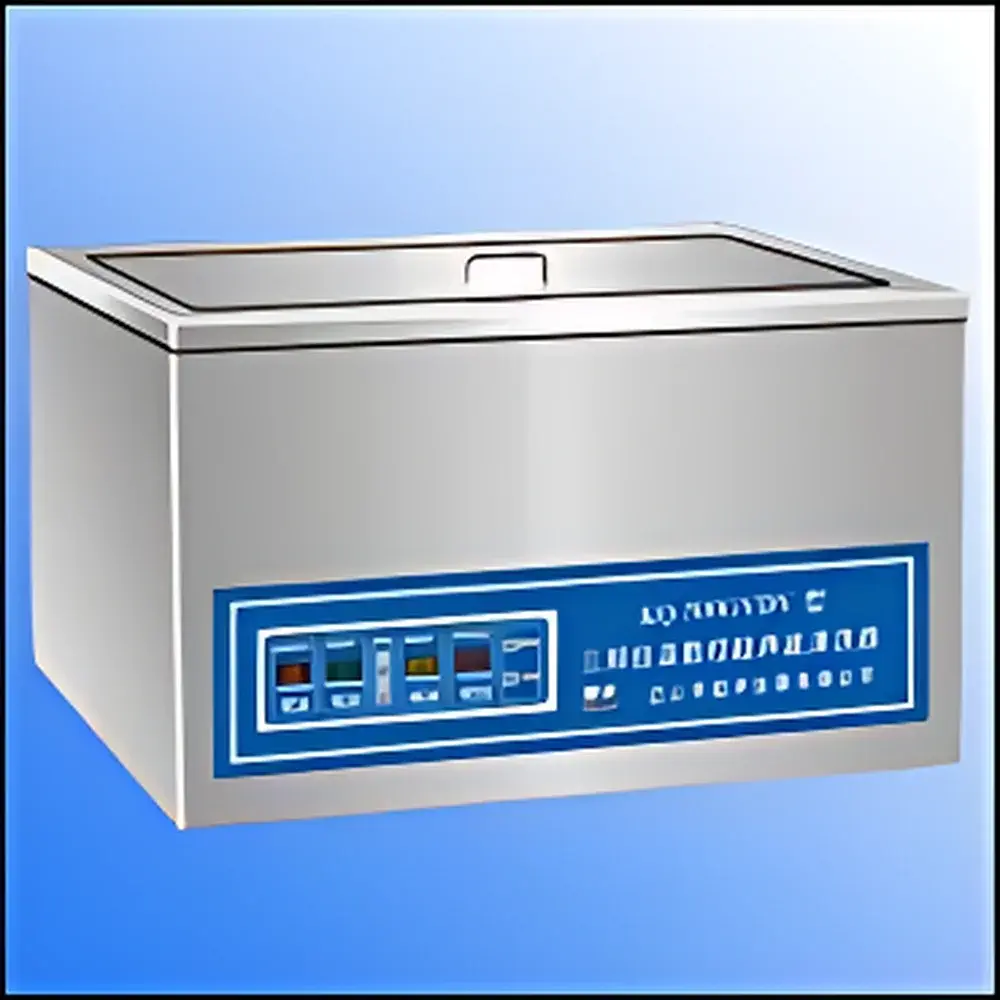
KQ-500GVDV Desktop Dual-Frequency Temperature-Controlled Ultrasonic Cleaner
| Origin | Shanghai, China |
|---|---|
| Manufacturer Type | Authorized Distributor |
| Country of Origin | China |
| Model | KQ-500GVDV |
| Price | USD 10,700 (FOB Shanghai) |
| Dimensions (L×W×H) | 840×410×400 mm |
| Tank Interior (L×W×H) | 500×300×180 mm |
| Capacity | 27 L |
| Ultrasonic Frequencies | 28 kHz |
| Ultrasonic Power Output | 500 W |
| Power Adjustment Range | 40–100% in 1% increments |
| Heating Power | 1000 W |
| Cooling Power | 300 W |
| Temperature Control Range | 0–80 °C (±0.5 °C stability) |
| Timer Range | 1–480 min |
| Transducer Power per Unit | 50 W |
| Frequency Switching Interval | 1–999 s (programmable) |
| Drain Valve | Stainless Steel Ball Valve |
| Tank Material | SUS304 Stainless Steel |
| Lid | Acoustically Damped Stainless Steel with Corrosion-Resistant Sealing Gasket |
| Filtration System | Integrated Thermostatically Controlled Recirculating Filter |
| Control System | Embedded Microcontroller with Non-Volatile Memory for Parameter Retention |
Overview
The KQ-500GVDV is a precision-engineered desktop dual-frequency temperature-controlled ultrasonic cleaner designed for laboratories and R&D facilities requiring strict thermal and acoustic control during critical cleaning, degassing, dispersion, and sample preparation workflows. Unlike conventional single-frequency ultrasonic systems, the KQ-500GVDV employs synchronized 28 kHz and 45 kHz transducers—each rated at 50 W—to generate complementary cavitation fields: lower frequency for macro-scale particle removal and surface debridement, and higher frequency for micro-scale contaminant dislodgement and uniform energy distribution across complex geometries. Its integrated thermoelectric cooling and PID-regulated heating subsystems enable active thermal management of the cleaning bath, maintaining solution temperature within ±0.5 °C over extended operation—eliminating thermal drift that compromises reproducibility in applications such as nanoparticle dispersion, cell lysis standardization, or solvent-sensitive sample handling.
Key Features
- Dual-frequency ultrasonic generation (28 kHz / 45 kHz) with independent programmable switching intervals (1–999 seconds), enabling adaptive cavitation profiles for heterogeneous sample loads.
- Precision temperature regulation from 0 °C to 80 °C using a hybrid system: 1000 W resistive heating element paired with 300 W thermoelectric cooling module—ensuring zero net temperature rise during continuous 500 W ultrasonic operation.
- 27-liter stainless steel tank (SUS304, 500 × 300 × 180 mm internal dimensions) with argon-welded stainless mesh basket and acoustically damped lid featuring corrosion-resistant EPDM sealing gasket.
- Microcontroller-based digital interface with non-volatile memory: retains user-defined parameters—including frequency mode, power level (40–100% in 1% steps), temperature setpoint, timer duration (1–480 min), and frequency transition logic—across power cycles.
- Integrated thermostatically controlled recirculating filtration system to maintain bath purity during prolonged use, especially critical for trace-level analytical sample preparation.
- Full-draft stainless steel ball valve drain assembly positioned at tank base for complete, residue-free fluid evacuation—compatible with GLP-compliant documentation of cleaning solution replacement intervals.
Sample Compatibility & Compliance
The KQ-500GVDV supports a broad range of sample types—including glassware, metal components, semiconductor wafers, optical lenses, surgical instruments, and biological substrates—without thermal or mechanical degradation when operated within validated parameter envelopes. Its temperature-stabilized operation meets requirements for ASTM D2603 (ultrasonic cleaning validation), ISO 13485 Annex A (cleaning process control in medical device manufacturing), and USP (ultrasonic cleaning of pharmaceutical equipment). The sealed transducer housing and IP54-rated electronics enclosure ensure operational safety in humid laboratory environments. All wetted surfaces comply with FDA 21 CFR 178.3570 (indirect food additives—sanitizers) and EU Regulation (EC) No. 1935/2004 for materials in contact with solvents and aqueous media.
Software & Data Management
While the KQ-500GVDV operates via an embedded real-time control system without external PC dependency, its firmware supports audit-trail-capable parameter logging: timestamped records of all setpoints (temperature, power, frequency, time), actual measured bath temperature (sampled every 5 seconds), and system status flags (e.g., overtemperature lockout, transducer fault, lid-open interlock). These logs are exportable via RS-232 interface in CSV format for integration into LIMS or electronic lab notebook (ELN) platforms. The system conforms to ALCOA+ principles for data integrity and satisfies core elements of FDA 21 CFR Part 11 for electronic records when deployed with appropriate access controls and electronic signatures in validated environments.
Applications
- Removal of organic residues, polishing compounds, and oxide layers from precision optics and MEMS devices prior to coating or metrology.
- Cell disruption and organelle isolation in molecular biology, where consistent cavitation intensity and stable temperature prevent protein denaturation.
- Degassing of HPLC mobile phases and ultrapure water systems to eliminate dissolved oxygen-induced baseline noise and column oxidation.
- Homogenization of nanomaterial suspensions (e.g., graphene oxide, quantum dots) with minimized agglomeration through dual-frequency acoustic shearing.
- Extraction of phytochemicals and nucleic acids from plant tissues under controlled thermal conditions to preserve labile compounds.
- Pre-cleaning of parts for SEM/TEM sample mounting, ensuring particulate-free surfaces without solvent-induced shrinkage or charging artifacts.
FAQ
What is the maximum allowable solvent temperature during continuous ultrasonic operation?
The system maintains bath temperature within ±0.5 °C of the setpoint up to 80 °C; however, for long-duration (>120 min) protocols with volatile solvents (e.g., acetone, ethanol), we recommend limiting setpoints to ≤50 °C to minimize evaporation and vapor pressure buildup.
Can the unit operate with deionized water only, without added detergents?
Yes—cavitation efficiency in DI water is sufficient for light particulate removal; however, for organic or proteinaceous soils, we recommend ISO 15883-compliant enzymatic or low-foaming alkaline cleaners compatible with stainless steel and 28/45 kHz excitation.
Is remote monitoring or control supported?
The RS-232 port enables serial command-and-control (SCPI-like syntax) and real-time data streaming; Ethernet or Wi-Fi modules are available as optional accessories for integration into centralized facility management systems.
How often should the recirculating filter be replaced?
Under standard laboratory use (8 hrs/day, aqueous solutions), replace the 5-µm pleated polypropylene filter cartridge every 200 operating hours or quarterly—whichever occurs first—to maintain filtration efficacy and thermal stability.
Does the system meet CE or UL safety certification requirements?
The KQ-500GVDV carries CE marking per EN 61000-6-3 (EMC) and EN 61000-6-2 (immunity), and complies with IEC 61010-1:2010 for laboratory electrical equipment; UL listing is available upon request for North American installations.
Related Products



