
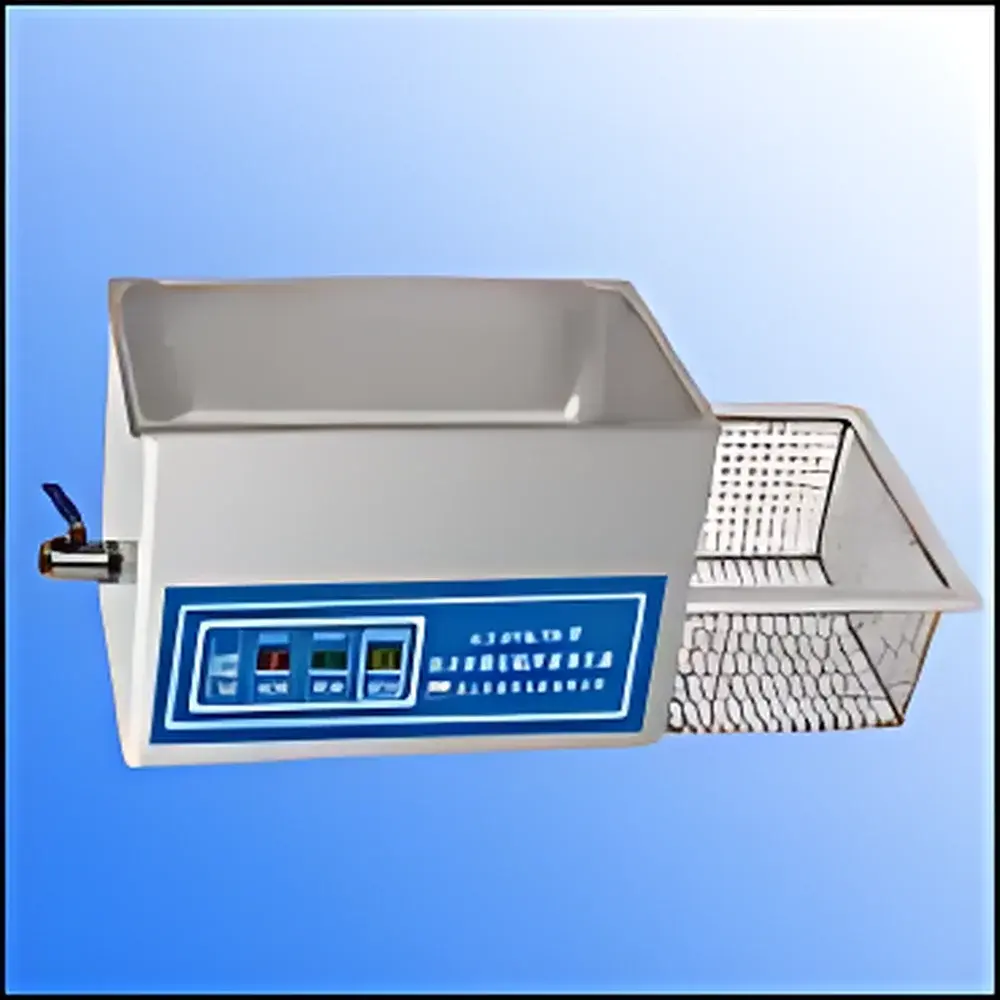
Chu Ding KQ2200DA / KQ2200DB / KQ2200DE / KQ2200DV Benchtop Digital Ultrasonic Cleaner
| Brand | Chu Ding |
|---|---|
| Origin | Shanghai, China |
| Model | KQ2200DA / KQ2200DB / KQ2200DE / KQ2200DV |
| Ultrasonic Frequency | 40 kHz |
| Ultrasonic Power | 100 W |
| Power Adjustment Range | 40–99% (KQ2200DA/DB/DE) / 40–100% (KQ2200DV) |
| Tank Capacity | 3 L (KQ2200DA–DE) / 4 L (KQ2200DV) |
| Internal Tank Dimensions (L×W×H) | 230×140×100 mm (KQ2200DA–DE) / 230×140×130 mm (KQ2200DV) |
| External Dimensions (L×W×H) | 260×160×260 mm (KQ2200DA–DE) / 340×250×330 mm (KQ2200DV) |
| Heating Power | 0 W (DA) / 200 W (DB, DE, DV) |
| Temperature Control Range | 20–80 °C (DB, DE, DV) |
| Timer Range | 1–99 min (DA–DE) / 1–480 min (DV) |
| Drain Valve | Yes (DA–DV) |
| Lid with Sound Dampening | No (DA) / Yes (DB–DV) |
| Optional Volatile Solvent Recovery | V-model (DV) only |
Overview
The Chu Ding KQ2200 series comprises four variants of benchtop digital ultrasonic cleaners—KQ2200DA, KQ2200DB, KQ2200DE, and KQ2200DV—engineered for precision cleaning, degassing, dispersion, cell disruption, extraction, emulsification, and solvent replacement in regulated laboratory environments. These units operate on the principle of piezoelectric transduction at a fixed frequency of 40 kHz, generating high-frequency acoustic pressure waves in liquid media. Cavitation—the formation, growth, and implosive collapse of microbubbles—produces localized transient pressures exceeding 1000 atm and temperatures above 5000 K, enabling mechanical removal of particulate contaminants from surfaces without chemical abrasion or thermal degradation. The integrated single-chip microcontroller architecture ensures stable ultrasonic output, real-time monitoring, and repeatable process control across diverse sample types and cleaning protocols.
Key Features
- Digital LED display showing real-time and set values for ultrasonic duration, power level (%), bath temperature (°C), liquid level (mm), and cumulative operational hours (up to 999,999 h)
- Intelligent safety interlocks: automatic shutdown upon low liquid level detection, over-temperature (>80 °C), over-voltage, or over-current conditions
- Stainless steel tank (SUS304) and outer housing; argon-welded stainless mesh basket for uniform energy distribution and corrosion resistance
- Adjustable ultrasonic power output (40–99% or 40–100%) to optimize cavitation intensity for delicate vs. robust substrates
- Variants DB, DE, and DV include a 200 W heating system with PID-controlled temperature regulation (20–80 °C ±1 °C accuracy)
- KQ2200DV integrates a vapor recovery port compatible with condenser systems for use with volatile organic solvents (e.g., acetone, isopropanol, chloroform), supporting ISO 14001-compliant solvent management
- Drain valve standard across all models for rapid tank emptying and residue-free maintenance
- Sound-dampening lid included on DB, DE, and DV models—reducing ambient noise to ≤55 dB(A) at 1 m distance per IEC 61672-1
Sample Compatibility & Compliance
The KQ2200 series accommodates glassware (vials, cuvettes, pipette tips), metal components (surgical instruments, optical mounts), silicon wafers, ceramic filters, and polymer-based labware. Its 40 kHz operating frequency delivers balanced cavitation energy—sufficient for particulate removal yet gentle enough for fragile coatings and MEMS devices. All models comply with IEC 61010-1:2010 for electrical safety in laboratory equipment and meet CE marking requirements under the EU Low Voltage and EMC Directives. The heating and timing functions support method validation per USP , ASTM D4290, and ISO 13485 Annex A for medical device cleaning verification. Data logging capabilities—including timestamped start/stop events, temperature excursions, and power modulation history—facilitate GLP/GMP audit readiness when paired with validated external software.
Software & Data Management
While the KQ2200 series operates via embedded firmware without PC connectivity, its digital interface supports full traceability: each unit records cumulative runtime, total number of cycles, and last 10 executed parameter sets (time, power, temp). This internal log satisfies basic 21 CFR Part 11 “audit trail” expectations for non-networked instruments when combined with laboratory SOPs governing manual entry into electronic lab notebooks (ELNs). For advanced data integration, optional RS-232 or USB-to-serial adapters enable third-party acquisition of real-time sensor outputs (temperature, liquid level, status flags) into LabVIEW, Python, or custom LIMS platforms—subject to user-developed driver validation.
Applications
- Life Sciences: DNA/RNA extraction from tissue homogenates; removal of RNase/DNase residues from PCR tubes; sonication-assisted protein solubilization
- Materials Science: Dispersion of carbon nanotubes and graphene oxide in aqueous/organic matrices; cleaning of SEM/TEM sample stubs and TEM grids
- Pharmaceutical QC: Dissolution testing apparatus cleaning per USP ; active pharmaceutical ingredient (API) filter cartridge decontamination
- Electronics Manufacturing: Flux residue removal from PCB assemblies prior to AOI inspection; ultrasonic rinsing of MEMS inertial sensors
- Environmental Testing: Extraction of PAHs and PCBs from soil/sediment samples per EPA Method 3550C; preparation of certified reference material (CRM) vials
FAQ
What is the maximum allowable solvent volume for safe operation?
The KQ2200DA–DE models require minimum liquid coverage of 30 mm above the transducer surface (≈1.8 L); KQ2200DV requires ≥40 mm (≈2.2 L). Operating below these levels risks transducer overheating and permanent damage.
Can the KQ2200 series be used with flammable solvents?
Only the KQ2200DV variant—with its sealed vapor recovery port and absence of internal ignition sources—is suitable for Class I flammable liquids (e.g., ethanol, acetone) when connected to an approved condenser and explosion-proof ventilation system per NFPA 30 and ATEX Directive 2014/34/EU.
Is calibration documentation provided with shipment?
Each unit ships with a factory test report verifying ultrasonic output stability (±3% power repeatability over 10 cycles), temperature control accuracy (±1 °C at 40 °C), and timer deviation (<±0.5 s/min). Full metrological calibration certificates are available upon request (ISO/IEC 17025 accredited third-party labs).
How often should the stainless steel tank be passivated?
Passivation per ASTM A967 is recommended after initial installation and annually thereafter—or following any cleaning with chloride-containing solutions—to maintain corrosion resistance and prevent iron contamination in ultra-trace analysis workflows.
Does the instrument support remote start/stop via dry contact input?
No. The KQ2200 series lacks external control I/O. Integration into automated workflows requires retrofitting with a programmable relay module triggered by TTL or 24 VDC signals—configuration must adhere to IEC 62061 functional safety requirements for machinery.



