
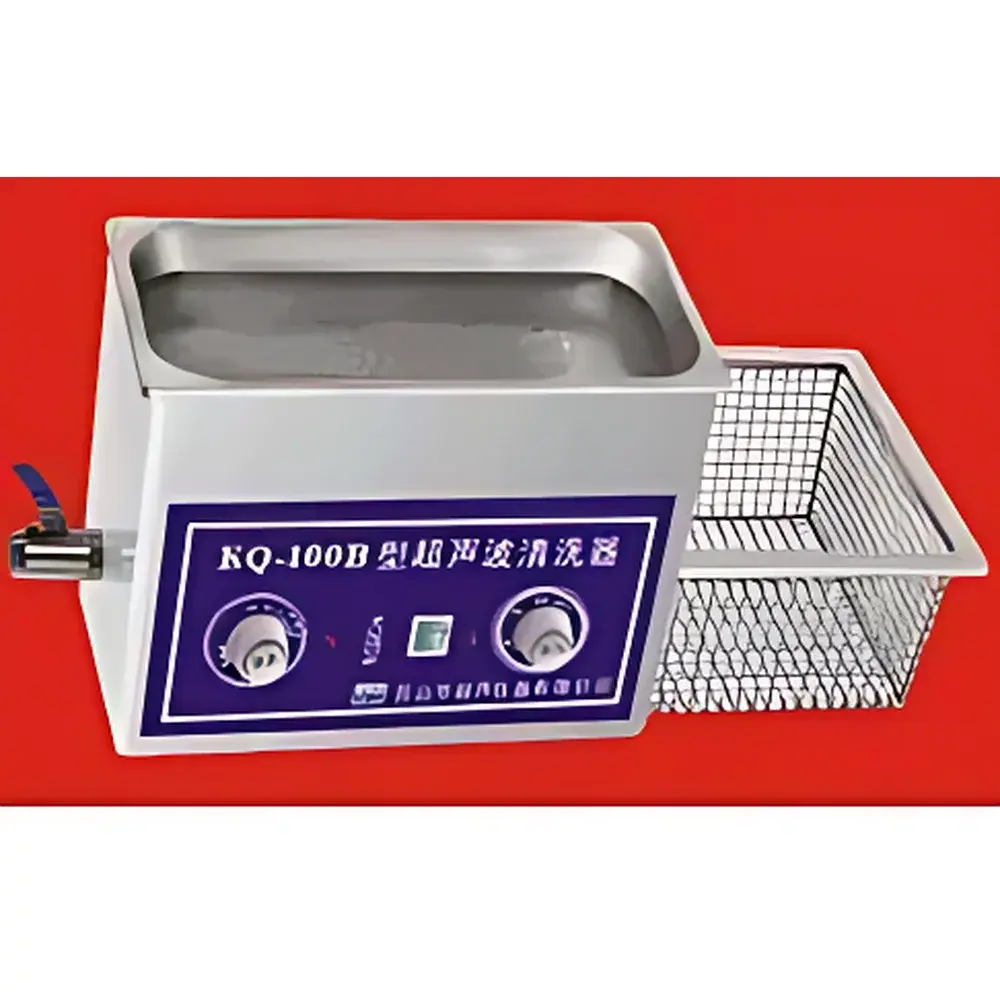
Chu Ding KQ2200 Series Benchtop Ultrasonic Cleaner (KQ2200 / KQ2200B / KQ2200E / KQ2200V)
| Brand | Chu Ding |
|---|---|
| Origin | Shanghai, China |
| Model | KQ2200 / KQ2200B / KQ2200E / KQ2200V |
| Tank Capacity | 3 L (KQ2200–KQ2200E), 4 L (KQ2200V) |
| Ultrasonic Frequency | 40 kHz |
| Ultrasonic Power Output | 100 W |
| Heating Power | 0 W (KQ2200), 200 W (KQ2200B/KQ2200E/KQ2200V) |
| Temperature Range | 0–80 °C (heating models only) |
| Timer Range | 1–20 min (KQ2200/KQ2200B/KQ2200V), 1–200 min (KQ2200E) |
| Tank Internal Dimensions | 230 × 140 × 100 mm (KQ2200–KQ2200E), 230 × 140 × 103 mm (KQ2200V) |
| External Dimensions | 260 × 160 × 260 mm (KQ2200–KQ2200E), 340 × 250 × 330 mm (KQ2200V) |
| Safety Features | Digital over-temperature, over-voltage and over-current protection |
| Accessories | Removable stainless steel mesh basket, sound-dampening lid (KQ2200B/KQ2200E/KQ2200V), drain valve (KQ2200E/KQ2200V), vapor recovery system (KQ2200V only) |
Overview
The Chu Ding KQ2200 Series Benchtop Ultrasonic Cleaner is an integrated ultrasonic cleaning system engineered for precision laboratory applications requiring consistent cavitation-based cleaning, degassing, dispersion, and cell disruption. Operating at a stable 40 kHz frequency, the unit generates high-intensity acoustic waves in liquid media, inducing controlled microbubble formation and collapse (acoustic cavitation) within the cleaning solution. This physical mechanism enables effective removal of particulate contaminants, organic residues, and surface-adhered biofilms from delicate instrumentation—including pipette tips, glassware, optical components, semiconductor wafers, and analytical sample vials—without mechanical abrasion or chemical aggression. Designed as a compact benchtop platform, the KQ2200 series accommodates routine QC/QA workflows in academic labs, R&D facilities, and regulated production environments where reproducible, low-volume cleaning is critical.
Key Features
- Integrated transducer-to-tank architecture ensures optimal energy coupling and long-term stability of ultrasonic output.
- Digital control panel with real-time display of set/actual temperature (heating models), elapsed time, and operational status; memory function retains last-used parameters across power cycles.
- Stainless steel inner tank (SUS304 grade) formed via deep-drawing process for corrosion resistance and structural integrity under repeated thermal and ultrasonic stress.
- Removable stainless steel mesh basket with argon-welded construction supports uniform sample suspension and prevents direct contact between parts and tank bottom.
- Comprehensive safety system includes digital monitoring and automatic shutdown for over-temperature, over-voltage, and over-current conditions—aligned with IEC 61010-1 requirements for laboratory electrical equipment.
- Optional accessories include sound-dampening lid (standard on KQ2200B/E/V), drain valve (KQ2200E/V), and integrated volatile solvent vapor recovery system (KQ2200V model only), supporting compliance with OSHA and local VOC emission guidelines.
Sample Compatibility & Compliance
The KQ2200 series accommodates a broad range of sample types and container geometries, including but not limited to: borosilicate glassware (vials, cuvettes, crucibles), metal tools (tweezers, forceps), ceramic substrates, and polymer-based microfluidic devices. Compatibility with common aqueous and mild organic solvents (e.g., isopropanol, ethanol, aqueous detergent solutions) is verified per manufacturer specifications. Units meet CE marking requirements for electromagnetic compatibility (EMC Directive 2014/30/EU) and low-voltage safety (LVD Directive 2014/35/EU). While not certified to ISO 13485 or FDA 21 CFR Part 11 out-of-the-box, the digital interface and parameter logging capability support integration into GLP/GMP-compliant workflows when paired with validated SOPs and audit-trail documentation protocols.
Software & Data Management
The KQ2200 series operates via embedded firmware without external PC dependency. All operational parameters—including timer setting, temperature setpoint (for heated models), and real-time sensor feedback—are displayed and stored locally. No proprietary software or drivers are required. The KQ2200E variant extends timer resolution to 200 minutes, enabling extended degassing or extraction protocols. For laboratories implementing electronic recordkeeping, manual entry of run logs—including date/time stamp, operator ID, cycle parameters, and observed outcomes—is recommended to satisfy ALCOA+ data integrity principles. Optional RS-232 or USB-to-serial adapters may be used for basic data export, though no native CSV or database export functionality is included.
Applications
- Pre-analytical sample preparation: removal of residual proteins or lipids from HPLC vials and autosampler needles.
- Electronics manufacturing: cleaning of PCB assemblies and MEMS components prior to soldering or coating.
- Pharmaceutical R&D: dissolution testing apparatus component sanitation between batches.
- Materials science: dispersion of nanomaterials (e.g., graphene oxide, TiO₂ nanoparticles) in aqueous or polar solvent matrices.
- Life sciences: gentle lysis of cultured cells or tissue homogenates for protein extraction, minimizing thermal denaturation compared to mechanical methods.
- Quality control laboratories: standardized cleaning of reference standards, calibration weights, and metrology fixtures to eliminate particulate interference.
FAQ
What is the difference between the KQ2200, KQ2200B, KQ2200E, and KQ2200V models?
The KQ2200 is non-heating with a 20-minute max timer and no lid or drain. The KQ2200B adds heating (0–80 °C) and a sound-dampening lid. The KQ2200E extends the timer to 200 minutes and adds a drain valve. The KQ2200V features a larger 4 L tank, drain valve, lid, heating, and an integrated volatile solvent vapor recovery system.
Can this unit be used with flammable solvents?
Only the KQ2200V model—with its vapor recovery system and sealed chamber design—is suitable for use with low-flashpoint solvents under controlled ventilation. Other models are intended for aqueous or high-flashpoint solutions only.
Is the ultrasonic power adjustable?
No—the 100 W output is fixed per transducer assembly. Intensity modulation is achieved indirectly via duty cycling (pulse mode) or by varying cleaning duration and solution composition.
What maintenance is required?
Regular descaling of the tank interior using 5–10% citric acid solution is recommended after prolonged use with hard water. Transducer performance should be verified annually using a calibrated hydrophone or cavitation intensity test kit per ASTM E1759-17.
Does the unit comply with FDA 21 CFR Part 11?
No—the device lacks electronic signature capability, audit trail generation, or user access controls required for Part 11 compliance. It may be used in Part 11-regulated environments only when operated under documented manual procedures and supplementary recordkeeping.



