
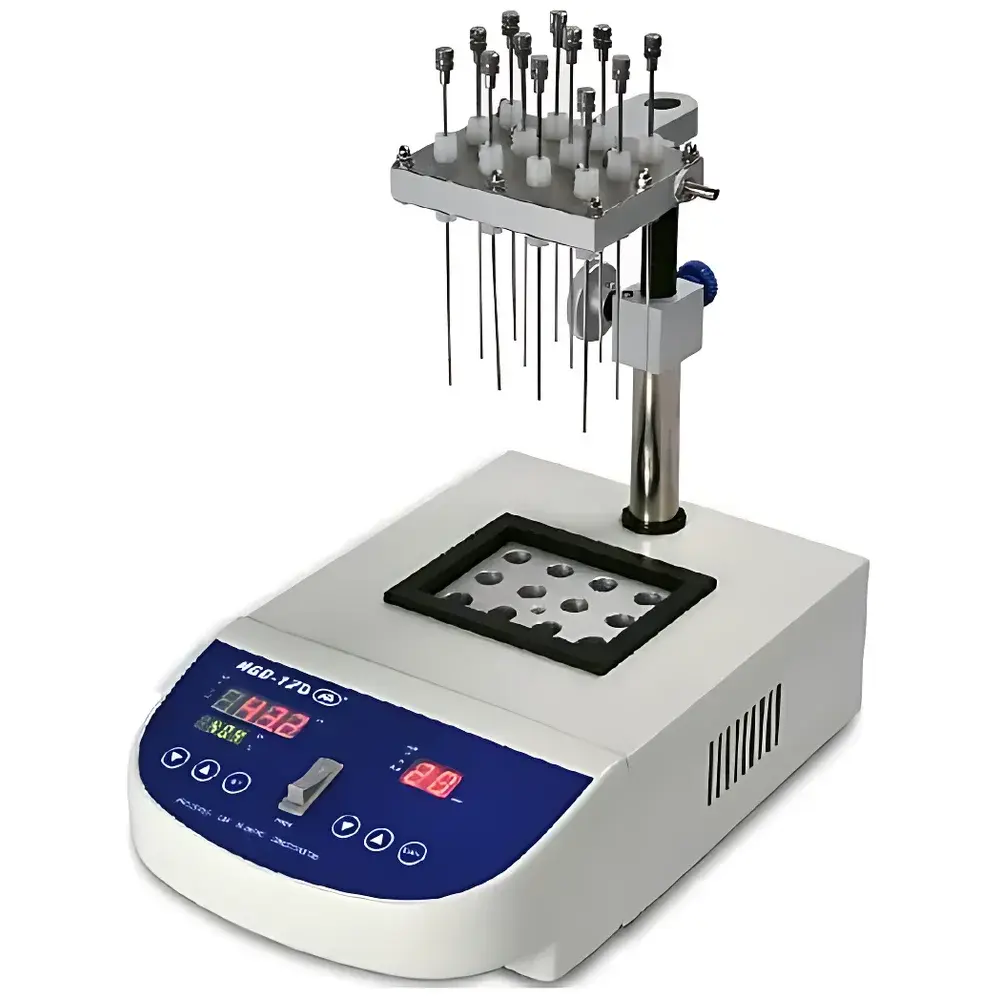
HGC-12D Dry-Block Nitrogen Evaporator
| Origin | Shanghai, China |
|---|---|
| Manufacturer Type | Authorized Distributor |
| Origin Category | Domestic (China) |
| Model | HGC-12D |
| Price | USD 650 (FOB Shanghai) |
| Sample Capacity | 12 positions |
| Heating Block Quantity | 1 |
| Dimensions (W×D×H) | 226 × 355 × 85 mm |
| Gas Flow Range | 0–5 L/min |
| Power Consumption | 150 W |
| Net Weight | 3.0 kg |
| Temperature Range | Ambient to 150 °C |
| Temperature Accuracy | ±1 °C |
| Temperature Control | 4-digit LED display, PID algorithm, overheat protection, PTC heating element |
| Input Power | 220 V AC, 50 Hz |
| Gas Supply Pressure | 0–200 kPa |
| Construction Materials | 316 stainless steel gas manifolds and needle guides, anodized aluminum heating block, plastic-coated housing |
Overview
The HGC-12D Dry-Block Nitrogen Evaporator is a precision-engineered sample concentration system designed for reproducible, solvent-free evaporation of multiple liquid samples under controlled inert gas flow. Unlike water bath-based evaporators, the HGC-12D employs a solid aluminum heating block with integrated PTC (Positive Temperature Coefficient) heating elements, delivering rapid thermal response, uniform temperature distribution across all 12 sample wells, and minimal risk of cross-contamination or water ingress. It operates on the principle of gentle nitrogen gas stream impingement—directed vertically through precisely aligned stainless steel needles—to accelerate solvent volatilization while maintaining analyte integrity. This method is widely adopted in regulated analytical workflows where residual moisture, temperature overshoot, or bath contamination must be strictly avoided. The unit complies with fundamental design expectations outlined in ISO/IEC 17025 for laboratory equipment used in accredited testing environments and supports traceable temperature calibration per ASTM E2251.
Key Features
- Dry-block architecture with single, interchangeable aluminum heating block (standard孔径: φ15 mm, φ17 mm, φ21 mm; custom bore configurations available upon order)
- PID-controlled digital temperature regulation with dual 4-digit LED display—showing setpoint and real-time block temperature simultaneously
- Overtemperature cutoff circuit with independent thermal fuse, preventing thermal runaway during unattended operation
- Modular gas distribution manifold featuring 12 individually height-adjustable 316 stainless steel needles; each channel supports independent gas flow optimization via integrated rotameter-style microvalves
- Chemically resistant construction: all solvent-facing surfaces fabricated from 316 stainless steel or anodized aluminum; external housing coated with corrosion-inhibiting epoxy-polyester powder coating
- Low-power operation (150 W) with energy-efficient PTC heating—no preheating delay, stable thermal equilibrium achieved within ≤8 minutes at 100 °C
Sample Compatibility & Compliance
The HGC-12D accommodates standard 10–15 mL conical glass tubes, 13 × 100 mm culture tubes, and 16 × 150 mm test tubes. Its dry-block geometry ensures compatibility with solvents including acetonitrile, methanol, ethyl acetate, hexane, and dichloromethane—without risk of immersion-related degradation or bath carryover. All materials contacting nitrogen or sample vapors meet USP Class VI biocompatibility requirements. While not a GMP-certified instrument per se, its design supports compliance with GLP documentation standards: temperature logs (when paired with external data loggers), maintenance records, and calibration certificates can be maintained per 21 CFR Part 11 guidelines when integrated into validated laboratory information management systems (LIMS). It is routinely deployed in laboratories adhering to EPA Method 508.1, AOAC 991.22, and Chinese Pharmacopoeia Volume IV (2020 Edition) residue testing protocols.
Software & Data Management
The HGC-12D operates as a standalone benchtop instrument with no embedded firmware or proprietary software dependency. Temperature setpoints and real-time monitoring are managed exclusively via front-panel controls and LED indicators—ensuring deterministic behavior, electromagnetic immunity, and zero cybersecurity surface. For audit-trail generation, users may integrate third-party calibrated thermocouple data loggers (e.g., Omega OM-DAQPRO-5300 or Testo 176 T4) directly into the heating block’s auxiliary port (optional adapter required). Such configurations enable CSV-exportable time-stamped temperature profiles compliant with ISO/IEC 17025 clause 6.4.8 (equipment monitoring) and internal SOPs requiring thermal validation for critical evaporation steps.
Applications
- Residue analysis in agricultural commodities: multi-residue pesticide screening in fruits, vegetables, cereals, and botanical matrices per GB 23200.113–2021
- Environmental monitoring: concentration of trace organochlorines, PAHs, and PCBs from drinking water, groundwater, and wastewater extracts prior to GC-MS analysis
- Pharmaceutical quality control: clean-up and concentration of herbal extract fractions during HPLC method development and stability-indicating assays
- Clinical toxicology: parallel processing of serum, plasma, urine, and whole blood samples for β-agonist (e.g., clenbuterol, ractopamine) and dioxin congener quantification
- Food safety testing: preparation of milk, beer, wine, and soft drink samples for mycotoxin (aflatoxin B1, ochratoxin A) and veterinary drug residue analysis
FAQ
What is the maximum recommended operating temperature for continuous use?
The HGC-12D is rated for sustained operation up to 150 °C; however, prolonged exposure above 120 °C may reduce long-term stability of silicone O-rings in gas line fittings—recommended limit for routine QC work is 100 °C.
Can I use this unit with corrosive gases such as HCl or Cl₂?
No. The system is engineered exclusively for high-purity nitrogen (≥99.998%) or compressed air meeting ISO 8573-1 Class 2:2:2 specifications. Exposure to acidic, oxidizing, or halogenated gases will compromise 316SS needle integrity and void warranty.
Is calibration certificate included with shipment?
A factory-assembled NIST-traceable temperature verification report (at 40 °C, 70 °C, and 100 °C) is provided with each unit. Full ISO/IEC 17025 calibration requires third-party service and is not included by default.
How often should the gas filter be replaced?
With clean, oil-free nitrogen supply and inline particulate/moisture filtration (0.01 µm + desiccant), replacement is recommended every 12 months or after 2,000 operational hours—whichever occurs first.
Are spare heating blocks available for purchase separately?
Yes. Standard φ15 mm, φ17 mm, and φ21 mm aluminum blocks are stocked; custom geometries (e.g., for 2 mL HPLC vials or 96-well plate formats) require minimum order quantity (MOQ) of 5 units and 6-week lead time.



