
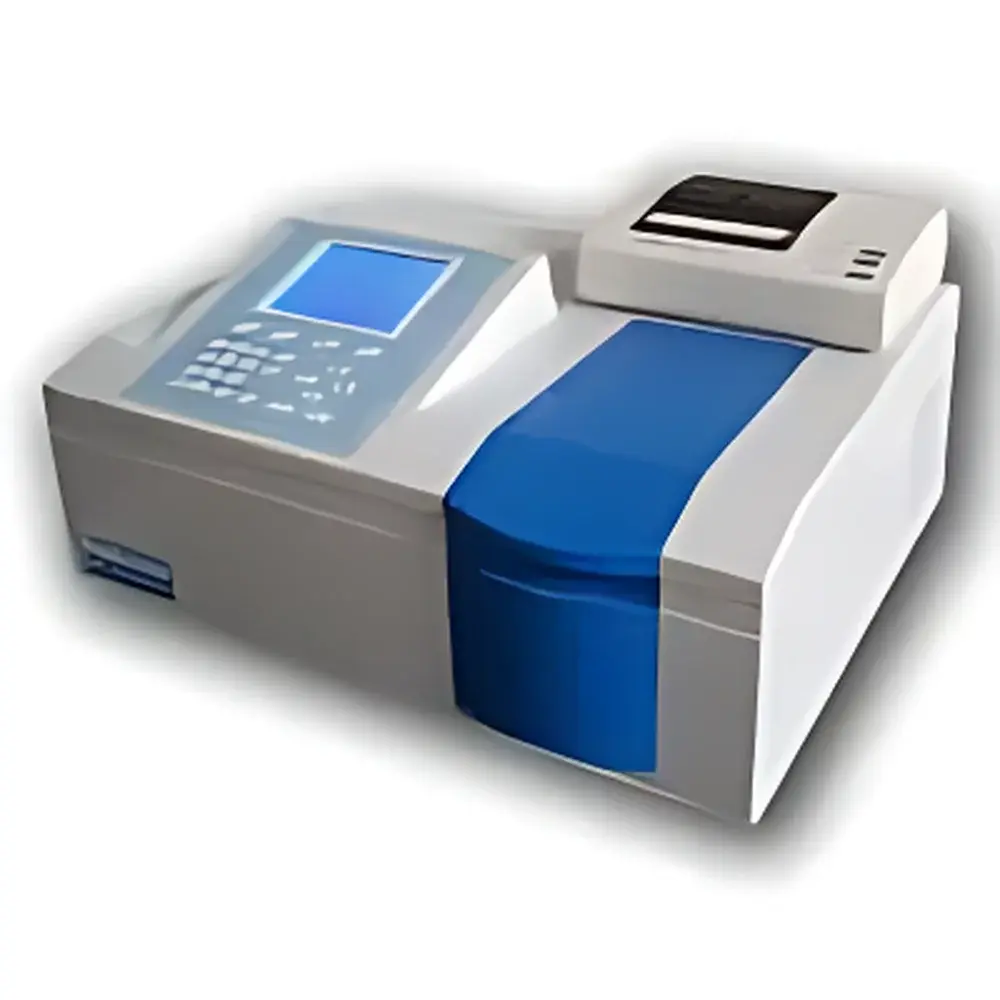
Chu Ding UV762 Dual-Beam Ultraviolet-Visible Spectrophotometer
| Brand | Chu Ding |
|---|---|
| Model | UV762 |
| Wavelength Range | 190–1100 nm |
| Spectral Bandwidth | 2 nm |
| Wavelength Accuracy | ≤ ±0.3 nm (auto-calibrated at startup) |
| Wavelength Repeatability | ≤ 0.2 nm |
| Photometric Accuracy | ±0.5% T |
| Photometric Repeatability | ≤ 0.2% T |
| Transmittance Range | 0–200% T |
| Absorbance Range | −0.301 to 3.000 A |
| Stray Light | ≤ 0.15% T (at 220 nm, measured with NaI) |
| Baseline Drift | ≤ 0.004 A/h (at 500 nm) |
| Noise | ≤ 0.15% T (100% line), ≤ 0.10% T (0% line) |
| Scan Speed Modes | Fast / Medium / Slow |
| Light Source | Automatically Switching Deuterium & Tungsten Lamps |
| Display | Large-Screen LED-Based Chinese GUI Interface |
| Data Processing | Multi-wavelength (1–3 λ), Kinetic Analysis, Polynomial Curve Fitting (1st–3rd order), Derivative Spectra (1st–4th order), Spectral Storage/Export/Print |
Overview
The Chu Ding UV762 Dual-Beam Ultraviolet-Visible Spectrophotometer is an analytical instrument engineered for precision molecular absorption spectroscopy across the ultraviolet and visible spectral regions (190–1100 nm). It operates on the dual-beam optical principle—splitting a single light source into sample and reference beams that are alternately directed onto a common detector via a rotating mirror or chopper assembly. This architecture inherently compensates for source intensity fluctuations and electronic drift, delivering superior photometric stability and long-term measurement reproducibility compared to single-beam designs. The system employs a high-efficiency Czerny–Turner monochromator with optimized grating dispersion and precision-aligned optics, minimizing stray light (<0.15% T at 220 nm using NaI solution) and ensuring accurate baseline fidelity. Its wavelength accuracy (≤ ±0.3 nm) and repeatability (≤ 0.2 nm) meet routine compliance requirements for QC laboratories operating under ISO/IEC 17025, USP , and ASTM E275–22 guidelines.
Key Features
- Dual-beam optical architecture with real-time reference compensation, enabling high-stability absorbance tracking over extended measurement periods.
- Automated lamp switching between deuterium (UV) and tungsten-halogen (VIS-NIR) sources, with motorized positioning to ensure optimal alignment and beam homogeneity without manual intervention.
- Fixed 2 nm spectral bandwidth—optimized for resolution/sensitivity trade-off in routine pharmaceutical, environmental, and academic applications.
- LED-backlit large-character Chinese-language display interface, supporting direct instrument control without external PC connection for basic operations (e.g., fixed-wavelength mode, %T/A measurement, kinetic runs).
- Integrated photometric calibration routines including auto-zero, auto-blank, and wavelength verification using holmium oxide or didymium filters (user-provided).
- Robust mechanical design with temperature-compensated optical bench and shock-absorbing base, enhancing operational reliability in shared lab environments.
Sample Compatibility & Compliance
The UV762 accommodates standard 10 mm pathlength quartz or glass cuvettes (including matched pairs for high-accuracy ratio measurements), as well as optional micro-volume adapters (e.g., 50–500 µL) and flow cells for continuous monitoring. Its optical path geometry supports both transmission and reflectance accessories (e.g., integrating spheres for diffuse reflectance analysis). From a regulatory standpoint, the instrument’s documented performance specifications—including photometric linearity (−0.301 to 3.000 A), low baseline drift (≤ 0.004 A/h), and traceable wavelength calibration—support method validation per ICH Q2(R2) and FDA 21 CFR Part 11 when used with compliant data acquisition software. While the base unit does not include audit trail or electronic signature functionality, its data export protocols (CSV, TXT) enable integration into validated LIMS or ELN systems under GLP/GMP frameworks.
Software & Data Management
The UV762 is supported by Windows-based application software offering full spectral control and post-acquisition processing. Capabilities include automated wavelength scanning, multi-point quantitative analysis (up to three wavelengths simultaneously), time-resolved kinetic profiling, polynomial regression (1st–3rd order), and derivative spectroscopy (1st–4th order) for peak sharpening and overlapping band resolution. All spectra and results are timestamped and stored with user-defined metadata (sample ID, operator, date/time, instrument serial number). Export formats include ASCII-compatible CSV and image-ready PNG/JPEG—facilitating inclusion in regulatory submissions, peer-reviewed publications, and internal QA documentation. Software logs retain instrument configuration history and calibration events, supporting retrospective review during internal audits or regulatory inspections.
Applications
This spectrophotometer serves core analytical functions across multiple sectors: quantification of nucleic acids and proteins (A260/A280 ratios), enzyme kinetics (NADH/NADPH assays), dissolution testing in pharmaceutical development, heavy metal analysis via colorimetric reagents (e.g., Fe²⁺ with 1,10-phenanthroline), water quality parameters (nitrate, phosphate, COD), dye concentration monitoring in textile QC, and pigment characterization in coatings R&D. Its wide dynamic range (0–200% T; −0.301–3.000 A) and low noise floor support both high-concentration screening and trace-level detection when coupled with appropriate sample preparation protocols.
FAQ
What is the optical design architecture of the UV762?
It utilizes a true dual-beam configuration with a mechanically chopped beam path and a single silicon photodiode detector, ensuring continuous reference correction during spectral acquisition.
Does the instrument support GLP-compliant data handling?
The hardware meets key photometric performance criteria referenced in GLP guidance; full compliance requires use of validated third-party software with audit trail, electronic signatures, and secure user access controls.
Can the UV762 perform spectral derivatization?
Yes—it supports up to fourth-order numerical derivatives for enhanced resolution of overlapping absorption bands in complex mixtures.
Is wavelength calibration traceable to NIST standards?
The instrument includes built-in procedures for verification using certified reference materials (e.g., holmium oxide filter); final traceability depends on user implementation of accredited calibration services.
What maintenance is required for lamp longevity?
Deuterium and tungsten lamps are rated for ≥1,000 hours; automatic shutdown after idle periods and avoidance of frequent on/off cycling extend service life and maintain spectral stability.





