
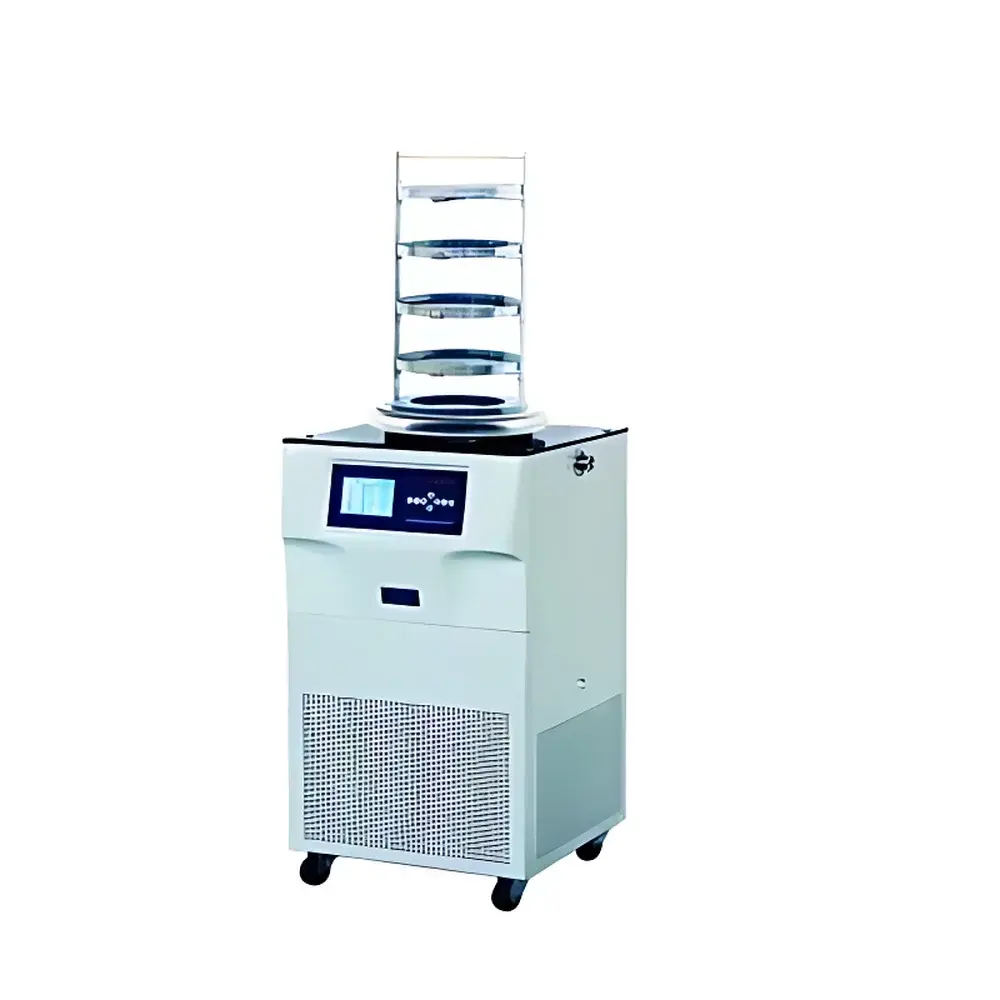
Shanghai-made FD-2 Benchtop Freeze Dryer (−70 °C Condenser, No Shelf Heating)
| Origin | Shanghai, China |
|---|---|
| Manufacturer Type | Authorized Distributor |
| Product Origin | Domestic (China) |
| Model | FD-2 |
| Price | USD 7,150 (FOB Shanghai) |
| Condenser Temperature | ≤ −70 °C |
| Ultimate Vacuum | < 13 Pa |
| Freeze-Drying Area | 0.27 m² |
| Tray Capacity | 2.7 L |
| Water Trapping Capacity | 6 kg/24 h |
| Condenser Dimensions | Φ280 × 420 mm |
| Tray Diameter | Φ240 mm |
| Power Supply | 220 V, 50 Hz, 1800 W |
| Overall Dimensions | 540 × 640 × 920 mm |
| Net Weight | Approx. 95 kg |
Overview
The FD-2 Benchtop Freeze Dryer is a compact, laboratory-scale lyophilization system engineered for primary drying of thermolabile biological and pharmaceutical samples under high-vacuum and sub-zero conditions. It operates on the principle of sublimation—removing water directly from the frozen solid phase to vapor without passing through the liquid state—thereby preserving structural integrity, activity, and stability of sensitive compounds including proteins, monoclonal antibodies, vaccines, enzymes, and microbial cultures. Unlike heated-shelf variants, the FD-2 model omits active shelf heating, making it suitable for applications where passive drying kinetics are preferred or where sample thermal sensitivity prohibits conductive heat input during primary drying. Its dual-stage cascade refrigeration system achieves a stable condenser temperature of ≤ −70 °C, enabling rapid freezing of bulk samples directly inside the stainless-steel condenser chamber—a design feature that eliminates the need for external ultra-low temperature freezers and streamlines workflow in QC labs, academic research facilities, and pilot-scale bioprocessing environments.
Key Features
- Dual-compressor cascade refrigeration architecture delivering consistent condenser performance at ≤ −70 °C
- Large-diameter stainless-steel condenser (Φ280 × 420 mm) with smooth interior surface and no internal coil obstructions—enhancing frost collection efficiency and simplifying defrosting and cleaning
- Patented air-guiding cylinder design increasing effective surface area for ice deposition and improving drying uniformity
- Integrated pre-freezing capability: samples can be frozen directly within the condenser chamber prior to vacuum application
- Large backlit LCD display showing real-time parameters including condenser temperature, chamber pressure, elapsed time, and system status
- 20 programmable user protocols (each supporting up to 20 time–temperature–vacuum segments), with automatic curve logging and recall functionality
- High-integrity gas inlet valve (imported) compatible with dry nitrogen or inert gas backfilling for oxygen-sensitive formulations
- Stainless-steel construction throughout wetted and vacuum-exposed components per ISO 13485-aligned material specifications
- Equipped with locking casters for flexible lab placement and ergonomic access
Sample Compatibility & Compliance
The FD-2 accommodates standard Ø240 mm stainless steel trays and supports batch processing of up to 2.7 L of aqueous solution (equivalent to ~2.7 kg ice load). It complies with fundamental safety and operational requirements outlined in ISO 22042 (freeze-drying equipment — terminology and performance criteria) and aligns with Good Laboratory Practice (GLP) documentation expectations for non-GMP environments. While not certified for cGMP manufacturing, its robust mechanical design, traceable vacuum and temperature monitoring, and configurable data logging support audit-ready workflows in R&D, analytical method development, and stability testing. Optional RS485 or USB interfaces enable integration into centralized lab data management systems compliant with FDA 21 CFR Part 11 for electronic record retention—subject to site-specific validation.
Software & Data Management
The FD-2’s embedded controller records time-stamped process variables—including condenser temperature, vacuum pressure, and runtime—at user-defined intervals (default: 10-second resolution). All freeze-drying profiles and historical curves are stored internally and exportable via optional USB interface to CSV format for post-run analysis in Excel or MATLAB. The system supports password-protected parameter editing and includes event logging for critical alarms (e.g., vacuum breach, compressor fault, door interlock failure). For laboratories requiring regulatory-grade traceability, third-party SCADA-compatible software packages may be deployed using the RS485 Modbus RTU protocol to feed data into LIMS or ELN platforms with full audit trail capabilities.
Applications
- Lyophilization of bacterial and fungal cultures for long-term cryostorage and strain banking
- Stabilization of diagnostic reagents, immunoassay standards, and ELISA kits
- Preparation of reference materials for analytical chemistry and metrology labs
- Drying of botanical extracts, probiotics, and nutraceutical formulations without thermal degradation
- Method development and cycle optimization studies prior to scale-up on production-grade freeze dryers
- Residual moisture analysis sample preparation for Karl Fischer titration
FAQ
Does the FD-2 include shelf heating capability?
No. The FD-2 is configured exclusively for passive drying; it lacks electric heating elements in the shelf or tray support structure.
Can samples be pre-frozen inside the condenser chamber?
Yes. The condenser doubles as a pre-freezing chamber, allowing direct freezing of samples at ≤ −70 °C prior to vacuum initiation.
What vacuum pump is recommended for optimal performance?
A two-stage oil-lubricated rotary vane pump with ultimate vacuum ≤ 5 × 10⁻² Pa and pumping speed ≥ 8 m³/h is advised for reliable operation across the full drying cycle.
Is the system compatible with glassware accessories such as manifold ports or stoppering devices?
No. The FD-2 is designed for tray-based operation only; it does not support manifold freeze-drying or vacuum stoppering configurations.
What maintenance intervals are recommended for the dual-compressor system?
Compressor oil should be replaced every 3,000 operating hours; condenser frost must be fully removed after each batch; and vacuum gaskets inspected quarterly for compression set or microcracking.



