
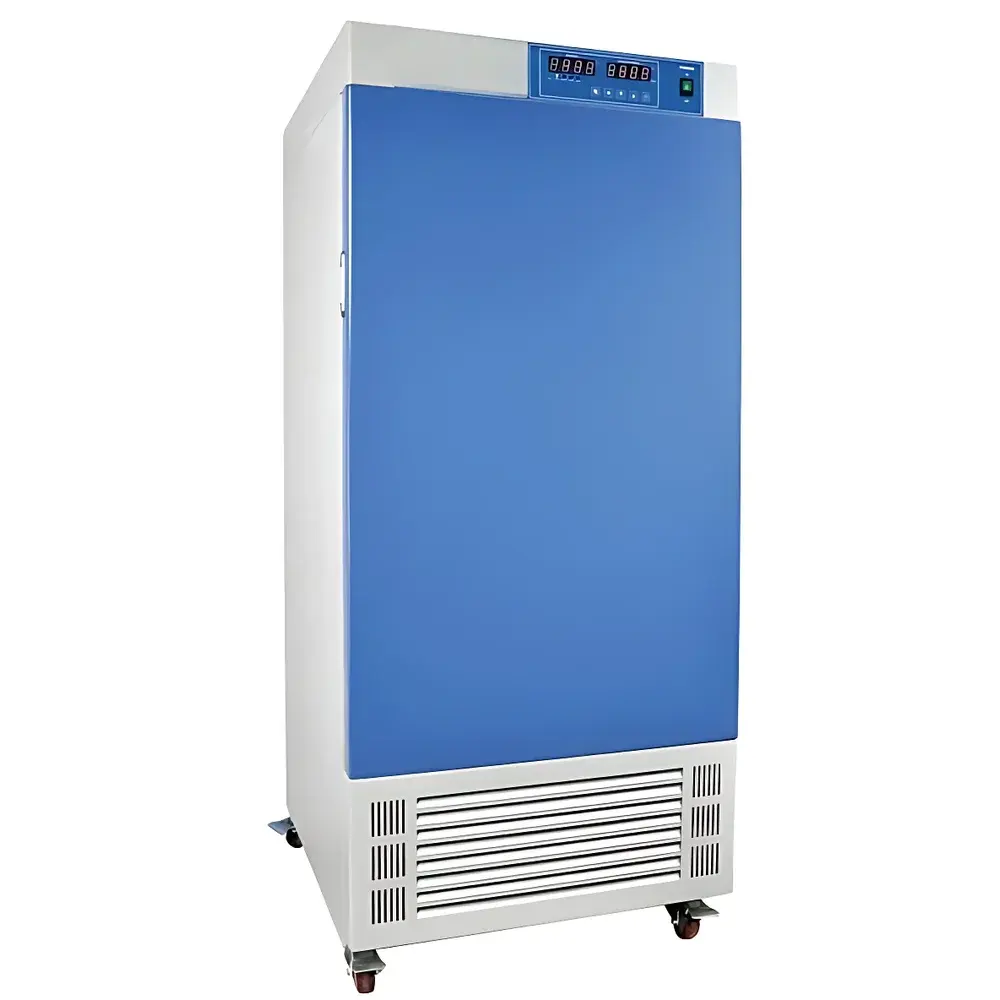
English Product Name
| Origin | Shanghai, China |
|---|---|
| Manufacturer Type | Authorized Distributor |
| Country of Origin | China |
| Models | MJ-70F-I / MJ-150F-I / MJ-250F-I / MJ-300F-I |
| Power Supply | AC 220 V, 50 Hz |
| Temperature Range | 0–60 °C |
| Temp. Uniformity | ±0.5 °C (at high temp), ±1.0 °C (at low temp) |
| Temp. Resolution | 0.1 °C |
| Humidity Control (Model “II” only) | Yes, with microcomputer-based humidity regulation |
| Refrigerant | R134a & R406a (CFC-free, ozone-safe) |
| Internal Chamber Material | Mirror-finish stainless steel, radius-corner design |
| Air Circulation | JAKEL tube-flow centrifugal fan + engineered air duct system |
| Control System | PID temperature control with timer (max. 99 h 59 min) |
| Safety | Independent over-temperature cutoff alarm with audible/visual alert |
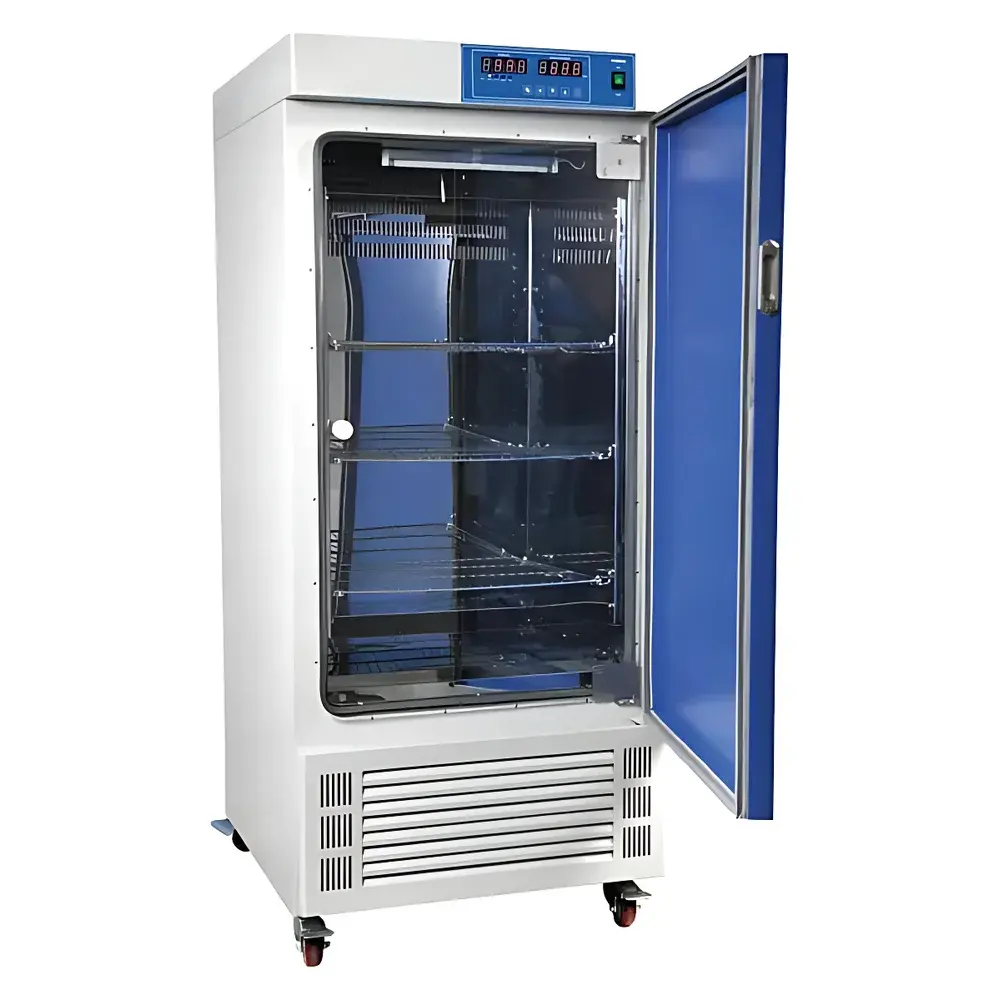
| UV Sterilization | Top-mounted UV-C lamp for continuous air disinfection |
| Interface Options | RS485 or USB port for data logging and external device connectivity (optional) |
| Standard Shelving | 3 adjustable stainless steel shelves |
| Chamber Volume | 70 L / 150 L / 250 L / 300 L |
| Dimensions (W×D×H, mm) | 575×605×1160 / 605×625×1350 / 705×725×1525 / 705×765×1640 |
| Net Weight | Approx. 85–145 kg (model-dependent) |
| Compliance | Designed per ISO 13485-aligned manufacturing practices |
Overview
The JAKEL MJ-Series F-Model Eco-Friendly Mold Incubators are precision-engineered environmental chambers designed for controlled microbial cultivation, mycological research, BOD analysis, plant tissue culture, and long-term biological sample preservation. These units operate on a validated convection-based thermal regulation principle, utilizing forced-air circulation driven by a high-efficiency JAKEL tube-flow centrifugal fan and an optimized internal duct architecture to ensure spatial temperature uniformity across the entire working chamber. The “F” designation indicates full compliance with international refrigerant phase-out protocols—specifically, the use of R134a and R406a, both zero-ozone-depletion-potential (ODP = 0) alternatives to legacy CFCs and HCFCs. This aligns the incubators with EU F-Gas Regulation (EU No 517/2014), U.S. EPA SNAP program requirements, and ISO 14001 environmental management frameworks. Units are calibrated and tested under standardized empty-chamber conditions (20 °C ambient, 50% RH, no vibration or EMI interference), delivering stable setpoint maintenance within ±0.5 °C at elevated temperatures and ±1.0 °C at lower ranges.
Key Features
- Large backlit LCD display with intuitive menu-driven interface—simultaneously shows setpoint, real-time chamber temperature, elapsed time, and operational status.
- Mirror-polished 304 stainless-steel interior with seamless radius-corner construction minimizes microbial adhesion and simplifies cleaning validation per ISO 14644 and FDA Aseptic Processing Guidance.
- Dual-stage PID temperature control algorithm ensures minimal overshoot and rapid thermal recovery after door opening—critical for sensitive fungal colony development and bacterial viability assays.
- Top-mounted 254 nm UV-C germicidal lamp provides continuous air sterilization during operation, reducing airborne bioburden and mitigating cross-contamination risk in multi-user lab environments.
- Independent over-temperature safety cutoff circuit interrupts power and triggers dual-mode (audible + visual) alarm if chamber exceeds user-defined limit—meeting IEC 61010-1 Clause 11.3 for laboratory equipment safety.
- Optional 15-segment, 30-step programmable controller enables complex diurnal or stress-response protocols (e.g., alternating temperature/humidity cycles for spore germination studies).
- Standard 25 mm or 50 mm Ø access port (left-side mounted) allows integration with external sensors, gas lines, or data loggers without compromising chamber integrity.
Sample Compatibility & Compliance
The MJ-F series accommodates standard microbiological vessels—including Petri dishes (90–150 mm), test tubes (13 × 100 mm to 18 × 150 mm), Erlenmeyer flasks (up to 2 L), and multi-well plates—on three independently adjustable stainless-steel shelves. Chamber geometry and airflow distribution have been validated using ASTM E2234-compliant thermal mapping procedures (16-point sensor grid, 24-hr stability test). All models support regulatory traceability requirements: built-in timer logs duration of each run; optional RS485/USB interface enables export of timestamped temperature histories compliant with FDA 21 CFR Part 11 (when paired with validated third-party software). Humidity-controlled “II” variants meet ISO 8573-1 Class 4 purity standards for saturated vapor delivery and maintain ±3% RH deviation across 40–95% RH range.
Software & Data Management
While the base unit operates via embedded firmware, optional connectivity modules provide direct interoperability with laboratory information management systems (LIMS) and electronic lab notebooks (ELN). The RS485 interface supports Modbus RTU protocol for integration into centralized building automation or QC dashboards. USB output delivers CSV-formatted temperature logs compatible with Excel, MATLAB, or JMP for statistical process control (SPC) charting. Audit trail functionality—including operator ID, parameter changes, alarm events, and calibration timestamps—is retained in non-volatile memory for ≥12 months, satisfying GLP Annex 11 and ISO/IEC 17025 clause 7.7 documentation mandates.
Applications
These incubators serve validated roles in environmental monitoring (EPA Method 1682 for fecal coliform enumeration), pharmaceutical stability testing (ICH Q1A–Q5C), mycotoxin production studies (Aspergillus spp. growth kinetics), seed germination physiology, and aquatic toxicity assays (OECD 201, 210). Their consistent thermal performance supports AOAC-approved methods for mold and yeast enumeration in food and feed matrices, as well as USP and microbial limits testing. The absence of halogenated refrigerants further qualifies them for LEED-certified laboratory infrastructure projects requiring low-GWP equipment.
FAQ
What does the “F” suffix signify in MJ-XXF-I models?
It denotes full compliance with Montreal Protocol-mandated refrigerant substitution—using only R134a and R406a, both non-ozone-depleting and low-global-warming-potential alternatives.
Is humidity control available on all MJ-F-I models?
No—only the “II” variant (e.g., MJ-150F-II) includes microprocessor-regulated humidity; the “I” models are temperature-only incubators.
Can the UV lamp operate independently of temperature control?
Yes—the UV sterilization module is manually activated/deactivated via dedicated front-panel switch and functions regardless of thermal setpoint.
Are calibration certificates included with shipment?
Factory calibration reports (traceable to NIM, China) are provided; UKAS or NIST-traceable certificates are available upon request with additional lead time.
What maintenance intervals are recommended for optimal performance?
Compressor oil inspection every 24 months; UV lamp replacement every 8,000 hours; air filter cleaning every 3 months; annual verification of temperature uniformity and alarm response per ISO/IEC 17025 Section 6.4.




