
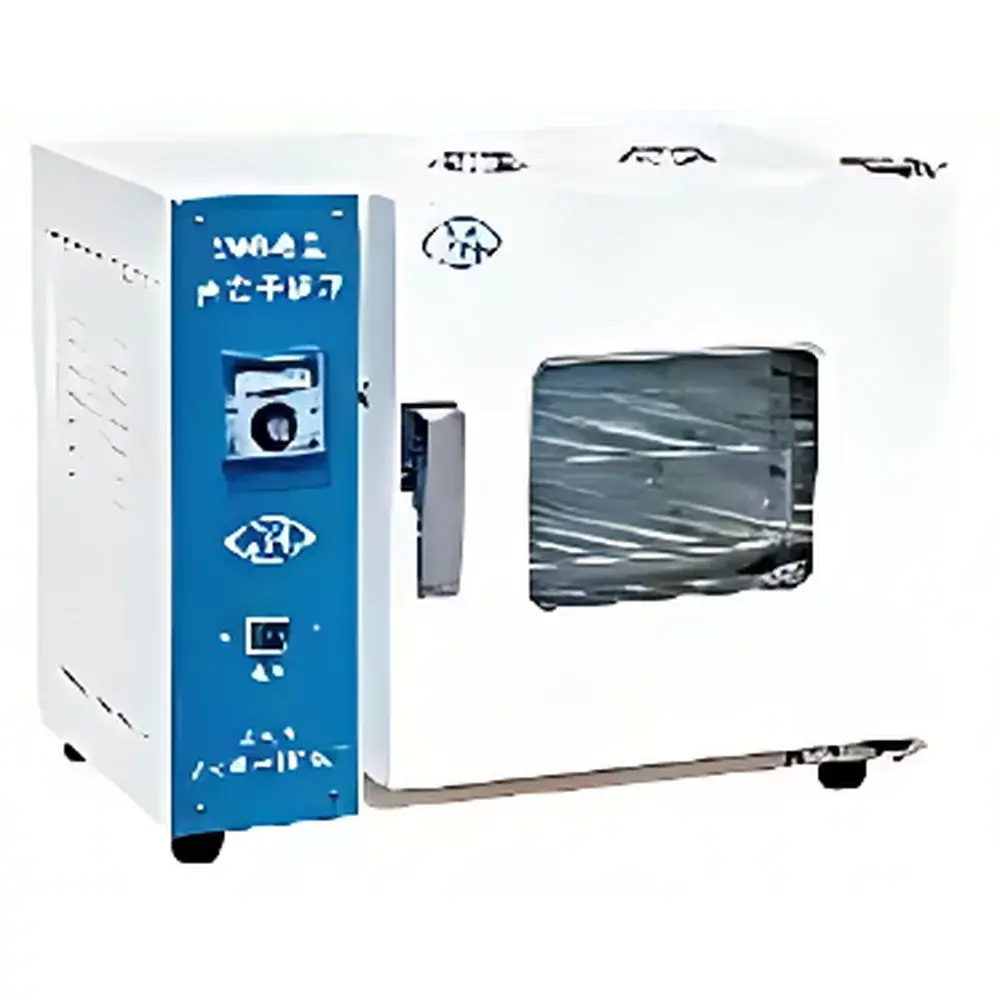
Lab Companion 202-1EBS Stainless Steel Interior Electric Hot Air Oven
| Origin | Shanghai, China |
|---|---|
| Manufacturer Type | Authorized Distributor |
| Country of Origin | China |
| Model | 202-1EBS |
| Power Supply | 220 V AC, 1800 W |
| Internal Chamber Dimensions | 350 × 450 × 450 mm (W × D × H) |
| External Dimensions | 515 × 740 × 655 mm (W × D × H) |
| Price | USD 410 (FOB Shanghai) |
Overview
The Lab Companion 202-1EBS Stainless Steel Interior Electric Hot Air Oven is a precision-engineered convection drying and thermal processing instrument designed for routine laboratory and industrial quality control environments. It operates on forced-air convection heating principles—using an internal axial fan to ensure uniform airflow distribution across the stainless steel chamber—enabling consistent temperature homogeneity and minimal spatial gradient (< ±1.5 °C at 100 °C, per ASTM E2207). This architecture supports critical non-destructive thermal treatments including moisture removal, sample conditioning, polymer curing, wax melting, and low-temperature sterilization of heat-stable labware. Its design adheres to fundamental thermal safety and operational reliability standards expected in ISO/IEC 17025-accredited laboratories and GMP-compliant manufacturing support labs.
Key Features
- Corrosion-resistant 304 stainless steel interior chamber—resistant to oxidation, acidic vapors, and repeated cleaning cycles; eliminates rust-induced particulate contamination in sensitive applications.
- Electrostatically coated mild steel exterior with high-adhesion polyester powder finish—provides mechanical durability, scratch resistance, and long-term aesthetic integrity under routine lab handling.
- Double-glazed tempered glass observation window integrated into the front door—permits real-time visual monitoring without compromising thermal stability or operator safety.
- Modular temperature control system compatible with analog dial thermometers, digital PID controllers, or optional programmable microprocessor-based units—supporting setpoint accuracy of ±0.5 °C and long-term thermal drift < 0.2 °C/h (at steady-state 105 °C).
- Over-temperature protection circuit with independent mechanical cut-off switch—meets IEC 61000-4-2 immunity requirements and provides fail-safe shutdown if primary controller malfunctions.
- Front-accessible heating elements and fan assembly—enabling rapid maintenance, calibration verification, and reduced downtime during preventive servicing.
Sample Compatibility & Compliance
The 202-1EBS accommodates standard laboratory glassware (e.g., Petri dishes, weighing boats, crucibles), metal trays, ceramic substrates, and polymer molds within its 71.4 L working volume. Its chamber geometry and airflow path are optimized for batch processing of solid particulates, granular powders, and thin-film specimens without significant convective disturbance. The unit complies with GB/T 5170.2–2017 (Chinese national standard for temperature uniformity testing of dry heat ovens) and aligns with functional equivalency to ASTM D1711 (Standard Terminology Relating to Electrical Insulation) for thermal aging protocols. While not certified for Class II biological safety or explosion-proof operation, it is routinely deployed in QC/QA workflows supporting USP , ISO 9001:2015 clause 7.1.5, and GLP Annex 11-aligned environmental validation studies when operated within its specified temperature range (ambient +10 °C to 250 °C).
Software & Data Management
The base configuration includes analog or digital manual control with local display only. Optional upgrades include RS-485 Modbus RTU interface and PC-compatible data logging software (sold separately), enabling time-stamped temperature recording, alarm event logging, and export to CSV or PDF formats. When equipped with compliant firmware, the system supports audit trail functionality—including user login tracking, parameter change history, and electronic signature capability—meeting foundational requirements of FDA 21 CFR Part 11 for regulated environments where electronic records serve as primary documentation. All firmware revisions undergo version-controlled release testing per IEC 62304 Annex C.
Applications
- Moisture content determination per AOAC 950.46 and ISO 5517 for food, feed, and pharmaceutical raw materials.
- Thermal conditioning of filter membranes and chromatography media prior to gravimetric analysis.
- Curing of epoxy-coated test coupons in corrosion resistance qualification per ASTM D1654.
- Drying of soil and sediment samples in environmental testing labs following EPA Method 9095B.
- Pre-heating of glass vials and syringes in sterile packaging validation protocols.
- Accelerated aging of polymeric medical device components per ISO 11607-1 Annex B.
FAQ
What is the maximum operating temperature of the 202-1EBS model?
The unit is rated for continuous operation up to 250 °C, with thermal cut-off activation at 270 °C. Extended use above 200 °C requires periodic verification of door gasket integrity and chamber insulation performance.
Is the stainless steel interior electropolished or passivated?
The interior uses standard mill-finish 304 stainless steel (ASTM A240); electropolishing is available as a custom option (lead time +3 weeks) for enhanced cleanability in semiconductor or biotech applications.
Can this oven be validated for IQ/OQ/PQ protocols?
Yes—the unit’s mechanical design, heater layout, and airflow symmetry support standardized qualification procedures. Documentation templates for installation, operational, and performance qualification are provided upon request for qualified purchasers.
Does it meet CE marking requirements?
The base model meets EMC Directive 2014/30/EU and Low Voltage Directive 2014/35/EU when supplied with EU-compliant power cord and labeling. CE Declaration of Conformity is issued upon order confirmation for export destinations requiring regulatory documentation.



