
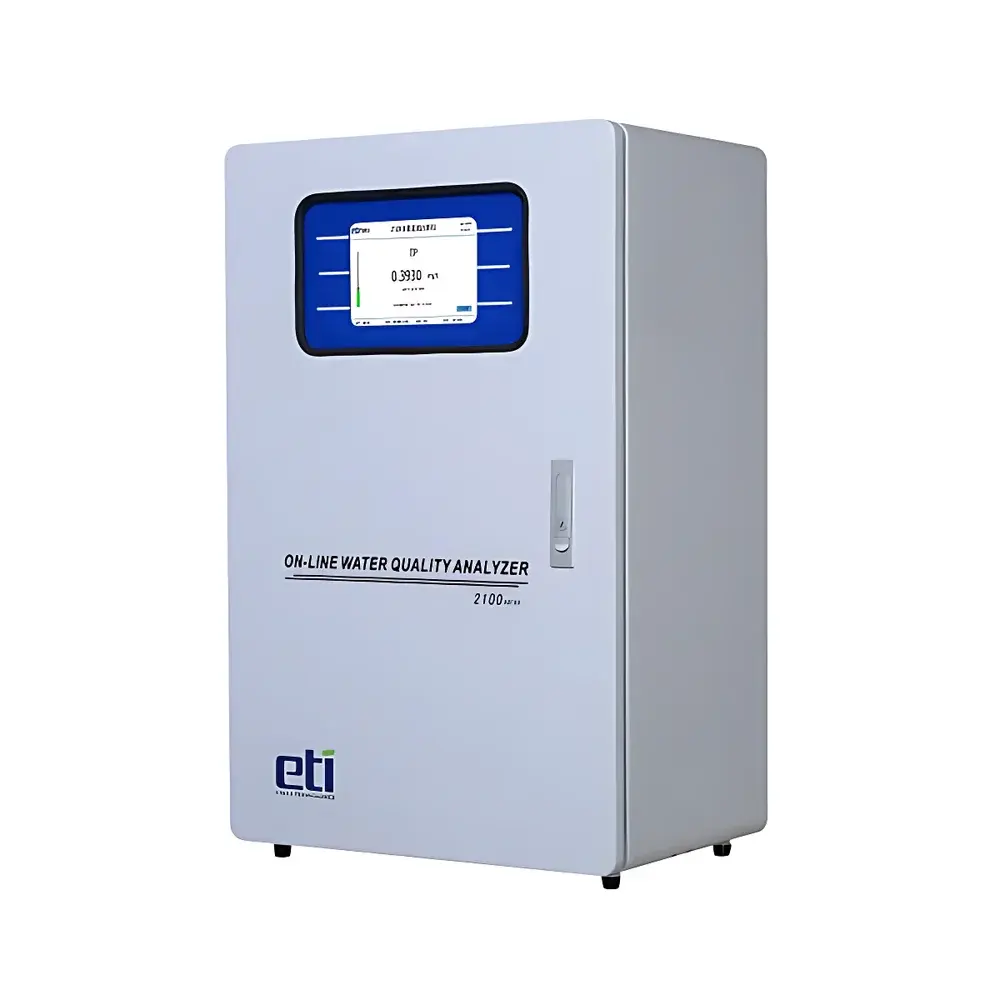
ETI 2100Plus CODCr Online Chemical Oxygen Demand Analyzer
| Brand | ETI |
|---|---|
| Origin | Guangdong, China |
| Manufacturer Type | Authorized Distributor |
| Country of Origin | China |
| Model | 2100Plus CODCr |
| Instrument Type | Online Analyzer |
| Measurement Principle | Rapid Digestion Spectrophotometry (Dichromate Oxidation) |
| Measurement Range | 0–1000 mg/L (standard), optional extended ranges up to 2000 mg/L |
| Accuracy | ±3% of reading or ±0.05 mg/L (whichever is greater) |
| Detection Limit | 0.001 mg/L |
| Analysis Time | 10–15 minutes per cycle |
| Batch Processing Capacity | Continuous unattended operation |
| Power Supply | 220 ± 22 VAC, 50 ± 0.5 Hz |
| Enclosure Dimensions | 520 mm (W) × 380 mm (D) × 800 mm (H) |
| Net Weight | ~45 kg (excluding reagents) |
| Output Signals | 4–20 mA analog output |
| Operating Modes | Cyclic, Triggered, Point-measurement, Continuous, Manual |
| QC Modes | Remote verification, manual verification, automated verification (time-based or threshold-triggered) |
Overview
The ETI 2100Plus CODCr Online Chemical Oxygen Demand Analyzer is a fully automated, laboratory-grade instrument engineered for continuous, real-time monitoring of chemical oxygen demand (COD) in aqueous matrices using the standardized dichromate oxidation method under acidic, high-temperature conditions. It implements rapid digestion spectrophotometry—compliant with ISO 6060 and APHA Standard Methods 5220 D—where Cr(VI) is reduced to Cr(III) proportional to the oxidizable organic load. The resulting Cr(III) concentration is quantified via absorbance measurement at 600 nm, enabling trace-level detection down to 0.001 mg/L COD. Designed for deployment in municipal wastewater treatment plants, industrial effluent discharge points, and surface water quality surveillance networks, the 2100Plus delivers stable, reproducible data under variable hydraulic and matrix conditions without operator intervention.
Key Features
- Patented intelligent dilution system with automatic range switching—enables seamless transition between low- and high-concentration measurement modes (e.g., 0–200 mg/L and 0–2000 mg/L) without manual recalibration.
- High-precision syringe pump architecture ensuring sub-microliter volumetric accuracy for both sample aspiration and reagent dosing—critical for maintaining stoichiometric consistency in dichromate-based oxidation.
- Integrated power-fail recovery protocol: retains configuration, calibration history, and pending analysis queue during unexpected outages; resumes operation automatically upon power restoration.
- Modular hardware layout with tool-free access to digestion chamber, optical path, and fluidic manifolds—reducing mean time to repair (MTTR) and simplifying routine maintenance by field technicians.
- Flexible operational logic engine supporting five distinct measurement paradigms: cyclic (fixed-interval), triggered (external signal input), point-sampling, continuous flow-through, and manual initiation—adaptable to regulatory reporting schedules or process control requirements.
- Dual-layer quality assurance: on-board standard solution verification (span check), spike recovery testing, and drift monitoring—all configurable via embedded scheduler and executable remotely via Modbus TCP or ASCII serial commands.
Sample Compatibility & Compliance
The 2100Plus accepts raw, filtered, or clarified liquid samples within pH 2–12 and suspended solids content ≤ 100 mg/L (pre-filtration recommended above this threshold). It is validated for use with municipal sewage, pulp-and-paper effluents, petrochemical discharges, and agricultural runoff. All analytical procedures adhere to the fundamental chemistry of ASTM D1252–06 (Method B) and ISO 6060:1989, with documented traceability to NIST-traceable potassium hydrogen phthalate (KHP) standards. Data integrity meets GLP/GMP-aligned audit trail requirements—including user action logging, parameter change timestamps, and electronic signature support for critical operations—facilitating compliance with EPA NPDES permit monitoring and EU WFD reporting obligations.
Software & Data Management
Embedded firmware (v3.2+) provides local HMI navigation via 7-inch capacitive touchscreen and supports remote configuration through secure HTTPS web interface or native ETI Link™ desktop application. All measurements are timestamped with UTC synchronization (NTP-capable), stored in non-volatile memory (≥12 months at 15-min intervals), and exportable as CSV or XML. Analog 4–20 mA outputs are linearly scaled to full-range COD values with configurable zero/span offsets. Digital communication supports Modbus RTU/ASCII over RS485 (up to 32 units on single bus) and optional Ethernet/IP integration. Audit logs record calibration events, QC failures, maintenance alerts, and firmware updates—retained for ≥18 months and exportable for regulatory review.
Applications
- Real-time compliance monitoring at wastewater treatment plant influent, effluent, and tertiary discharge points per national discharge permits (e.g., China’s GB 8978–1996, US EPA 40 CFR Part 136).
- Process optimization in industrial pretreatment systems—tracking COD load fluctuations to adjust aeration rates, chemical dosing, or sludge retention time.
- Early-warning detection of accidental spills or upstream contamination events in river basin monitoring networks.
- Long-term trend analysis for environmental impact assessments (EIAs) and sustainability reporting (GRI 306, CDP Water Security).
- Supporting ISO 14001-certified EMS frameworks through automated, auditable environmental performance metrics.
FAQ
What digestion temperature and duration does the 2100Plus employ?
The system performs closed-vessel digestion at 165 °C for 15 minutes—optimized to achieve >95% oxidation efficiency for refractory organics while minimizing chloride interference via Ag₂SO₄ catalysis.
Is the analyzer compatible with existing SCADA or DCS platforms?
Yes—via Modbus RTU/ASCII over RS485 or optional Modbus TCP/Ethernet modules; all register maps and scaling conventions are provided in the Integration Guide v2.1.
How often is calibration verification required under routine operation?
Automated span checks are scheduled daily by default; however, frequency may be adjusted per site-specific QA/QC plans—minimum recommendation is every 24 hours for Class I monitoring per ISO/IEC 17025:2017 Annex A.3.
Can the instrument handle high-chloride wastewater samples?
Chloride tolerance is up to 2000 mg/L when using the integrated mercury sulfate masking protocol; samples exceeding this require pre-dilution or alternative chloride removal—detailed in Application Note AN-COD-07.
Does the system meet cybersecurity requirements for industrial IoT deployment?
Firmware includes TLS 1.2 encryption for web interface, role-based access control (RBAC), disabled default credentials, and periodic security patching aligned with IEC 62443-3-3 SL2 recommendations.
Related Products







