
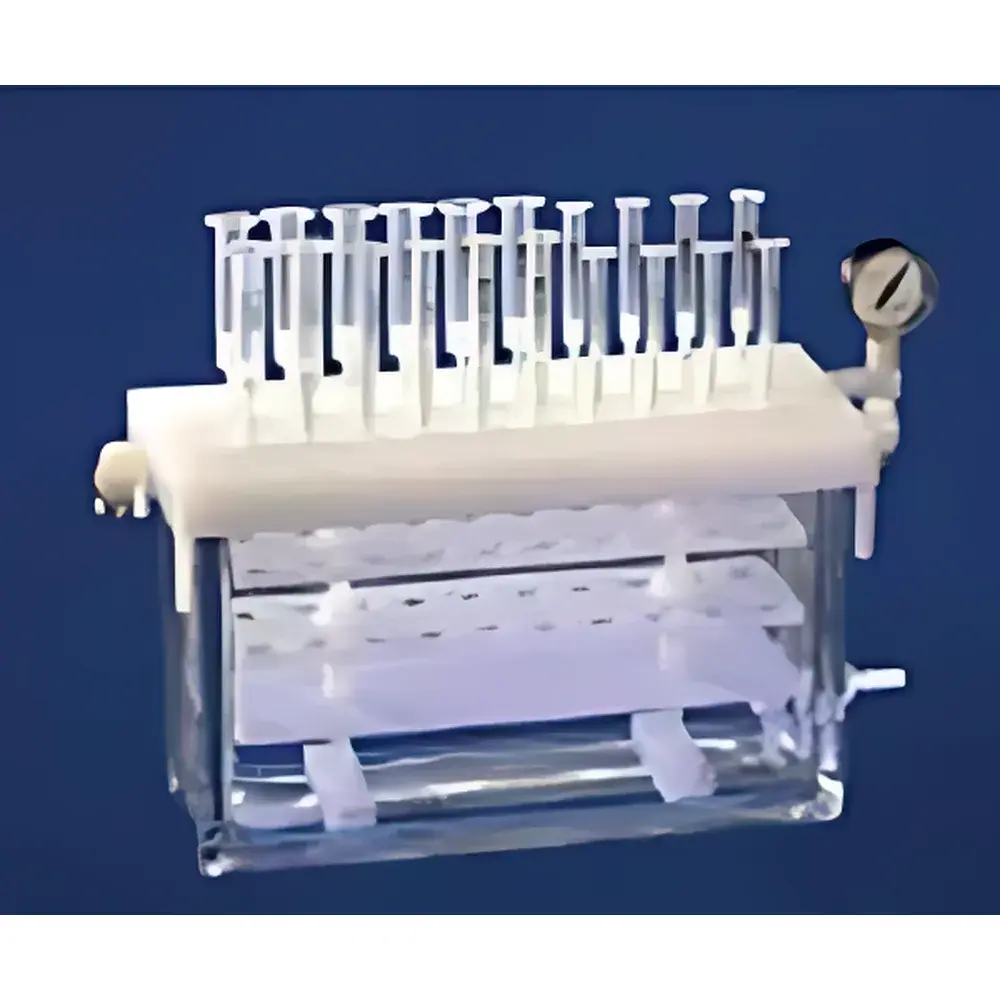
Agilent 5982-9110 Manual 12-Position Vacuum Manifold for Solid Phase Extraction
| Brand | Agilent Technologies |
|---|---|
| Origin | USA |
| Model | 5982-9110 |
| Automation Level | Manual |
| Channel Count | 12-channel |
| Extraction Type | Column-based SPE |
| Flow Rate Control Range | 0.1–30 mL/min |
| Solvent Compatibility | Up to 5 different elution solvents |
| Sample Capacity | 24 samples per run (with optional rack configuration) |
| Sample Loading Volume | 1–30 mL |
| Wetted Materials | Borosilicate glass, PTFE, UHMW polyethylene |
Overview
The Agilent 5982-9110 is a manually operated, 12-position vacuum manifold engineered for reproducible and scalable solid-phase extraction (SPE) in regulated and research laboratory environments. It operates on the principle of vacuum-assisted gravity flow through bonded-silica or polymer-based SPE cartridges, enabling selective analyte retention, matrix removal, and concentration prior to downstream analysis (e.g., GC, HPLC, LC-MS). Designed as a core component of Agilent’s SampliQ SPE workflow, the manifold provides precise control over elution dynamics without motorized automation—making it ideal for method development, validation studies, and laboratories requiring full operator intervention at each step. Its modular architecture supports seamless integration with Agilent-certified SPE cartridges (e.g., C18, SCX, SAX, Florisil), ensuring consistent bed integrity and minimal channel-to-channel variability.
Key Features
- Borosilicate glass collection chamber rated for vacuum operation up to –760 mmHg, offering chemical resistance to chlorinated, polar, and protic solvents including DCM, methanol, acetonitrile, and 0.1 M HCl.
- UHMW polyethylene (ultra-high-molecular-weight) base and sealing components provide long-term mechanical stability and solvent compatibility across acidic, basic, and organic media.
- Dual-scale vacuum gauge with coarse and fine adjustment knobs enables real-time monitoring and stepwise optimization of vacuum pressure—critical for maintaining laminar flow and avoiding cartridge channeling or dry-bed formation.
- PTFE-coated stainless steel piston valves allow independent flow regulation for each of the 12 ports, eliminating cross-contamination and supporting parallel processing of heterogeneous sample matrices.
- Height-adjustable support frame accommodates standard 13 × 75 mm, 13 × 100 mm, 16 × 75 mm, and 16 × 100 mm collection tubes—including conical-bottom vials and autosampler-ready formats.
- Luer-Lock compatible inlet ports ensure secure, leak-free connection to SPE cartridges with standardized 1/4″–28 threaded fittings or push-fit adapters.
- Integrated quick-release vacuum relief valve prevents accidental over-pressurization during system shutdown or solvent switching—enhancing operator safety and column lifetime.
Sample Compatibility & Compliance
The 5982-9110 manifold is validated for use with Agilent SampliQ SPE cartridges (1 mL, 3 mL, 6 mL formats) and third-party Luer-Lock–compatible columns meeting ASTM D5762 and ISO 13877 specifications for environmental hydrocarbon analysis. All wetted surfaces comply with USP Class VI biocompatibility requirements. When deployed within documented SOPs, the system supports GLP and GMP workflows—including audit trails when paired with Agilent OpenLab CDS or third-party LIMS platforms. Its manual operation inherently satisfies FDA 21 CFR Part 11 requirements for user-controlled parameter logging and electronic signature-capable reporting systems.
Software & Data Management
As a benchtop manual platform, the 5982-9110 does not include embedded firmware or onboard software. However, its operational parameters—including vacuum setpoints, loading volumes, elution sequence, and solvent selection—are fully traceable via Agilent’s OpenLab ECM (Electronic Lab Notebook) or configurable Excel-based tracking templates aligned with ISO/IEC 17025 documentation standards. Optional barcode-scannable rack labels (e.g., 5982-9116 16 × 100 mm tube rack) enable sample-level traceability during high-throughput runs. Full maintenance logs—including seal replacement (5982-9112), gauge calibration (5982-9108), and piston servicing—are supported by Agilent’s ServiceParts Portal.
Applications
- Environmental analysis: EPA Methods 508.1, 525.3, and 8270D for pesticide, PAH, and PCB extraction from water, soil, and sediment extracts.
- Pharmaceutical QC: Residual solvent cleanup and impurity isolation per ICH Q2(R2) guidelines prior to HPLC assay.
- Clinical toxicology: Isolation of amphetamines, opioids, and benzodiazepines from plasma and urine using mixed-mode cation-exchange SPE.
- Food safety: Multi-residue screening of mycotoxins (aflatoxin B1, ochratoxin A) in cereals and dairy matrices per AOAC 2005.02.
- Forensic chemistry: Cleanup of post-extraction samples prior to GC-MS confirmation in accordance with SWGTOX best practices.
FAQ
Is the 5982-9110 compatible with non-Agilent SPE cartridges?
Yes—provided they feature standard Luer-Lock or 1/4″–28 threaded interfaces and physically fit within the 12-port spacing. Performance validation is recommended for each cartridge type.
What vacuum source is required?
A diaphragm or oil-free vacuum pump capable of sustaining ≥700 mmHg negative pressure is recommended; Agilent offers the 5982-9200 vacuum pump kit as an optimized match.
Can the manifold be sterilized for microbiological applications?
The glass chamber and PTFE components are autoclavable at 121°C for 20 minutes; UHMW polyethylene parts must be cleaned with ethanol or isopropanol only.
How often should the sealing gasket (p/n 5982-9112) be replaced?
Under routine use with proper cleaning, the gasket maintains integrity for ≥500 vacuum cycles; visual inspection for compression set or cracking is advised before critical extractions.
Does Agilent provide method transfer documentation for this manifold?
Yes—Agilent Application Notes #5989-0349EN and #5991-4577EN detail validated SPE protocols for water, plasma, and food matrices, including flow rate optimization curves and recovery data across pH and solvent gradients.



