
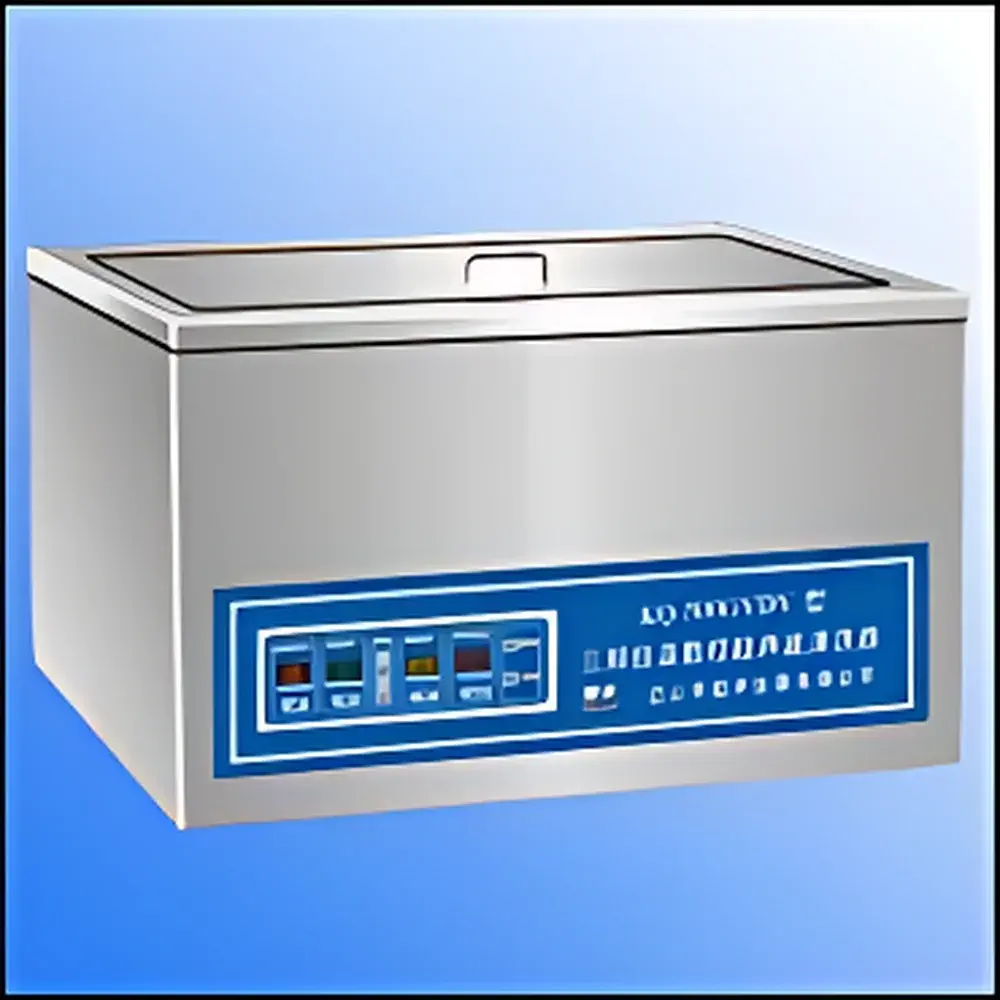
Chu Ding KQ-600DB / KQ-600DA / KQ-600DE / KQ-600DV Benchtop Digital Ultrasonic Cleaner
| Brand | Chu Ding |
|---|---|
| Origin | Shanghai, China |
| Model Series | KQ-600DB / KQ-600DA / KQ-600DE / KQ-600DV |
| Ultrasonic Frequency | 40 kHz |
| Ultrasonic Power Output | 600 W |
| Power Adjustment Range | 40–100% |
| Heating Power | 1000 W (DB/DE/DV models only) |
| Temperature Control Range | 20–80 °C |
| Timer Range | 1–480 min |
| Tank Capacity | 22.5 L (DA/DB/DE) or 27 L (DV) |
| Internal Tank Dimensions | 500 × 300 × 150 mm (DA/DB/DE) or 500 × 300 × 180 mm (DV) |
| External Dimensions | 530 × 320 × 360 mm (DA/DB/DE) or 610 × 410 × 380 mm (DV) |
| Stainless Steel Tank Material | SUS304 |
| Safety Features | Low-level liquid protection, over-temperature, over-voltage and over-current monitoring |
| Accessories | Adjustable mesh basket, acoustic lid (DE/DV), drain valve (DB/DE/DV), volatile solvent recovery system (DV model only) |
Overview
The Chu Ding KQ-600 series comprises a family of benchtop digital ultrasonic cleaners engineered for precision cleaning, degassing, dispersion, emulsification, and cell disruption in academic, industrial, and quality control laboratories. These units operate on the principle of piezoelectric ultrasonics: high-frequency (40 kHz) electrical energy is converted into mechanical vibrations via transducers bonded to the stainless steel tank base, generating controlled cavitation in the cleaning medium. This process produces transient microbubbles that collapse near surfaces, delivering localized energy sufficient to remove particulates, organic residues, and biofilms from delicate instruments, optical components, electronic assemblies, and biological samples—without mechanical abrasion or thermal degradation. The integrated digital control system ensures reproducible, protocol-driven operation across routine and regulated environments.
Key Features
- Digital microprocessor control with real-time display of elapsed time, set temperature, actual temperature, and ultrasonic power level
- Programmable timer (1–480 minutes) with automatic shutdown and memory retention for frequently used parameters
- Adjustable ultrasonic power output (40–100% of nominal 600 W) to optimize cleaning intensity for sensitive substrates
- Heating function (1000 W) with precise PID temperature regulation (20–80 °C) available on DB, DE, and DV variants
- SUS304 stainless steel tank (500 × 300 × 150 mm or 500 × 300 × 180 mm) formed by deep-drawing for structural integrity and corrosion resistance
- Integrated safety protections: low-fluid level detection, over-temperature cutoff, over-voltage monitoring, and over-current limiting
- Acoustic lid (standard on DE/DV models) reduces airborne noise and solvent evaporation during operation
- Drain valve (DB/DE/DV) enables safe, tool-free emptying of spent solutions; DV model includes optional volatile solvent recovery assembly compliant with OSHA and local VOC handling guidelines
Sample Compatibility & Compliance
The KQ-600 series accommodates a broad range of sample types—including glassware, metal parts, semiconductor wafers, surgical tools, filtration membranes, and tissue culture plates—provided they are compatible with aqueous or mild solvent-based cleaning media. All models meet CE electromagnetic compatibility (EMC) requirements and conform to IEC 61000-6-3 for industrial emission limits. While not certified for ISO 13485 or FDA 21 CFR Part 11 out-of-the-box, the devices support GLP/GMP-aligned workflows through parameter logging (via external data capture), operator-defined protocols, and audit-ready operational consistency. The stainless steel construction complies with ASTM A240 for corrosion-resistant alloys used in laboratory equipment.
Software & Data Management
These units operate as standalone hardware with no embedded software stack or network interface. Parameter settings—including time, temperature, and power—are stored in non-volatile memory and recalled at power-on. For traceability in regulated labs, users may integrate external USB data loggers or serial-to-USB adapters (RS-232 optional on select configurations) to record timestamps, setpoints, and status flags. No proprietary drivers or cloud services are required. The absence of firmware updates or remote connectivity aligns with IT security policies common in pharmaceutical QC and government research facilities where air-gapped instrumentation is mandated.
Applications
- Routine cleaning of HPLC vials, pipette tips, and chromatography columns prior to analysis
- Removal of flux residues and solder paste from PCB assemblies in electronics manufacturing QA
- Preparation of TEM/SEM specimens by particle dispersion and surface decontamination
- Cell lysis and DNA/RNA extraction in molecular biology workflows using controlled cavitation
- Degassing of solvents and resins prior to casting or coating applications
- Restoration of optical lenses and precision metrology fixtures without surface scratching
- Validation of cleaning efficacy per ASTM F312-22 (Standard Test Methods for Cleaning of Medical Devices)
FAQ
What is the difference between the KQ-600DA, DB, DE, and DV models?
The DA variant lacks heating and drainage; DB adds heating and drainage; DE adds an acoustic lid to DB; DV includes all DB/DE features plus a volatile solvent recovery system and larger tank volume (27 L).
Can these units be used with flammable solvents?
Only the DV model—with its integrated condenser and sealed recovery path—is designed for intermittent use with low-flashpoint solvents such as acetone or isopropanol. All other models are intended for aqueous or non-flammable cleaning solutions only.
Is calibration or certification provided with shipment?
No factory calibration certificate is included. Users should perform periodic verification of temperature accuracy using NIST-traceable thermometers and timer accuracy with stopwatch validation per internal SOPs.
What maintenance is required for long-term reliability?
Routine cleaning of the tank interior and transducer surfaces with isopropyl alcohol; inspection of the drain valve seal every 6 months; replacement of the acoustic lid gasket if compression set exceeds 20% per ASTM D395.
Related Products



